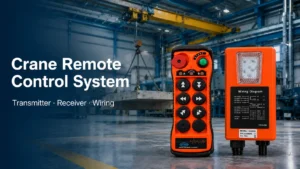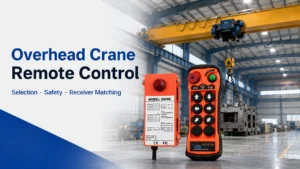
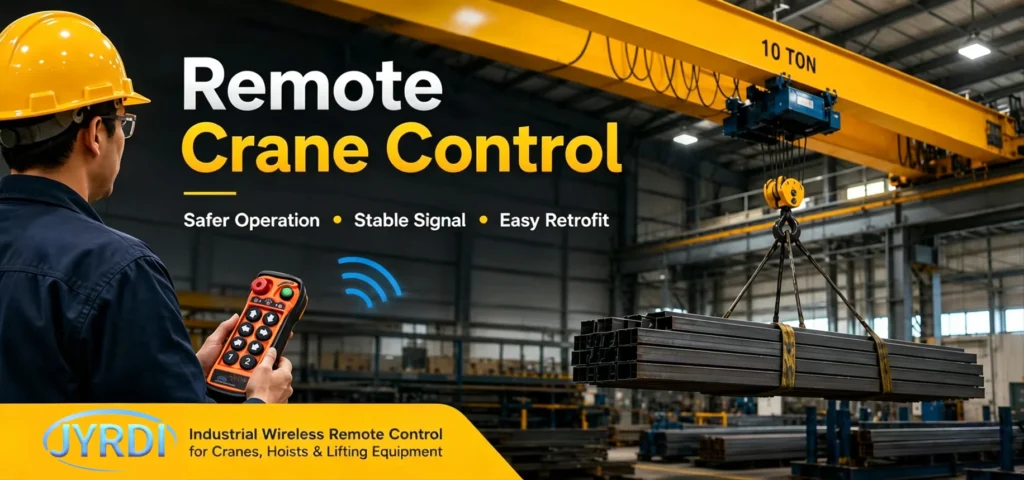
Cranes can be controlled remotely, and wireless crane remote control systems are now widely used in factories, workshops, warehouses, steel plants, logistics centers, and many other industrial lifting applications.
For most industrial cranes, remote control does not mean fully unmanned operation. It usually means using a handheld wireless transmitter and a receiver installed on the crane control cabinet. The operator can control lifting, lowering, trolley travel, bridge travel, and other crane movements from a safer and more flexible position.
Remote crane control is especially common for overhead cranes, bridge cranes, gantry cranes, jib cranes, electric hoists, winches, and customized lifting equipment. Compared with traditional pendant control, wireless remote control can improve operator mobility, reduce pendant cable problems, and make crane operation more efficient.
What Does Remote Crane Control Mean?
Remote crane control can mean different things depending on the application.
In large port terminals, remote crane operation may involve control rooms, camera systems, automation software, and remote operator stations. This type of solution is commonly used for ship-to-shore cranes, stacking cranes, and container handling equipment.
In normal industrial applications, remote crane control usually refers to a wireless handheld crane remote control system. This system includes:
- A handheld transmitter operated by the crane operator
- A receiver installed inside or near the crane control cabinet
- Output relays or control signals connected to the crane electrical system
- An emergency stop function for safe operation
- A matched communication system between the transmitter and receiver
For most factories and equipment users, a wireless crane remote control is the most practical and cost-effective way to add remote control to an existing crane.
How Does a Wireless Crane Remote Control Work?
A wireless crane remote control system works by sending control commands from the transmitter to the receiver.
When the operator presses a button on the transmitter, the transmitter sends a wireless signal to the receiver. The receiver identifies the signal, processes the command, and outputs the corresponding control signal to the crane control cabinet.
For example:
- Pressing “UP” controls the hoist lifting function.
- Pressing “DOWN” controls the hoist lowering function.
- Pressing “EAST” or “WEST” controls trolley movement.
- Pressing “NORTH” or “SOUTH” controls bridge movement.
- Pressing the emergency stop button stops the control output.
The basic control process is:
Operator → Wireless Transmitter → Receiver → Crane Control Cabinet → Crane Movement
This makes the crane easier to operate because the operator is no longer limited by a hanging pendant cable.
What Types of Cranes Can Be Controlled Remotely?
Many types of cranes and lifting equipment can use wireless remote control systems.
Overhead Cranes
Overhead cranes are one of the most common applications for wireless crane remote controls. In factories and warehouses, operators often need to move around the working area to observe the load, avoid obstacles, and communicate with other workers.
A wireless remote control allows the operator to choose a better position during lifting and positioning.
Bridge Cranes
Bridge cranes usually require multiple movement directions, such as hoist up/down, trolley left/right, and bridge forward/backward. Depending on the crane configuration, they may require 6-button, 8-button, 10-button, or 12-button remote control systems.
For double-speed bridge cranes, the remote control must also match the crane’s speed control logic.
Gantry Cranes
Gantry cranes are often used in outdoor yards, precast plants, steel handling areas, warehouses, and logistics sites. Because the operating area may be larger, stable signal transmission and anti-interference performance are important.
Jib Cranes
Jib cranes are commonly used at workstations, assembly lines, and material handling points. Remote control allows the operator to stand close enough to observe the load while keeping better movement flexibility.
Electric Hoists
Electric chain hoists and wire rope hoists can often be upgraded from pendant control to wireless remote control. This can reduce cable wear, improve operator convenience, and make lifting work easier.
Winches and Industrial Machinery
Wireless remote control systems can also be used for winches, lifting platforms, tail lifts, electric doors, and other industrial equipment that requires safe distance control.
Why Are Cranes Controlled Remotely?
Remote control is used because it solves real problems in daily crane operation.
1. Better Operator Position
With a wired pendant, the operator is limited by the pendant cable length and position. In some cases, the operator may have to walk close to the load or crane path.
With a wireless crane remote control, the operator can move to a better position to observe the crane, the load, and the surrounding area.
2. Improved Safety Distance
Remote control helps the operator stay away from unnecessary risk zones. The operator should never stand under the load, but wireless control makes it easier to choose a safer operating position.
This is especially useful when lifting large, heavy, or irregular materials.
3. No Pendant Cable Problems
Pendant cables can become worn, damaged, pulled, twisted, or tangled. In busy factories, pendant cables may also interfere with equipment, workers, or materials.
Wireless remote control reduces these cable-related problems and keeps the control system cleaner and more flexible.
4. Easier Load Positioning
When the operator can move freely, it is easier to observe the load from different angles. This helps improve positioning accuracy during lifting, lowering, and moving.
For bridge cranes and overhead cranes, better visibility can make operation smoother and more efficient.
5. Higher Working Efficiency
In many workshops, wireless control allows one operator to control the crane and guide the load more easily. This can reduce communication delays and improve workflow.
6. Easy Retrofit for Existing Cranes
Many existing cranes can be upgraded with wireless remote control without replacing the entire crane. For maintenance companies, crane service teams, and factory users, this makes wireless remote control a practical modernization option.
Remote Crane Operation vs Wireless Crane Remote Control
Remote crane operation and wireless crane remote control are related, but they are not exactly the same.
| Type | Common Application | Typical Equipment | Best For |
|---|---|---|---|
| Wireless crane remote control | Factories, workshops, warehouses | Handheld transmitter + receiver | Overhead cranes, bridge cranes, gantry cranes, hoists |
| Control room remote crane operation | Ports and automated terminals | Control station, cameras, automation system | Container cranes, stacking cranes, large terminal systems |
For most industrial users, wireless crane remote control is the more practical choice. It is easier to install, easier to operate, and more suitable for crane retrofit, replacement, and daily maintenance.
Is Remote Crane Control Safe?
Remote crane control can be safe when the system is correctly selected, installed, tested, and operated by trained personnel.
A reliable crane remote control system should include important safety and stability features, such as:
- Emergency stop function
- Clear button layout
- Stable signal transmission
- Anti-interference communication
- Unique transmitter and receiver pairing
- Signal loss protection
- Industrial-grade buttons
- Stable receiver output
- Correct wiring and installation
- Full testing before operation
The operator must still follow safe lifting procedures. Wireless control does not replace crane safety rules. The operator should keep clear visibility of the crane, the hook, the load, and the working area.
Can an Existing Crane Be Upgraded to Remote Control?
In many cases, yes. Existing overhead cranes, bridge cranes, gantry cranes, jib cranes, and electric hoists can often be upgraded with a wireless crane remote control system.
Before upgrading, you should confirm several key details:
- Crane type
- Control voltage
- Number of crane movements
- Single-speed or double-speed control
- Pendant wiring diagram
- Receiver output requirement
- Working distance
- Operating environment
- Safety requirements
- Required button layout
- Need for spare transmitters
- OEM or private label requirements
The installation should be handled by a qualified electrician, crane technician, or experienced control system installer. After installation, every movement direction, emergency stop function, limit switch, and safety function should be tested carefully.
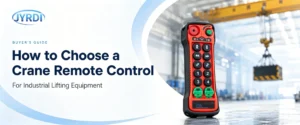
What Should You Check Before Choosing a Crane Remote Control?
Choosing the right crane remote control is not only about the number of buttons. The system must match the crane’s control logic and working environment.
Crane Type
Different cranes need different control layouts. A simple electric hoist may only need up/down control, while a bridge crane may need hoist, trolley, and bridge movement.
Number of Buttons
Common crane remote control options include 4-button, 6-button, 8-button, 10-button, and 12-button models. The correct option depends on how many functions the crane needs.
Single-Speed or Double-Speed Control
Some cranes use single-speed control. Others require double-speed control for more accurate lifting and positioning. The remote control must match the crane’s speed control system.
Control Voltage
The receiver must be compatible with the crane control circuit voltage. Common industrial control voltages vary by country, equipment type, and control cabinet design.
Working Distance
The required control distance depends on the crane span, workshop size, outdoor or indoor use, and operator position. For large areas, stable signal performance is very important.
Signal Stability
Industrial environments may include motors, metal structures, electrical cabinets, other wireless devices, and high-power equipment. A good crane remote control should have strong anti-interference ability.
Pairing Method
Easy pairing is important for maintenance, replacement, and distributor supply. A flexible pairing method can reduce downtime when replacing transmitters or receivers.
Durability
Buttons, housing, circuit boards, power modules, and internal components all affect product life. Industrial crane remote controls should be built for frequent use and harsh working conditions.
JIAYI Wireless Crane Remote Control Solution
JIAYI provides industrial wireless remote control systems for cranes, hoists, winches, tail lifts, electric doors, and other industrial equipment.
For crane applications, JIAYI focuses on stable signal, easy matching, safe operation, and practical customization. Our crane remote controls are suitable for overhead cranes, bridge cranes, gantry cranes, jib cranes, electric hoists, and customized industrial lifting systems.
JIAYI Q Series crane remote control is designed for demanding industrial use. It can help users replace pendant control, upgrade existing cranes, and improve daily operation efficiency.
Key Advantages of JIAYI Q Series
LLCC68 Control Chip
The upgraded Q Series uses an LLCC68 control chip with improved processing capability. It supports frequency modulation, spread spectrum, and automatic frequency selection technology.
When multiple remote controls are used in the same working area, automatic frequency selection helps avoid occupied frequencies and improve signal stability.
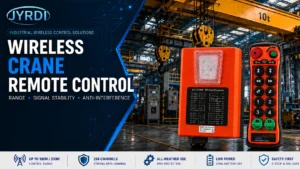
Up to 250m Control Distance
The upgraded signal mode supports a control distance of up to 250 meters, making it suitable for most factory, workshop, and warehouse crane applications.
Japan KDS Crystal
The Q Series uses Japan KDS crystal components to improve frequency stability and support reliable communication.
Upgraded Power Module
The receiver power module is designed to better filter electrical noise and reduce the impact of voltage fluctuation on the remote control system.
Multiple Pairing Methods
The upgraded Q Series supports multiple pairing methods, including card insertion pairing, button pairing, and SN number pairing. This makes replacement and maintenance easier.
256 Channel Options
The system supports 256 channel options, giving users more flexibility when multiple remote controls are used in the same site.
Lower Transmitter Power Consumption
The transmitter includes a power management chip. Signal strength can be adjusted according to different working scenarios, helping reduce unnecessary power consumption.
German Imported Buttons
JIAYI Q Series uses imported German buttons for better operation feel and longer service life.
Bidirectional Communication
The transmitter and receiver adopt bidirectional communication. The transmitter is equipped with signal strength indicator lights and status indicators, allowing users to see the signal and connection status more clearly.
Common Applications of JIAYI Crane Remote Controls
JIAYI wireless crane remote controls can be used in many industrial applications, including:
- Overhead crane control
- Bridge crane control
- Gantry crane control
- Jib crane control
- Electric hoist control
- Wire rope hoist control
- Chain hoist control
- Winch control
- Lifting platform control
- Industrial machinery control
- Crane retrofit projects
- OEM equipment control
- Distributor replacement projects
When Should You Replace a Pendant Control with Wireless Remote Control?
You may consider upgrading to wireless remote control if you have any of the following problems:
- The pendant cable is often damaged.
- The operator cannot find a good viewing position.
- The crane is used in a large working area.
- The load is difficult to observe from one fixed position.
- The working environment has many obstacles.
- The pendant cable affects operation efficiency.
- You need easier crane maintenance or replacement.
- You want to modernize an old crane.
- You need OEM or customized remote control solutions.
Remote Control Does Not Replace Safe Crane Operation
Wireless remote control can improve convenience and help operators work from a better position, but it does not remove the need for safe operation.
Before using a crane remote control, users should make sure:
- The remote control is correctly wired.
- The transmitter and receiver are correctly paired.
- The emergency stop function works properly.
- Every movement direction is tested.
- The crane limit switches are working.
- Operators understand the button functions.
- Operators keep clear visibility of the load.
- The system is maintained regularly.
A crane remote control should always be treated as part of the overall crane safety system.
How to Choose the Right JIAYI Crane Remote Control
If you are not sure which model is suitable for your crane, you can send the following information to JIAYI:
- Crane type
- Number of buttons needed
- Control voltage
- Single-speed or double-speed control
- Working distance
- Photos of the crane and control cabinet
- Existing pendant wiring diagram
- Required quantity
- OEM logo or customization requirements
Based on this information, JIAYI can help recommend a suitable wireless crane remote control model.
Frequently Asked Questions
Can cranes be controlled wirelessly?
Yes. Many industrial cranes can be controlled wirelessly by using a handheld transmitter and a receiver connected to the crane control cabinet.
Can an overhead crane use remote control?
Yes. Overhead cranes are one of the most common applications for wireless crane remote controls. Remote control allows the operator to move to a better position while controlling the crane.
Can a bridge crane be converted to remote control?
In many cases, yes. A bridge crane can often be upgraded with a wireless remote control system if the control cabinet supports the required wiring and output logic.
Is wireless crane control better than pendant control?
Wireless crane control offers better operator mobility, fewer cable problems, and easier load observation. Pendant control is simple and familiar, but it limits operator movement.
What is needed to install a crane remote control?
You usually need a transmitter, receiver, wiring connection to the crane control cabinet, correct voltage matching, function testing, and emergency stop verification.
How far can a crane remote control work?
The working distance depends on the remote control model, environment, signal design, and interference conditions. JIAYI upgraded Q Series supports up to 250m control distance in suitable conditions.
Can one remote control operate multiple cranes?
This depends on the control system design and safety requirements. Some systems can be customized for special applications, but the operation logic must be carefully designed and tested.
Is OEM customization available?
Yes. JIAYI supports OEM and ODM customization for distributors, equipment manufacturers, and industrial control solution providers.
Conclusion
Cranes can be controlled remotely, and wireless crane remote control is one of the most practical solutions for industrial lifting equipment.
For most factories, workshops, warehouses, and crane service companies, a wireless crane remote control system can improve operator flexibility, reduce pendant cable problems, and make crane operation more convenient.
The key is choosing the right system for your crane type, control voltage, button functions, working distance, and safety requirements.
JIAYI provides wireless crane remote control solutions for overhead cranes, bridge cranes, gantry cranes, hoists, winches, and customized industrial equipment. Whether you need crane retrofit, replacement remote controls, OEM supply, or technical support, JIAYI can help you choose a suitable solution.
Contact JIAYI for crane remote control selection and customization.
Website: www.jiayiremotecontrol.com
Email: sales@jiayiremotecontrol.com
WhatsApp: +86 15705596884