Short Answer
When selecting a wireless crane remote control, buyers should look beyond the advertised range and evaluate signal stability, anti-interference performance, receiver compatibility, safe signal loss behavior and long-term component reliability. For overhead cranes, hoists, gantry cranes and general industrial lifting equipment, a suitable radio remote system should maintain stable communication around steel structures, motors, inverters, power cables and multiple remote-control systems. It should also match the crane control cabinet, including receiver voltage, relay outputs, common wire design, momentary or maintained output logic and emergency stop wiring. In real industrial sites, a stable and correctly matched control system is usually more important than choosing the longest range or the lowest price.
What Is a Wireless Crane Remote Control?
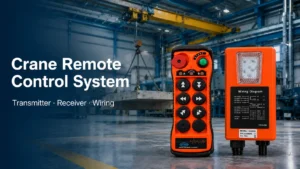
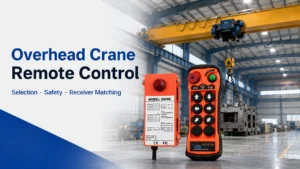
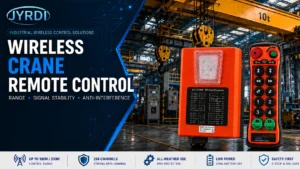
A wireless crane remote control is a radio control system used to operate industrial lifting equipment without a wired pendant cable. It normally includes two main parts:
- A handheld transmitter used by the operator
- A receiver installed in or near the crane electrical control cabinet
When the operator presses a button on the transmitter, the command is sent by radio signal to the receiver. The receiver then outputs electrical signals to the crane control circuit, contactors, PLC inputs or other machine control components.
Wireless crane remote controls are commonly used for:
- Overhead cranes
- Bridge cranes
- Electric hoists
- Gantry cranes
- Jib cranes
- Winches
- Truck cranes
- Hydraulic lifting equipment
- Industrial lifting machinery
- Customized industrial equipment
Compared with a wired pendant control, a wireless crane remote control gives the operator more freedom of movement. The operator can stand in a safer position, keep a better view of the load and avoid dragging a pendant cable around the working area.
However, a crane remote control is not just a handheld device. It is a complete control system. The transmitter, receiver, relay outputs, wiring logic, emergency stop circuit and signal behavior must match the lifting equipment.
That is why buyers should not select a crane wireless remote control only by appearance or price. The correct selection should start from the actual equipment and working site.
Why Signal Stability Matters in Crane Operation
In crane operation, unstable signal does not only reduce convenience. It can cause delayed response, shorter working distance, troubleshooting difficulty and unnecessary downtime.
A crane remote control is often used in a complex industrial environment, not in an open test field. The site may include:
- Steel structures
- Overhead crane beams
- Electric motors
- Frequency inverters
- Welding equipment
- Power cables
- Control cabinets
- Other wireless systems
- Several cranes working in the same workshop
These conditions can affect wireless communication. A remote control that works well in open space may not perform the same in a steel-structure factory.
Common signal-related problems include:
| Signal Problem | Possible Result |
|---|---|
| Weak signal margin | Shorter practical working distance |
| Signal delay | Slower crane response |
| Frequency conflict | Multiple remote systems affecting each other |
| Poor anti-interference design | Unstable communication in complex workshops |
| Weak receiver feedback | Operator cannot clearly identify connection status |
| Poor power filtering | Receiver may be affected by voltage fluctuation or electrical noise |
For industrial lifting equipment, the goal is not simply “long distance.” The real goal is stable, predictable and safe control within the actual working environment.
How Far Can a Wireless Crane Remote Control Work?
The working range of a wireless crane remote control depends on the transmitter, receiver, communication chipset, antenna design, frequency environment and working site.
Some basic crane remote controls may work well in short-range applications. More advanced industrial systems can provide a longer reserve range. For example, an upgraded Q Series remote control can support up to 250 m working distance in suitable or open-area conditions.
However, buyers should understand the difference between advertised range and practical working range.
The actual range inside a factory may be affected by:
- Steel columns
- Crane beams
- Motors
- Inverters
- Control cabinets
- Walls and obstacles
- Receiver installation position
- Antenna placement
- Battery condition
- Nearby wireless devices
A practical rule is:
Choose a remote control with enough signal margin for your real site.
If your operator normally works within 50 meters, do not choose a system that only barely reaches 50 meters in ideal conditions. Industrial environments need reserve performance. A stronger signal margin can help the system remain stable when the operator moves, the load changes position or the signal path is partially blocked.
What Affects Wireless Remote Control Range?
Several factors affect the actual operating distance of a crane remote control.
1. Wireless Communication Chipset
The wireless communication chipset affects how the system processes signals, manages channels and resists interference.
A more advanced chipset can improve signal recognition, channel management and communication stability. This does not mean the system will work perfectly in every environment, but it can improve performance in complex industrial sites.
2. Receiver Sensitivity
The receiver must identify valid commands accurately. If receiver sensitivity or signal processing is weak, the system may lose connection more easily in steel-structure workshops or noisy electrical environments.
3. Channel Management
If several remote-control systems are used in the same area, frequency conflict may occur. More available channels give maintenance teams more flexibility when installing multiple crane remote controls.
4. Antenna Design and Placement
A good transmitter and receiver can still perform poorly if the antenna is blocked, damaged or installed in a poor position. Receiver placement should avoid unnecessary shielding from metal cabinets or heavy steel structures where possible.
5. Metal Structures
Metal can reflect, block or weaken radio signals. Overhead crane beams, gantry structures, steel walls and large machines may all affect the signal path.
6. Electrical Noise
Motors, frequency inverters, welding machines and high-power cables can create electrical noise. A receiver with better power filtering and interference resistance is more suitable for this type of environment.
7. Battery and Power Management
Low transmitter battery power can reduce signal quality. Stable power management helps maintain more consistent operation and reduces the risk of unexpected battery-related problems.
What Is Anti-Interference Performance?
Anti-interference performance means the remote control system can maintain reliable communication in environments where other signals, electrical equipment or metal structures may affect wireless transmission.
For crane remote controls, anti-interference performance is especially important in:
- Multi-crane workshops
- Steel-structure factories
- Warehouses with several remote-controlled machines
- Production lines with motors and inverters
- Outdoor yards with large metal equipment
- OEM systems using multiple remote-control sets
When evaluating anti-interference performance, buyers should check the following points.
Does the System Support Multiple Channels?
More channels help reduce the risk of frequency conflict. This is especially useful when several transmitter-receiver sets work in the same facility.
Does the System Support Automatic Frequency Selection?
Automatic frequency selection can help the system avoid crowded signal environments. This is useful when a factory already has several remote-control systems installed.
Are Frequency Components Reliable?
Frequency stability depends partly on component quality. A higher-quality crystal component can help reduce frequency drift and improve long-term communication consistency.
Does the Receiver Have Power Filtering?
Power noise can affect receiver performance. A receiver power module with filtering and protection components can help reduce the impact of electrical noise and voltage fluctuation.
Does the Transmitter Show Signal Status?
Signal indicators help operators understand whether the transmitter and receiver are communicating normally. This is useful for daily operation and troubleshooting.
Is the Pairing Method Clear and Reliable?
Each transmitter should control the intended receiver only. In multi-crane workshops, clear transmitter-receiver pairing helps avoid confusion and improves maintenance efficiency.
Signal Loss Protection: What Should Happen If Communication Is Interrupted?
This is one of the most important safety questions when choosing a wireless crane remote control.
Buyers should always ask:
What happens if the signal is lost?
In a properly designed crane remote control system, motion commands should not continue indefinitely after communication is interrupted. The receiver output behavior should be designed and wired according to the crane control logic and safety requirements.
For many lifting applications, when communication is interrupted, motion outputs should be released or the system should enter a safe stop state according to the wiring design. This is especially important for:
- Hoisting movement
- Trolley travel
- Bridge travel
- Dual-speed control
- Heavy load positioning
- Multi-motion crane systems
The exact behavior depends on the receiver design, output logic and machine wiring. Before installation, buyers should confirm:
- Emergency stop wiring
- Motion output behavior
- Momentary or maintained output logic
- Receiver power supply
- Control cabinet circuit design
- Whether the machine requires additional safety relays or control devices
A wireless crane remote control should not be evaluated only by range. Safe behavior during signal interruption is equally important.
Multi-Crane Workshops: How to Reduce Frequency Conflict
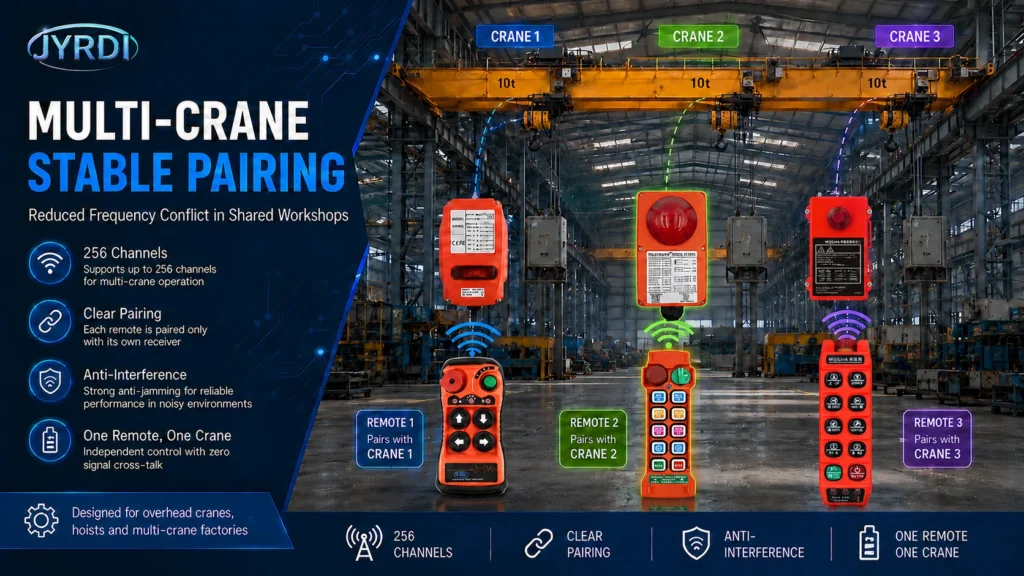
In many factories, several cranes may work in the same workshop. Each crane may have its own transmitter and receiver. If frequency management is poor, remote controls may interfere with each other or become difficult to maintain.
For multi-crane environments, buyers should pay attention to:
- Number of available channels
- Pairing method
- Clear equipment identification
- Receiver installation location
- Spare transmitter management
- Operator training
- Maintenance records
Each transmitter-receiver set should be clearly paired and assigned to the correct equipment. The transmitter should be labeled or visually identified to avoid operator confusion.
More available channels can help reduce the risk of frequency conflict when several crane remote controls are used in the same area. For large workshops, this can make future expansion easier because new remote-control sets can be added with less risk of overlapping frequencies.
JYRDI Q Series Signal Upgrade Explained
The upgraded JIAYI / JYRDI Q Series is designed for industrial lifting environments where stable communication matters more than simple open-space distance.
LLCC68 Wireless Communication Chipset
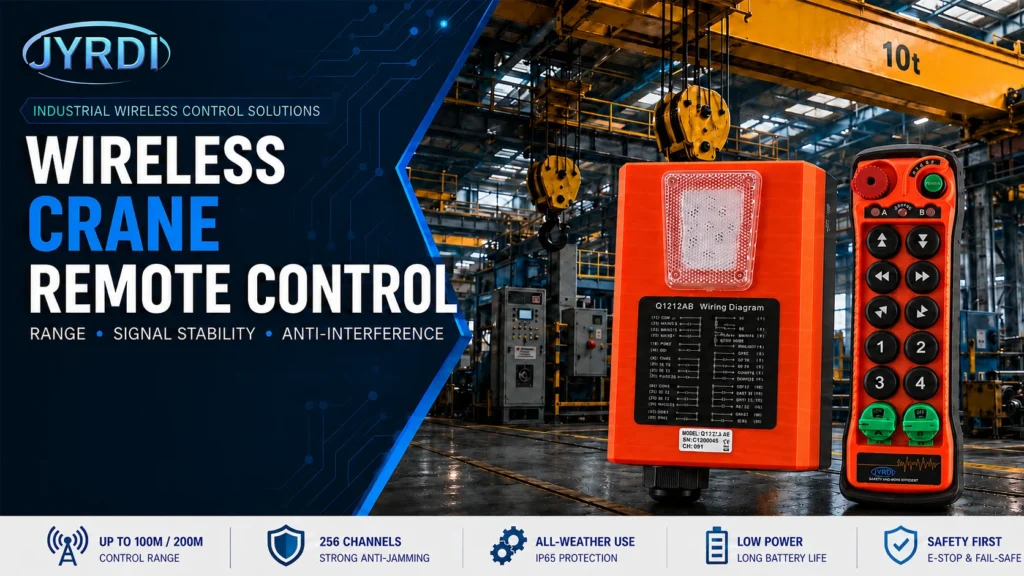
The upgraded Q Series uses an LLCC68 wireless communication chipset to improve signal processing, channel management and anti-interference performance.
Compared with older basic wireless designs, this upgrade helps the remote system perform more reliably in complex industrial environments such as steel-structure workshops, warehouses and multi-crane sites.
Improved Signal Recognition
The upgraded communication design improves signal recognition and helps the receiver maintain more reliable communication in weak-signal or interference-prone environments.
For safety and reliability, invalid or incomplete commands should not be treated as normal control signals. The goal is not to execute uncertain commands, but to improve valid signal recognition and reduce unnecessary communication loss.
Up to 250 m Working Distance Under Suitable Conditions
Under suitable or open-area conditions, the upgraded system can support up to 250 m working distance.
In real factory environments, the actual range may vary depending on crane structure, motors, inverters, control cabinets, antenna placement and surrounding wireless devices.
This wording is important because industrial buyers should not assume that any remote control can always achieve its maximum advertised range in every workshop.
256 Available Channels
The upgraded software supports 256 available channels. This gives users more flexibility in multi-crane workshops or sites with several remote-control systems.
For distributors, maintenance teams and OEM equipment manufacturers, more channel options can make installation and future replacement easier.
Japan KDS Crystal
The upgraded Q Series uses Japan KDS crystal components. Stable frequency components help reduce the risk of frequency drift and improve long-term communication consistency.
Improved Power Module
The receiver power module is enhanced with additional protection and filtering components, including thermistor, varistor and common mode inductor design.
This helps filter electrical noise and improves the receiver’s ability to handle voltage fluctuation in industrial environments.
Bidirectional Communication and Status Indication
The upgraded system supports communication feedback between transmitter and receiver. The transmitter includes signal strength and status indicators, helping operators understand whether the system is connected normally.
For daily operation, this is useful because the operator and maintenance team can identify connection status more quickly instead of guessing whether the transmitter and receiver are working properly.
Industrial Wireless Crane Remote Control vs Basic Remote Control
| Comparison Item | Industrial Wireless Crane Remote Control | Basic Remote Control |
| Signal design | Designed for industrial lifting environments | Suitable for simpler control environments |
| Signal margin | Higher reserve performance under suitable conditions | Limited signal margin |
| Anti-interference | Stronger channel management and interference resistance | Limited anti-interference design |
| Channel options | More channel choices for multi-crane sites | Fewer channel options |
| Frequency stability | Higher-quality frequency components | Basic frequency components |
| Receiver power design | Better filtering and voltage fluctuation handling | Basic power protection |
| Signal feedback | Signal and status indicators available | Limited feedback |
| Maintenance | Easier pairing and troubleshooting options | Less flexible maintenance |
| Suitable applications | Overhead cranes, hoists, gantry cranes, industrial equipment | Simple or low-interference applications |
This comparison does not mean every basic remote control is unusable. For very simple equipment in low-interference environments, a basic remote may be enough. But for industrial lifting equipment, especially in steel-structure factories or multi-crane workshops, a stronger industrial remote system is usually a better long-term choice.
Application Selection Guide
Different lifting equipment requires different wireless remote control performance.
| Application | Recommended Focus | Why It Matters |
| Electric hoist | Compact transmitter, stable short-range control | Simple lifting, frequent daily use |
| Overhead crane | Signal margin, emergency stop, interlock logic | Steel structures and motors may affect signal |
| Bridge crane | Multi-motion control and stable receiver output | Several movements must be controlled safely |
| Gantry crane | Longer range and environmental durability | Often used in outdoor or semi-outdoor areas |
| Multi-crane workshop | Multiple channels and clear pairing | Several remote systems may work together |
| Hydraulic lifting equipment | Customized output and control logic | Standard relay output may not always be enough |
| OEM equipment | Button customization and receiver integration | Requires technical support and stable supply |
When Is a Wireless Crane Remote Control the Best Choice?
A wireless crane remote control is usually a good choice when:
- The operator needs a better view of the load
- The lifting area is large
- A wired pendant cable is inconvenient or easily damaged
- The operator needs to stay away from suspended loads
- The crane works in a workshop, warehouse or outdoor yard
- The equipment needs more flexible operation
- Several operators or maintenance teams need easier control access
- The customer wants to reduce cable-related downtime
For overhead cranes, hoists and gantry cranes, wireless control can improve daily operation efficiency and give the operator more freedom to choose a safer working position.
When Is It Not the Best Choice?
A standard push-button wireless crane remote control is not suitable for every machine.
It may require additional engineering evaluation when:
- The equipment requires proportional hydraulic control
- The crane is part of a certified safety-critical system
- The machine requires special functional safety integration
- The receiver wiring cannot be modified
- The working site has extreme electromagnetic interference
- The machine uses a non-standard control circuit
- The buyer cannot confirm voltage, output logic or emergency stop wiring
- The application involves tower crane control or other highly regulated systems
In these situations, do not buy only by button quantity or remote-control appearance. Provide the wiring diagram, equipment photos and control requirements before ordering. A customized solution may be needed.
Common Mistakes When Choosing a Wireless Crane Remote Control
Mistake 1: Only Looking at Maximum Range
A long advertised range does not always mean stable industrial performance. Buyers should ask whether the range is tested in open space or in a real factory environment.
Mistake 2: Ignoring Steel Structures and Electrical Interference
Factories often contain crane beams, steel columns, motors, inverters and power cables. These can affect signal quality. Anti-interference performance should be considered before ordering.
Mistake 3: Choosing Too Few Channels
In a multi-crane workshop, limited channel options can create frequency planning problems. More available channels provide better flexibility for installation and future expansion.
Mistake 4: Not Checking Receiver Voltage
The receiver must match the crane control cabinet voltage. Wrong voltage selection can cause installation failure or damage.
Mistake 5: Not Confirming Output Logic
Some equipment needs momentary output, while other equipment may require maintained output or special relay logic. This should be confirmed before ordering.
Mistake 6: Forgetting Emergency Stop Wiring
The emergency stop is not just a button on the transmitter. It must be connected correctly in the receiver and crane control circuit.
Mistake 7: Not Asking About Signal Loss Behavior
Buyers should ask what happens when communication is interrupted. Motion outputs should not continue in an unsafe way after signal loss.
Mistake 8: Buying a General Remote for a Special Machine
Truck cranes, hydraulic equipment, automation systems and OEM machines may require customized output logic. A standard crane remote control may not be suitable.
Buyer Checklist Before Ordering
Before buying a wireless crane remote control, prepare the following information:
- What type of lifting equipment do you use?
- Is it an overhead crane, hoist, gantry crane, truck crane or hydraulic machine?
- How many functions need to be controlled?
- Do you need single-speed or dual-speed control?
- What receiver voltage do you need?
- What operating distance is required?
- Is the equipment used indoors or outdoors?
- Are there multiple cranes or multiple remote controls in the same area?
- Are there motors, inverters or welding machines near the crane?
- Do you need automatic frequency selection?
- Do you need custom button functions?
- Do you need momentary or maintained outputs?
- How should the emergency stop be wired?
- Can you provide a wiring diagram or photos of the control cabinet?
The more complete the information, the easier it is to recommend the correct wireless crane remote control system.
Product Recommendation
For overhead cranes, hoists and gantry cranes that work in steel-structure factories or multi-crane workshops, the JYRDI Q Series is suitable for buyers who need stronger signal margin, multiple channel options and easier receiver matching.
The upgraded Q Series is designed with:
- LLCC68 wireless communication chipset
- Improved signal recognition
- Automatic frequency selection
- Up to 250 m working distance under suitable or open-area conditions
- 256 available channels
- Japan KDS crystal
- Improved receiver power module
- Signal strength indicators
- Bidirectional communication between transmitter and receiver
- Multiple button options for different lifting applications
Before ordering, buyers should confirm equipment type, voltage, button functions, operating distance and wiring requirements. If you are replacing an old remote control, clear photos of the old receiver and control cabinet can help our technical team recommend a suitable model.
View Industrial Remote Control Products →
Send Us Your Equipment Details for a Model Recommendation →
Conclusion
Choosing a wireless crane remote control is not only about distance. For industrial lifting equipment, the most important factors are stable signal, anti-interference performance, correct receiver matching and safe behavior during communication interruption.
A suitable radio remote system should work reliably around steel structures, motors, inverters and multiple remote-control systems. Buyers should check the communication chipset, channel quantity, frequency management, receiver voltage, emergency stop wiring, output logic and signal feedback before ordering.
For overhead cranes, hoists, gantry cranes and other industrial lifting equipment, an upgraded wireless crane remote control can improve operation flexibility, reduce cable-related problems and help the operator work from a safer position. The best choice is not always the cheapest remote control. It is the system that matches your equipment, your working site and your safety requirements.
FAQ
What is the best wireless crane remote control range?
The best range depends on the working site. For many industrial lifting applications, 50–100 meters may be enough for daily operation. A system with longer reserve range, such as up to 250 meters under suitable or open-area conditions, can provide better signal margin in complex environments.
Why does a crane remote control lose signal in a factory?
Signal loss may be caused by steel structures, crane beams, motors, frequency inverters, power cables, other wireless systems, low battery power, poor antenna placement or weak anti-interference design.
Is a wireless crane remote control safe?
Yes, a wireless crane remote control is safe when it is properly selected, installed and maintained. Important safety points include emergency stop wiring, button interlock, stable pairing, signal loss behavior, receiver voltage matching and clear status indication.
What should happen if the wireless crane remote control loses signal?
In a properly designed system, motion commands should not continue indefinitely after communication is interrupted. The receiver output behavior should be designed and wired according to the crane control logic and safety requirements, often releasing motion outputs or entering a safe stop state.
What is anti-interference technology in a crane remote control?
Anti-interference technology helps the remote control maintain stable communication in complex environments. It may include multiple channels, automatic frequency selection, improved signal recognition, stable frequency components, better receiver sensitivity and stronger power filtering.
How many channels should a wireless crane remote control have?
For simple single-crane applications, fewer channels may be enough. For factories with multiple cranes or multiple wireless devices, more channels are better. A system with 256 available channels provides more flexibility for frequency planning.
Can one wireless remote control work with any crane?
No. The remote control must match the crane’s receiver voltage, wiring method, output logic and required functions. Before ordering, buyers should confirm equipment type, voltage, button functions, output requirements and emergency stop wiring.
What is the difference between a crane radio remote control and a wireless crane remote control?
In many industrial applications, the two terms are used similarly. A crane radio remote control usually refers to a wireless control system that uses radio signals to transmit commands from the transmitter to the receiver.
What information should I send before buying a crane wireless remote control?
You should send the equipment type, required control functions, receiver voltage, operating distance, working environment, single-speed or dual-speed requirement, output logic and photos of the old receiver or control cabinet if available.