Short Answer
A crane remote control system is a complete transmitter-and-receiver control set, not just a handheld remote. To choose the right system, buyers need to confirm the crane functions, receiver voltage, relay output type, emergency stop circuit, wiring method and control cabinet design. In most overhead cranes, hoists and gantry cranes, the receiver does not directly drive the motor. It sends control signals to the existing crane control circuit, contactors, PLC inputs or VFD control terminals. Before ordering, the most important step is to confirm whether the receiver can match the crane’s electrical panel and required motion logic.
What Is a Crane Remote Control System?
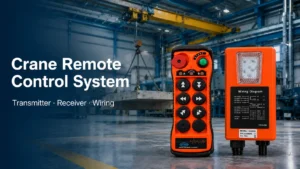
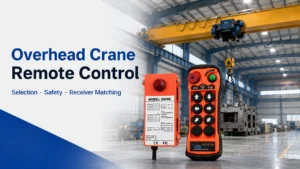
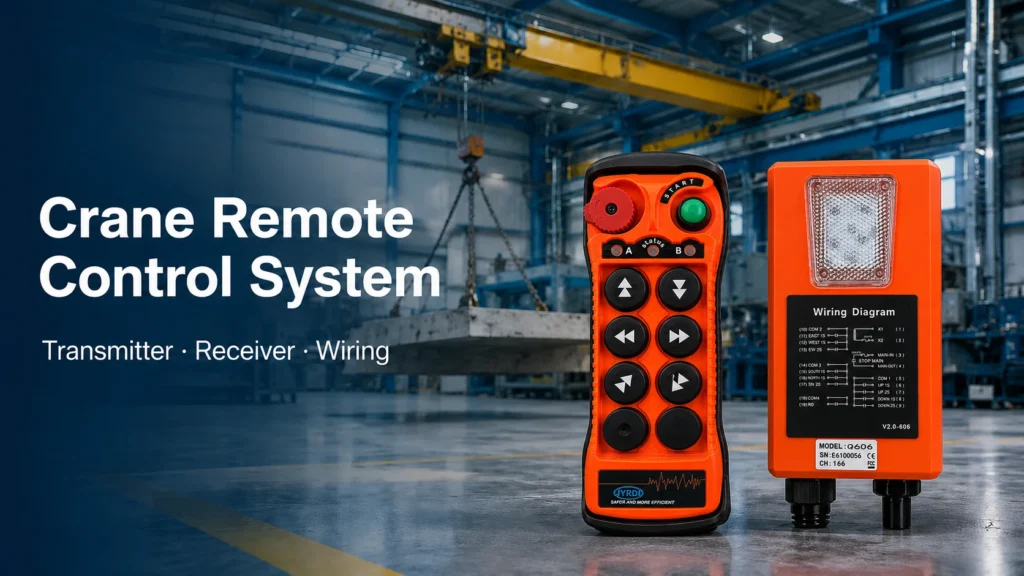
A crane remote control system is a wireless radio control system used to operate crane movements from a handheld transmitter. It is commonly used for overhead cranes, bridge cranes, electric hoists, gantry cranes, jib cranes and other industrial lifting equipment.
A complete system usually includes:
| Part | Main Function |
|---|---|
| Transmitter | The handheld remote used by the operator |
| Receiver | The control unit installed near or inside the crane electrical panel |
| Relay outputs | Convert remote commands into control signals |
| Power supply connection | Provides power to the receiver |
| Emergency stop interface | Connects the stop function to the crane control circuit |
| Pairing logic | Links one transmitter with the correct receiver |
| Wiring terminals | Connect the receiver to the crane control panel |
The transmitter is the part the operator sees, but the receiver is the part that determines whether the system can actually work with the crane.
This is why a buyer should not choose a crane remote control system only by button quantity or product appearance. The correct model depends on the crane’s control voltage, output logic, wiring method and operating environment.
Transmitter and Receiver: What Is the Difference?
The transmitter and receiver work together, but they have different roles.
The transmitter sends commands. It usually includes buttons for hoist up, hoist down, trolley travel, bridge travel, start, stop and emergency stop. Some transmitters are designed for single-speed control, while others support dual-speed or customized functions.
The receiver receives the wireless signal and sends output signals to the crane control circuit. It must match the electrical panel, including voltage, relay outputs, common wire arrangement and emergency stop wiring.
A transmitter may look suitable, but if the receiver does not match the control cabinet, the system will not work correctly.
For replacement projects, the receiver information is often more important than the transmitter appearance.
How Does a Crane Remote Control System Work?
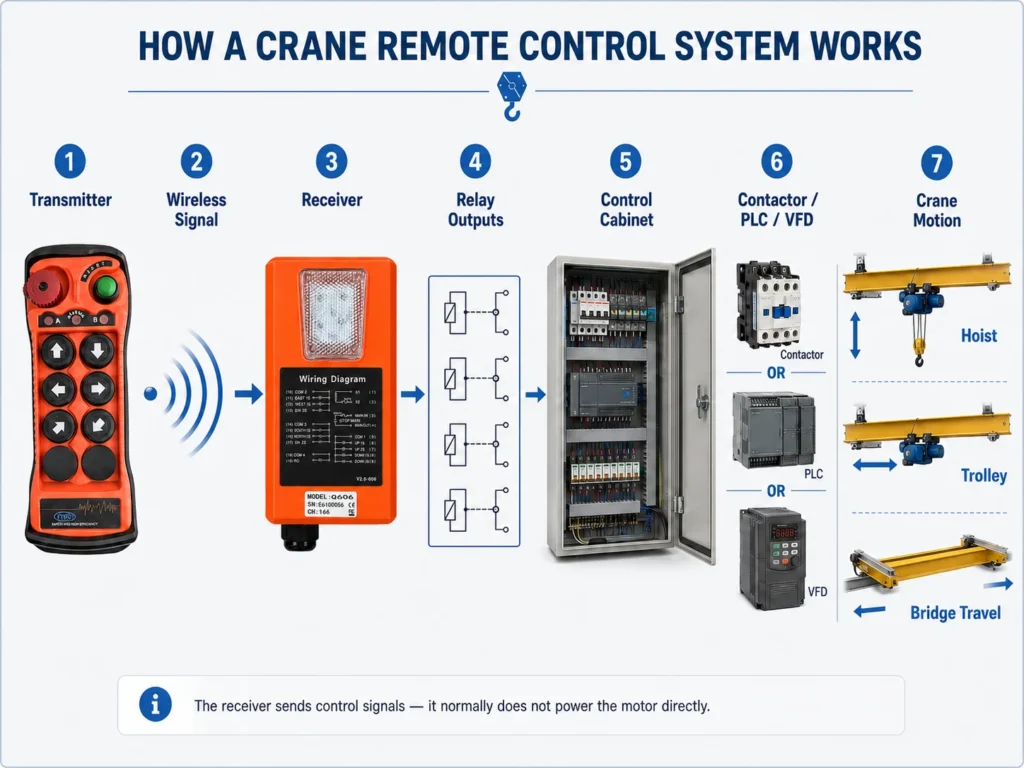
A typical crane radio remote system works in this sequence:
- The operator presses a button on the transmitter.
- The transmitter sends a wireless signal.
- The receiver verifies that the signal comes from the paired transmitter.
- The receiver activates the corresponding relay output.
- The crane control panel receives the command.
- The contactor, PLC or VFD system performs the crane movement.
- When the button is released, the output follows the designed control logic.
For example, when the operator presses Hoist Up, the receiver activates the hoist-up output. The crane control circuit then performs the lifting command according to the existing electrical design.
In most industrial cranes, the receiver does not directly power the motor. It works as a control interface between the operator and the existing crane electrical system.
Receiver Voltage Must Match the Crane Control Panel
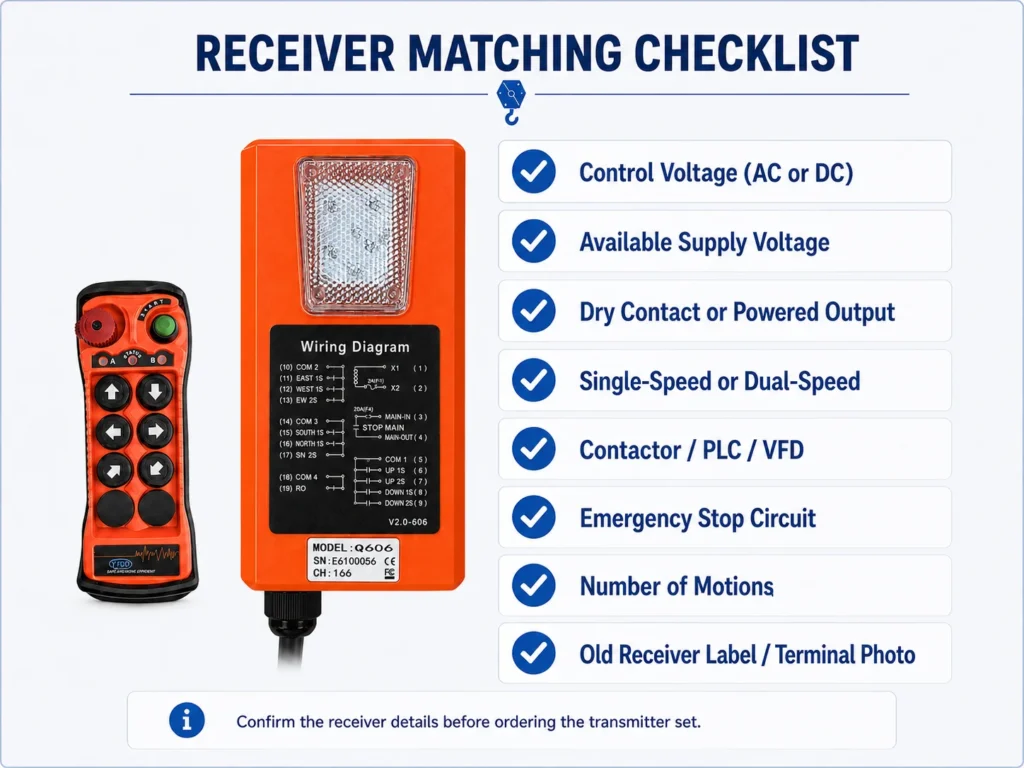
Receiver voltage is one of the most important details before ordering.
If the receiver voltage does not match the crane control panel, the system may not work, or the receiver may be damaged.
Before selecting a model, buyers should confirm:
- Is the receiver powered by AC or DC?
- What voltage is available in the control cabinet?
- Is the voltage shown on the old receiver label?
- Is there a transformer inside the electrical panel?
- Does the crane use contactor control, PLC control or VFD control?
- Is there an electrical drawing or wiring diagram?
If the voltage is unclear, do not guess. Send photos of the old receiver, wiring terminals and control cabinet to the supplier for confirmation.
A clear photo of the receiver label often helps the supplier identify the correct voltage range and replacement direction.
Relay Output, Dry Contact and Powered Output
The receiver usually controls the crane through relay outputs. This is where many buyers get confused.
A dry contact relay output works like a switch. It does not supply voltage by itself. It only opens or closes a circuit. This type of output is common in crane control systems because it can connect to contactors, control relays or PLC inputs.
A powered output sends voltage directly to the connected circuit. This must be matched very carefully with the control panel.
| Output Type | Meaning | Typical Use |
|---|---|---|
| Dry contact relay output | Works like a switch and does not supply voltage | Common for crane control circuits |
| Powered output | Sends voltage to the connected circuit | Used only when the panel requires it |
| Momentary output | Active only while the button is pressed | Common for crane motion commands |
| Maintained output | Stays active after pressing | Used for selected auxiliary functions |
| Interlocked output | Prevents opposite directions from working together | Up/down, left/right, forward/reverse |
For most crane movement commands, momentary output is preferred. When the operator releases the button, the output should drop out according to the control logic.
Maintained output may be used for auxiliary functions such as lights, alarms or special equipment functions, but it should not be used for crane motion unless the crane system is designed for it.
Emergency Stop Is Not Just a Red Button
The emergency stop button on the transmitter is important, but it should not be treated as a complete safety system by itself.
It must be integrated into the crane control circuit according to the machine design and site requirements.
Before installation, buyers and technicians should confirm:
- How the emergency stop output is connected
- Whether the circuit uses normally closed or normally open logic
- Whether the existing crane has a safety relay
- Whether the stop circuit interrupts the main control circuit
- What happens when communication is lost
- Whether motion outputs drop out when the emergency stop is activated
A red emergency stop button on the transmitter does not automatically mean the whole crane system meets every safety requirement.
The final stop behavior depends on the receiver design, crane control circuit, electrical panel and site safety architecture. For special safety requirements, the system should be reviewed by qualified personnel.
Wiring: What Buyers Should Confirm Before Ordering
This article is not a DIY wiring instruction. Crane remote control wiring should be performed or checked by qualified technicians.
For buyers, the key is to provide the right information before selecting a model.
Before ordering, confirm:
- Receiver voltage
- AC or DC power supply
- Dry contact or powered output
- Relay output quantity
- Common wire arrangement
- Momentary or maintained output
- Emergency stop circuit
- Single-speed or dual-speed control
- Contactor, PLC or VFD control
- Old pendant wiring
- Old receiver terminal photo
- Control cabinet photo
- Wiring diagram, if available
The more complete this information is, the easier it is to recommend the correct transmitter-and-receiver set.
If you are replacing an old remote system, photos are often more useful than a written description.
Replacing an Old Crane Remote Control System
Many buyers need a new remote system because the old transmitter is damaged, the receiver has failed, or the original model is no longer available.
In replacement projects, it is usually safer to replace both the transmitter and receiver unless the same model, same coding, same pairing method and same output logic can be confirmed.
A transmitter from one system usually cannot be freely paired with another receiver. Even if the frequency looks similar, the communication protocol, coding method and output logic may be different.
Before replacing an old system, prepare:
- Old transmitter photo
- Old receiver photo
- Receiver model label
- Wiring terminal photo
- Voltage label photo
- Control cabinet photo
- Existing pendant photo
- Wiring diagram, if available
- Required button functions
This helps the supplier check whether a standard replacement system is suitable or whether a customized solution is needed.
PLC, VFD and Dual-Speed Crane Control
Not every crane uses simple contactor control.
Some cranes use:
- PLC input control
- VFD or frequency inverter control
- Dual-speed contactor control
- Inverter-controlled hoist or trolley movement
- Safety relay integration
- Special interlock logic
- Customized electrical panels
If the crane uses PLC or VFD control, the receiver output must match the required input signal type.
In many cases, the receiver only sends control signals to the PLC or VFD input terminals. The crane’s existing control system then manages the motor movement.
For this type of crane, buyers should provide the wiring diagram, I/O input requirement, control voltage and required button logic before selecting a remote control system.
For dual-speed cranes, button quantity alone is not enough. The supplier needs to confirm the low-speed and high-speed output logic before recommending a model.
Multi-Crane Pairing and Frequency Management
In workshops with several cranes, pairing and frequency planning are important.
Each transmitter should be clearly paired with its own receiver and assigned to one crane.
For example:
- Remote 1 → Crane 1
- Remote 2 → Crane 2
- Remote 3 → Crane 3
More available channels can help with frequency planning when multiple radio remote systems operate in the same area. However, channel quantity alone does not guarantee a reliable multi-crane setup.
A good multi-crane setup also requires:
- Clear transmitter labels
- Clear receiver labels
- Correct pairing
- Installation records
- Spare transmitter management
- Operator training
- Routine inspection
For workshops with multiple cranes, tell the supplier how many cranes operate in the same area and whether several operators will use remote controls at the same time.
Common Mistakes When Choosing a Crane Remote Control System
Choosing Only by Button Quantity
Button quantity is important, but it is not enough. Two 8-button remotes may have different receiver voltage, output logic and wiring requirements.
Buying Only the Transmitter
A new transmitter may not pair with the old receiver. If compatibility cannot be confirmed, replacing the complete transmitter-and-receiver set is usually more reliable.
Ignoring Receiver Voltage
Wrong voltage can cause installation failure or receiver damage. Always confirm AC or DC voltage before ordering.
Confusing Dry Contact and Powered Output
Dry contact and powered output are different. The wrong output type can cause wiring problems or malfunction.
Treating Emergency Stop as Only a Button
The emergency stop must be correctly integrated into the crane control circuit. It is not only a red button on the handheld transmitter.
Not Checking PLC or VFD Control
PLC and VFD cranes may require specific input signals. Standard relay output may still work in some cases, but it must be confirmed before ordering.
Replacing an Old System Without Photos
Without photos of the old receiver, terminal block and control cabinet, it is difficult to confirm the right replacement model.
Buying the Cheapest System for Heavy-Duty Use
For industrial lifting equipment, incorrect wiring, downtime and troubleshooting costs can be higher than the price difference between a basic remote and a properly matched remote system.
What Information Should You Send Before Ordering?
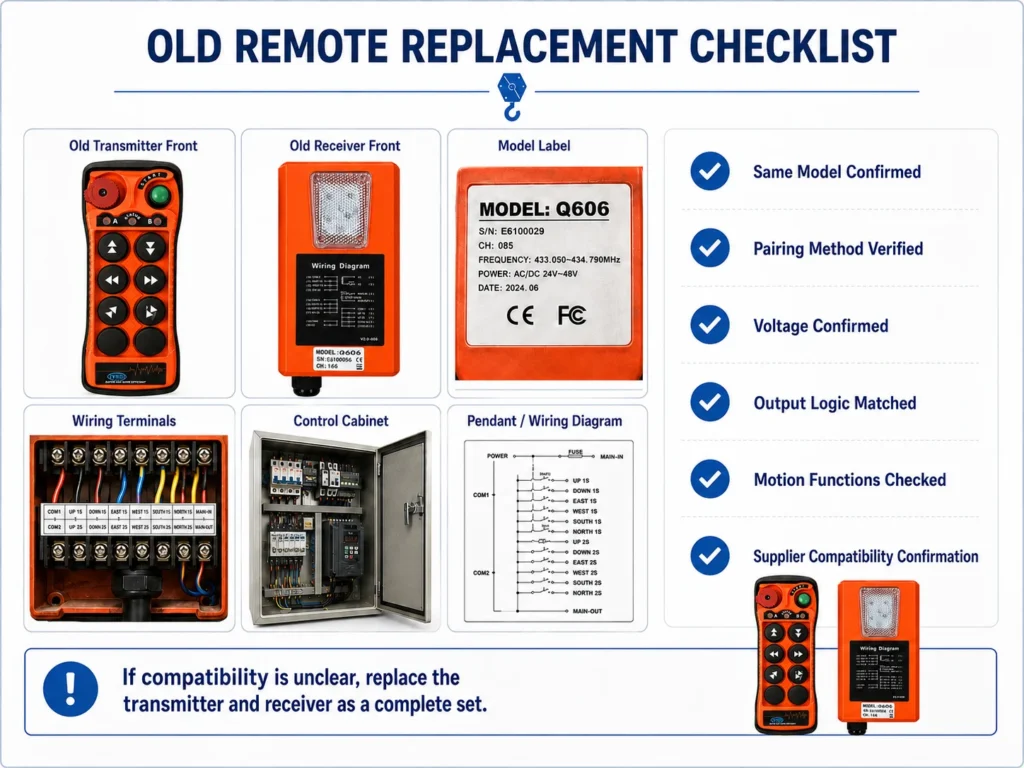
Before ordering a crane remote control system, send as much of the following information as possible:
| Information Needed | Why It Matters |
|---|---|
| Crane type | Helps determine the control functions |
| Required motions | Determines button and output quantity |
| Receiver voltage | Prevents wrong power matching |
| AC or DC control voltage | Affects receiver selection |
| Old transmitter photo | Helps identify old functions |
| Old receiver photo | Helps check wiring terminals and model |
| Control cabinet photo | Helps understand the electrical system |
| Wiring diagram | Helps confirm output logic |
| Single-speed or dual-speed | Affects receiver output planning |
| PLC, VFD or contactor control | Affects compatibility |
| Emergency stop requirement | Affects stop circuit integration |
| Working distance | Helps select signal range |
| Number of cranes in workshop | Affects frequency planning |
A simple message like this is very useful:
“This is our old receiver. The crane is single-speed. The control voltage is AC 220V. We need up, down, left, right, forward, reverse, start and stop. Three cranes work in the same workshop.”
With this information, the supplier can recommend a suitable system more accurately.
Recommended JIAYI Solution
For standard overhead cranes, electric hoists, bridge cranes, gantry cranes and general industrial lifting equipment using relay-based control circuits, JIAYI / JYRDI can provide transmitter-and-receiver remote control sets with different button layouts, receiver voltage options and pairing configurations.
For replacement projects, the correct model should be confirmed based on:
- Receiver voltage
- Required button functions
- Relay output logic
- Emergency stop wiring
- Single-speed or dual-speed control
- Control cabinet photos
- Working distance
- Number of cranes in the same workshop
For multi-crane workshops, available channel options and clear transmitter-receiver pairing can help with frequency planning. For PLC, VFD, dual-speed or special safety-related applications, wiring diagrams should be reviewed before recommendation.
View Industrial Remote Control Products →industrial-remote-control
Need Help Matching a Transmitter and Receiver? Send Your Crane Details →contact
Conclusion
A crane remote control system is not just a handheld remote. It is a complete control set that must match the crane’s electrical panel, receiver voltage, relay outputs, emergency stop circuit and motion logic.
Before choosing a model, buyers should confirm:
- What crane functions need to be controlled
- Whether the receiver voltage is AC or DC
- Whether dry contact or powered output is required
- Whether the crane is single-speed or dual-speed
- Whether the crane uses contactors, PLC or VFD control
- How the emergency stop circuit should be integrated
- Whether multiple cranes work in the same workshop
- Whether old receiver and control cabinet photos are available
The right crane remote control system is not always the one with the most buttons or the lowest price. It is the system that matches your crane, your control cabinet and your working environment.
FAQ
What is a crane remote control system?
A crane remote control system is a wireless radio control set used to operate crane movements from a handheld transmitter. It usually includes a transmitter, receiver, relay outputs, power connection, emergency stop interface and wiring connection to the crane control panel.
Is the handheld remote the whole system?
No. The handheld transmitter is only one part of the system. The receiver, relay outputs, voltage matching and wiring integration are equally important.
Can I replace only the transmitter?
Only if the new transmitter is compatible with the existing receiver, coding method, pairing logic and output configuration. If compatibility cannot be confirmed, replacing both transmitter and receiver is usually more reliable.
What voltage should the receiver use?
The receiver voltage must match the crane control panel power supply. Buyers should confirm whether the voltage is AC or DC and provide the voltage shown on the old receiver, pendant circuit, electrical drawing or control cabinet label.
What is dry contact output?
Dry contact output works like a switch. It does not supply voltage by itself. It only opens or closes the circuit according to the command, which is common in crane control systems.
Can a crane remote control work with PLC or VFD control?
Yes, in many cases, but the receiver output must match the required PLC or VFD input signal. Wiring diagrams, I/O requirements and control cabinet photos should be reviewed before model selection.
How do multiple crane remote controls avoid interference?
Each transmitter should be paired with its own receiver and assigned to one crane. More channel options can help with frequency planning, but clear labeling, correct pairing and operator training are also required.
What information should I send before ordering?
Send the crane type, required functions, receiver voltage, AC or DC control voltage, single-speed or dual-speed requirement, output type, emergency stop requirement, working distance and photos of the old receiver, transmitter or control cabinet.