
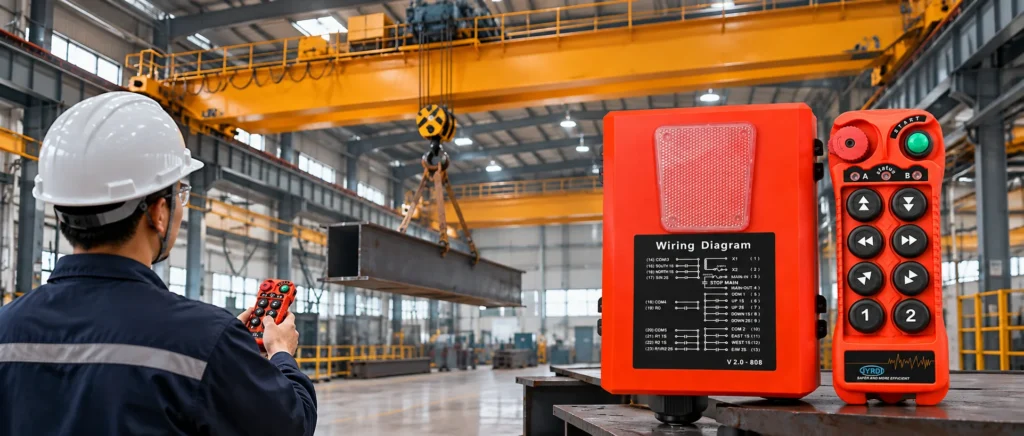
Improve operator mobility with a wireless remote control system configured for your overhead crane, EOT crane or bridge crane.
JIAYI provides push-button crane remote controls for standard lifting and travelling functions, with single-speed and dual-speed options, different receiver voltage configurations and support for replacement, retrofit and OEM projects.
The right remote control should be selected according to the actual crane functions, speed-control logic, receiver voltage and control circuit — not simply by the number of buttons on the transmitter.
Single & Dual Speed Options
Configurations for standard and two-speed crane control.
Flexible Receiver Matching
Different receiver voltage and output configurations for different crane control systems.
Replacement & Retrofit Support
For new cranes, existing wireless systems and wired pendant conversions.
CTA: Get a Model Recommendation
What Remote Control Is Suitable for an Overhead Crane?
For most conventional overhead and EOT cranes, a push-button wireless remote control is the most practical solution.
The correct configuration depends on the crane movements, number of required functions, single- or dual-speed operation, receiver voltage and existing control circuit.
A standard travelling overhead crane may require three groups of movement commands:
Hoist: Up / Down
Trolley: East / West
Bridge: North / South
Start, stop and auxiliary functions may also be required depending on the crane design.
Not every overhead crane uses the same control logic, so the transmitter and receiver should be matched to the actual machine rather than selected only by appearance or button count.
Typical Overhead Crane Remote Control Functions
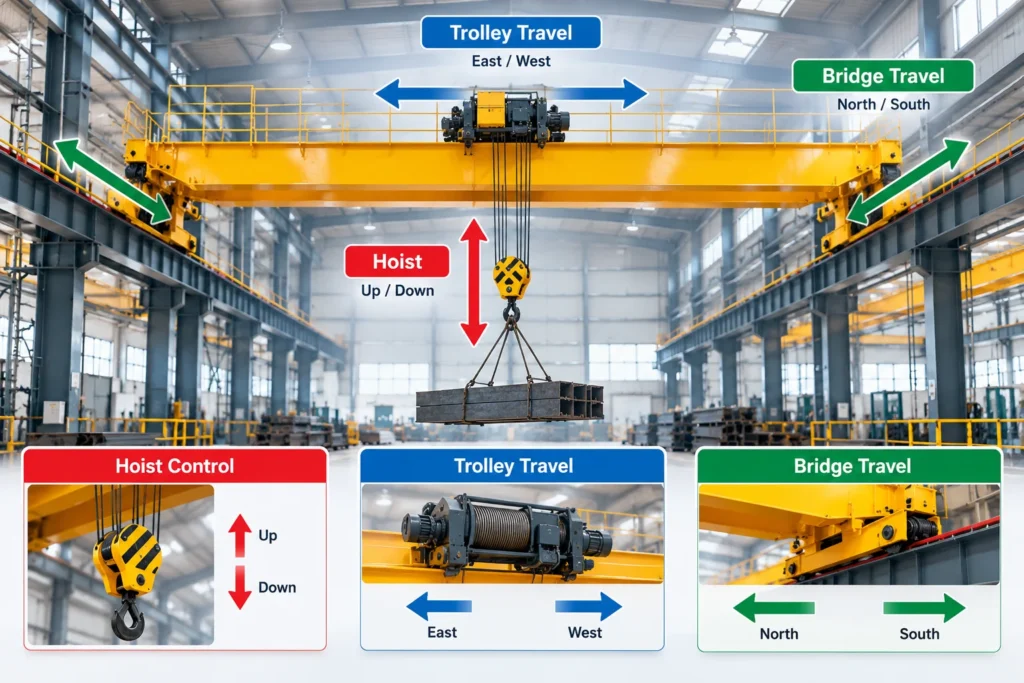
An overhead crane remote control may operate several independent movements.
Hoist Control
Up / Down
Controls the lifting and lowering movement of the hook or hoist.
Trolley Travel
East / West
Controls movement of the trolley along the crane bridge.
Bridge Travel
North / South
Controls movement of the complete crane along the runway.
Additional Functions
Depending on the crane, additional commands may include Start, Stop or auxiliary functions.
A simple hoist may require only a few commands, while a travelling bridge crane may require six or more movement functions.
The remote control should therefore be configured around the crane’s real operating requirements.
Which Overhead Crane Remote Control Configuration Do You Need?
Instead of starting with a model number, first identify how the crane is controlled.
Basic Hoist or Simple Crane
For equipment requiring only basic lifting or a limited number of directional commands, a smaller push-button configuration may be sufficient.
Typical applications include:
electric hoists, small workshop cranes and simple lifting equipment.
For these applications, compact Q Series models can provide a straightforward wireless control solution.
Standard Overhead Crane
A conventional overhead crane often requires:
Up / Down
East / West
North / South
For this type of system, a 6-button configuration is commonly considered.
JIAYI Q600 / Q606 configurations can be evaluated depending on whether the crane uses single-speed or dual-speed operation.
Multi-Function Overhead or EOT Crane
Some cranes require additional control functions beyond the main hoist, trolley and bridge movements.
An 8-button configuration such as Q800 / Q808 may be more suitable when the crane requires additional outputs or more complex control.
The final model should still be confirmed against the actual receiver and crane control circuit.
Recommended JIAYI Remote Controls for Overhead Cranes
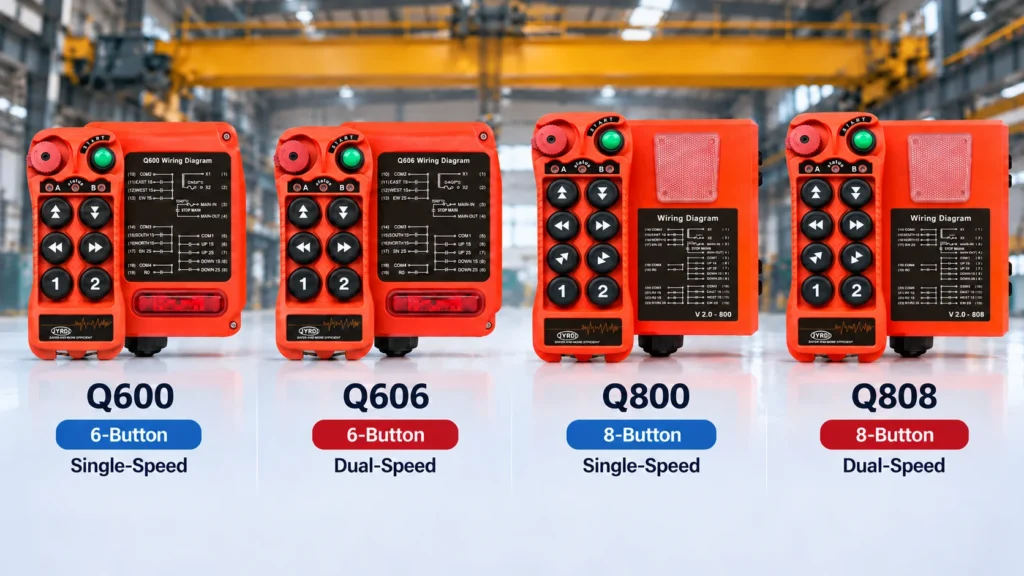
| Model | Control Type | Typical Application |
|---|---|---|
| Q600 | 6-button, single-speed | Standard overhead cranes and hoists with conventional directional control |
| Q606 | 6-button, dual-speed | Two-speed crane or hoist applications where the control system supports dual-speed commands |
| Q800 | 8-button, single-speed | Overhead cranes requiring additional movements or auxiliary functions |
| Q808 | 8-button, dual-speed | Multi-function EOT / overhead crane systems requiring two-stage speed commands |
Q600
6-Button Single-Speed Crane Remote Control
A practical option for standard lifting and travelling functions where the crane uses conventional single-speed control.
CTA: View Q600
Q606
6-Button Dual-Speed Crane Remote Control
Suitable for cranes that already use two-stage speed-control logic.
The transmitter alone does not create dual-speed operation. The receiver outputs and crane control system must also support the required speed commands.
CTA: View Q606
Q800
8-Button Single-Speed Crane Remote Control
Designed for applications requiring more control functions than a standard six-button configuration.
CTA: View Q800
Q808
8-Button Dual-Speed Crane Remote Control
Suitable for multi-function overhead and EOT crane applications where the machine already supports dual-speed operation.
CTA: View Q808
Single-Speed or Dual-Speed?
Choosing between single-speed and dual-speed control depends on the existing crane control system.
Single-Speed Control
A single-speed command provides one operating stage for each movement.
It is commonly used on conventional hoists and standard overhead cranes.
Dual-Speed Control
A dual-speed push button provides two command stages, typically used for low-speed and high-speed movement.
This can be useful where slower positioning and faster travel are both required.
Important: A dual-speed remote control cannot convert a single-speed crane into a two-speed crane by itself.
The crane motor drive, contactor logic, PLC or inverter must already support the required speed-control method.
Match the Receiver to Your Overhead Crane
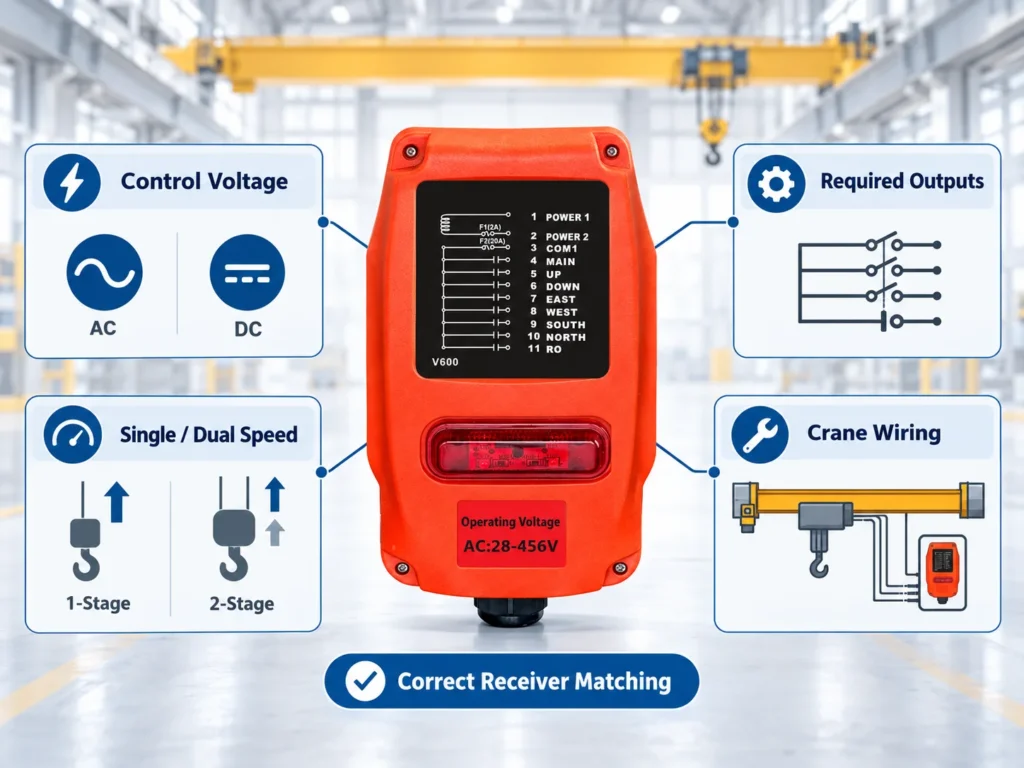
The handheld transmitter is only one part of the wireless control system.
Before ordering, the receiver should be checked against the crane control circuit.
Receiver Voltage
Confirm the actual voltage supplied to the receiver or crane control circuit.
Do not assume that the crane’s main incoming power voltage is the same as the receiver control voltage.
Depending on the Q Series configuration, JIAYI can provide receiver options covering different AC and DC control-voltage requirements.
Required Outputs
The receiver must provide enough outputs for every required crane movement and auxiliary function.
For example, a travelling overhead crane may require independent outputs for:
Up / Down
East / West
North / South
Start / Stop
Speed Logic
Single-speed and dual-speed cranes require different output logic.
The remote control configuration must match the way the crane already controls its motors or drives.
Existing Control Method
The receiver may interface with:
contactors, relays, PLC inputs or an inverter.
The existing wiring diagram is one of the most useful references for selecting the correct configuration.
CTA: Send Us Your Wiring Diagram
Send your control voltage, required functions and wiring information, and we can help narrow down a suitable configuration.
How Does an Overhead Crane Remote Control System Work?
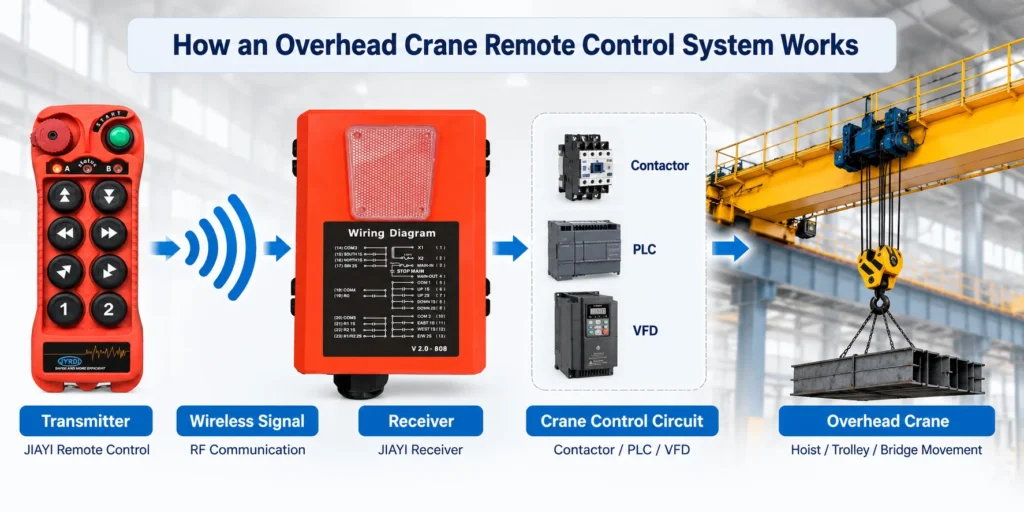
A wireless overhead crane control system does not connect the handheld transmitter directly to the crane motor.
The control path is:
Transmitter → Wireless Signal → Receiver → Crane Control Circuit → Crane
The operator sends a command using the handheld transmitter.
The matched receiver receives that wireless signal and activates the appropriate control output.
Those outputs then interface with the crane’s existing contactors, PLC or other control components.
The crane responds according to its original electrical control logic.
For a deeper technical explanation of the transmitter, receiver, relay outputs and control wiring, read our Crane Remote Control System: Transmitter, Receiver, Wiring and Outputs Explained guide.
Overhead Crane Remote Control for Different Project Types
New Crane / OEM Projects
For crane manufacturers, control-panel builders and OEM projects, the remote control system can be selected as part of the crane’s original electrical design.
Typical information includes:
crane movements, control voltage, speed mode, required outputs and customization requirements.
JIAYI can also support project-specific button functions, labeling and OEM requirements depending on the product configuration.
CTA: Discuss an OEM Configuration
If an existing crane radio remote control has failed, first determine whether you n
Replacing an Existing Wireless Crane Remote
eed only a replacement transmitter or a complete transmitter-and-receiver set.
Before replacement, check:
existing transmitter model, receiver information, control functions, speed mode and control voltage.
A new transmitter should not be assumed to work with an existing receiver simply because the button layout looks similar.
If compatibility cannot be confirmed, replacing the complete transmitter and receiver system may be the more practical approach.
Related Guide: Can You Replace Only a Crane Remote Control Transmitter?
Retrofitting a Wired Pendant Overhead Crane
Many existing overhead cranes can be converted from wired pendant control to wireless operation when the receiver outputs can be correctly integrated into the existing control circuit.
Before retrofit, confirm:
the pendant functions, control voltage, single- or dual-speed logic and existing wiring.
The goal is not simply to remove the pendant and connect a receiver. The wireless system should reproduce the correct crane commands through the existing control architecture.
CTA: Ask About an Overhead Crane Retrofit
Why Use Wireless Control on an Overhead Crane?
Wireless control is often selected because it gives the operator more flexibility in where they stand while controlling the crane.
Better Operator Position
A fixed pendant can restrict the operator to a limited area.
With wireless control, the operator can choose a position that provides a clearer view of the hook, load and surrounding workspace.
Greater Mobility
The operator is no longer physically tied to a travelling pendant cable.
This can be useful in manufacturing workshops, warehouses and material-handling areas where the operator needs to move around the load.
Flexible Industrial Use
Wireless crane controls can be applied to overhead cranes used in production lines, machinery workshops, steel processing, warehouses and general material handling.
Wireless operation does not replace proper crane safety procedures or correct electrical design. The crane itself must still be operated according to the applicable site and equipment requirements.
Common Overhead Crane Remote Control Selection Mistakes
Choosing the right remote becomes easier when several common mistakes are avoided.
Choosing only by button count.
Two six-button transmitters may use different speed logic, receiver voltage or output configuration.
Using the crane main voltage as the receiver voltage.
The main power supply and control voltage are not necessarily the same.
Ignoring single-speed vs dual-speed operation.
The transmitter, receiver and crane circuit all need to support the required speed logic.
Assuming any transmitter can pair with the existing receiver.
Wireless communication and matching requirements vary between systems.
Ignoring the wiring diagram.
For replacement and retrofit projects, the existing control circuit often provides more useful information than the appearance of the old remote.
Real Overhead Crane Applications
JIAYI overhead crane remote control solutions are intended for industrial lifting applications such as workshop cranes, EOT cranes, bridge cranes, electric hoists and general material-handling equipment.
For real projects, the most useful information is not only what the transmitter looks like, but how the complete system is configured.
Why Choose JIAYI for Overhead Crane Remote Controls?
JIAYI focuses on industrial wireless remote controls for cranes, hoists and machinery.
Our approach is based on matching the remote control system to the actual machine requirements.
Multiple Push-Button Configurations
Different button counts and single- or dual-speed configurations are available for different overhead crane requirements.
Receiver Matching Support
Customers can provide the control voltage, existing receiver information or wiring diagram to help identify a more suitable configuration.
OEM & Custom Functions
Depending on the project and model, customization can include button functions, symbols, labels, branding and control configuration.
Product Testing
Configured transmitter and receiver sets can be checked according to the required control functions before shipment.
Need More Technical Detail?
Overhead Crane Remote Control Selection, Safety and Receiver Matching Guide
If you need more detail about:
receiver matching, control voltage, single- or dual-speed logic, safety functions, interference considerations and installation requirements,
read our complete Overhead Crane Remote Control Selection, Safety and Receiver Matching Guide.
Frequently Asked Questions
Can an overhead crane be controlled wirelessly?
Yes. A wireless remote control system can send crane movement commands from a handheld transmitter to a receiver connected to the crane control circuit. The receiver then activates the required outputs for hoisting, trolley travel, bridge travel or other configured functions.
How many buttons does an overhead crane remote control need?
It depends on the actual crane movements. A travelling overhead crane commonly requires commands for hoist Up/Down, trolley East/West and bridge North/South, while simpler equipment may require fewer functions and more complex cranes may require additional outputs.
Can I use a dual-speed remote on a single-speed overhead crane?
A dual-speed transmitter alone will not make a single-speed crane operate at two speeds. The receiver outputs and the crane’s motor, contactor, PLC or inverter control must already support dual-speed operation.
What receiver voltage should I choose?
Use the actual voltage required by the crane control circuit or existing receiver. The control voltage may be different from the crane’s main incoming power supply, so the wiring diagram or receiver label should be checked before ordering.
Can wireless remote control be added to an older overhead crane?
In many cases, yes. The receiver must be correctly integrated with the existing control circuit and reproduce the required pendant commands. Control voltage, wiring and speed logic should be checked first.
Can I replace only the overhead crane remote transmitter?
Sometimes, but only when the new transmitter is compatible with the existing receiver and can be correctly matched. If compatibility cannot be confirmed, replacing the complete transmitter-and-receiver system is usually more straightforward.
Which JIAYI models are suitable for overhead cranes?
The suitable model depends on the required functions and speed mode. Q600/Q606 and Q800/Q808 are typical options for six- and eight-button overhead crane applications, but the final selection should be confirmed against the actual crane control system.
What information do I need for a quotation?
The most useful information is the crane functions, single- or dual-speed requirement, receiver/control voltage, wiring diagram and required quantity. If you are replacing an existing system, also send the transmitter and receiver model information.
Final CTA
Need the Right Remote Control for Your Overhead Crane?
Send us four key details:
Crane functions · Single or dual speed · Control voltage · Wiring diagram
We can use this information to help narrow down a suitable transmitter and receiver configuration for your overhead or EOT crane.
Get an Overhead Crane Remote Recommendation
Send Your Wiring Diagram
For OEM or distributor projects, also include the required models, customization requirements and order quantity.
Before purchasing an overhead crane remote control, it is important to confirm the required functions, single- or dual-speed operation, control voltage, existing model or wiring diagram, and order quantity. You should also clarify whether you need only a replacement transmitter or a complete transmitter-and-receiver system. For replacement, OEM, or distributor orders, we can help recommend and quote the correct configuration based on the actual control system, compatibility requirements, and project needs to reduce the risk of ordering the wrong model or encountering matching issues later.