
Wireless Crane Remote Control Systems
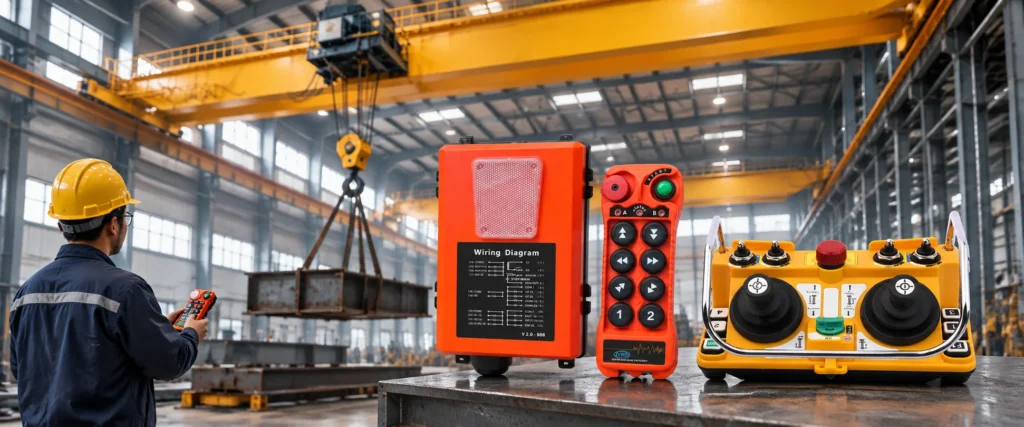
Reliable wireless control solutions for overhead cranes, electric hoists, EOT cranes, gantry cranes and other industrial lifting equipment.
JIAYI provides push-button and joystick crane remote control systems with different numbers of control functions, single- or dual-speed options, receiver voltage configurations and customizable control logic.
Whether you are selecting a remote control for a new crane, replacing an existing radio system or retrofitting a wired pendant crane, the correct solution should be based on the crane control system — not simply the appearance of the transmitter.
Stable Wireless Control
Reliable radio control for everyday industrial lifting applications.
Flexible Receiver Matching
Receiver voltage, outputs and control logic can be matched to different crane systems.
OEM & Custom Functions
Button layouts, symbols, functions and configurations can be customized for different projects.
What Is a Crane Remote Control System?
A crane remote control system allows an operator to send movement commands wirelessly from a handheld transmitter to a receiver installed on the crane. The receiver then converts those commands into electrical outputs for the crane’s contactors, PLC, inverter or other control circuit.
The correct system therefore depends on more than the transmitter itself. Crane type, number of functions, single- or dual-speed operation, receiver voltage and existing wiring all need to be considered before selecting a replacement or new control system.
For conventional overhead cranes and electric hoists, a push-button remote is usually the most practical solution. Equipment with multi-axis, hydraulic or more complex control requirements may be better suited to a joystick or customized system.
Related guide: How cranes can be controlled remotely
Crane Remote Control Solutions for Different Lifting Equipment
Different types of cranes do not always require the same remote control. The operating functions and control circuit should determine the configuration.
Overhead & EOT Cranes

Wireless crane remote controls are commonly used on bridge cranes, overhead cranes and EOT cranes in workshops, factories and material-handling facilities.
Typical functions may include:
Up / Down · East / West · North / South · Start / Stop · Single or Dual Speed
For these applications, push-button transmitters are usually the first option to consider.
Explore: Overhead Crane Remote Control Solutions
Technical guide: Overhead crane remote control selection, safety and receiver matching
Electric Hoists

Electric chain hoists and wire-rope hoists often require fewer functions than a full travelling crane.
Depending on the hoist, a compact push-button system may provide:
Up / Down · Start / Stop · Single or Dual Speed
If the hoist currently uses a wired pendant, compatibility should be checked before adding wireless control.
Related guide: Can You Add a Wireless Remote to an Electric Hoist?
Gantry Cranes

Wireless operation can give the operator more flexibility to move around the lifting area while maintaining a better view of the crane, load and surrounding workspace.
The required control functions depend on whether the gantry crane includes hoisting only or additional travelling movements.
Tower Cranes

Tower crane control can require more functions and more complex movement logic than a simple hoist.
Depending on the machine design, push-button or joystick control may be considered.
Truck-Mounted & Hydraulic Cranes
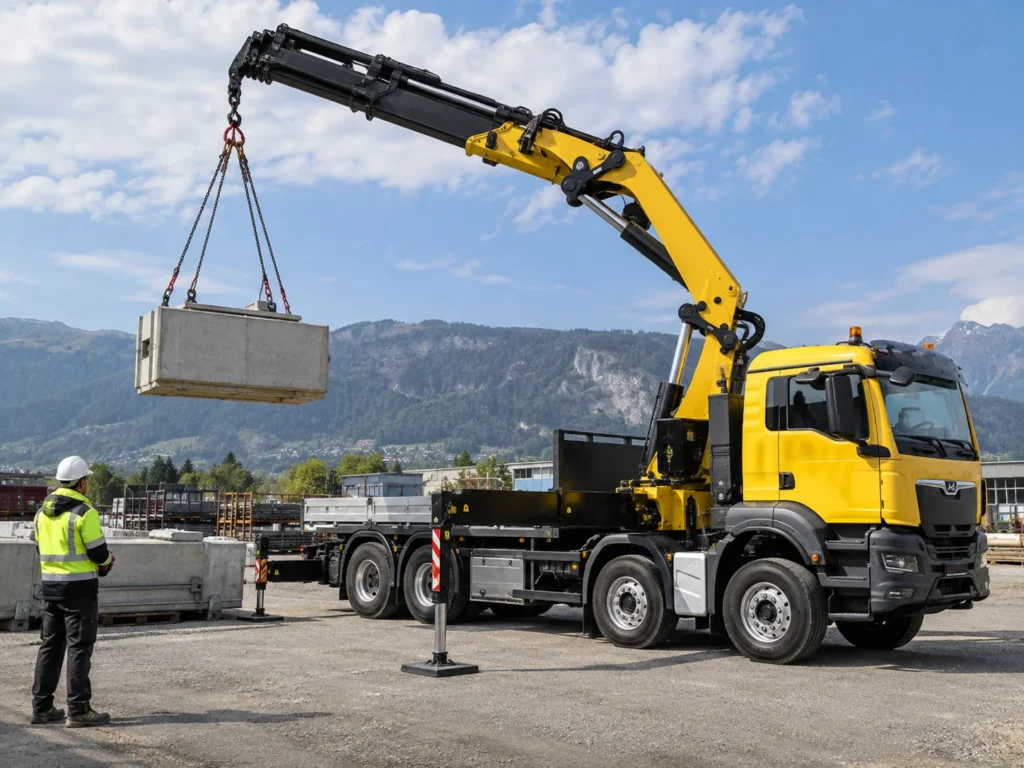
Hydraulic cranes, mobile lifting equipment and truck-mounted cranes may require different outputs or multi-axis control.
For these applications, the choice between push-button and joystick control should be based on the hydraulic and electrical control system rather than transmitter style alone.
How to Choose the Right Crane Remote Control
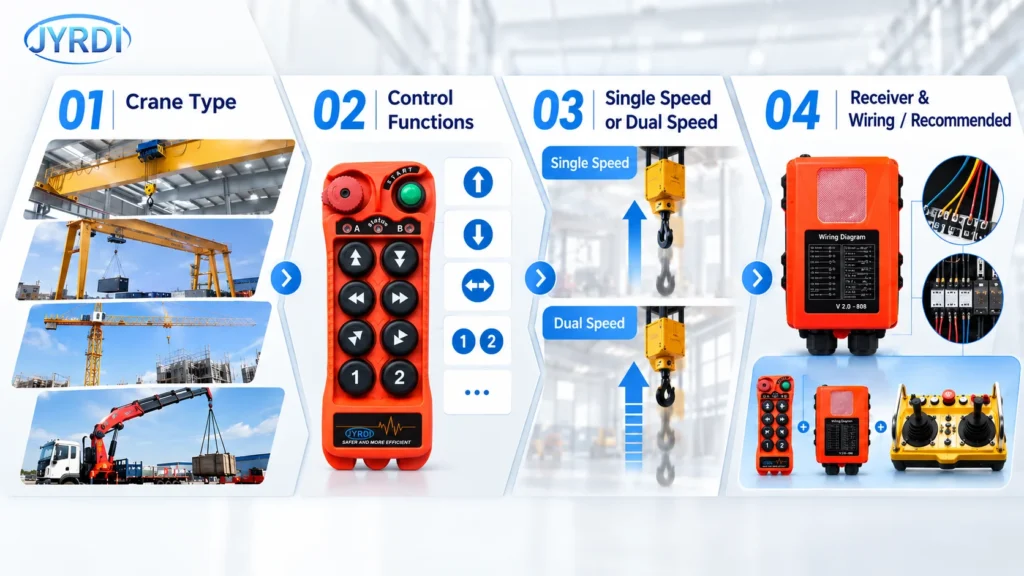
The fastest way to select a suitable crane remote control is to start with the machine rather than the model number.
1. Identify the Crane Type
First confirm whether the remote will be used for an overhead crane, electric hoist, gantry crane, tower crane, truck-mounted crane or hydraulic machine.
This helps define the likely control functions and transmitter type.
2. Confirm the Required Functions
List the actual movements and auxiliary functions that must be controlled.
For example, a standard travelling crane may require:
Up / Down
East / West
North / South
Start / Stop
A different crane may require only lifting functions or additional auxiliary outputs.
The transmitter and receiver should provide the functions actually required by the machine — not simply the maximum available number of buttons.
3. Confirm Single-Speed or Dual-Speed Operation
A single-speed crane normally requires one command stage for each movement.
A dual-speed crane requires two-stage control logic, commonly used for low/high-speed operation.
A dual-speed transmitter cannot create dual-speed movement by itself. The receiver outputs and crane control system must already support the appropriate speed logic.
4. Check the Receiver and Control Circuit
Before ordering, confirm:
Receiver/control voltage → required outputs → speed logic → wiring/control method
The crane may use contactors, relays, PLC inputs, an inverter or a customized control circuit.
This is why sending an existing wiring diagram is often more useful than sending only a photograph of the transmitter.
Need a deeper selection process?
Read our complete crane remote control selection guide.
CTA: Get a Model Recommendation
Send us your crane type, required functions, control voltage and wiring diagram.
JIAYI Crane Remote Control Series
JIAYI provides several industrial remote control platforms for different levels of crane and machinery control.
The best series depends on the required functions, speed logic, operating environment and receiver configuration.
Q Series Crane Remote Controls
The Q Series is JIAYI’s newer push-button platform for overhead cranes, electric hoists and industrial machinery.
Available configurations cover 2–12 buttons, with single-speed and dual-speed options for different lifting requirements.
Depending on the model/configuration, the Q Series can support:
433 MHz wireless control
Up to 250 m nominal operating distance
DC12–65V / AC28–465V receiver voltage options
LLCC68 wireless platform
Custom button functions
Transmitter and receiver matching
The Q Series is particularly suitable when buyers need a modern push-button platform with flexible control configurations rather than a one-model-fits-all solution.
CTA: Explore Q Series
F Series Crane Remote Controls
The F Series is a familiar push-button platform for conventional cranes, electric hoists and industrial lifting equipment.
Models such as F21, F23 and F24 provide different numbers of control functions for common crane applications.
The F Series can be considered when the application requires a conventional industrial radio remote control with straightforward directional control.
CTA: Explore F Series
KT Series
KT Series products are designed for industrial applications where radio performance and configurable control are important.
Depending on the model, KT solutions can use TI wireless chip platforms for industrial radio communication.
Selection should still be based on the required functions, receiver and operating environment.
CTA: Explore KT Series
Joystick Crane Remote Controls
Joystick systems are better suited to equipment requiring more complex motion control than a conventional push-button transmitter.
Typical applications can include:
Hydraulic cranes · truck-mounted cranes · tower cranes · multi-axis machinery
Joystick control should not automatically be considered an “upgrade” for every crane. For a conventional overhead crane using simple contactor control, a push-button system is usually easier to install, operate and replace.
CTA: View Joystick Remote Controls
Push-Button vs Joystick Crane Remote Control
For most overhead cranes and electric hoists, a push-button remote is the simpler choice. A joystick remote becomes more useful when the equipment requires multi-axis operation, hydraulic control or more complex movement commands.
| Requirement | Push-Button | Joystick |
|---|---|---|
| Standard overhead crane | Recommended | Optional |
| Electric hoist | Recommended | Usually unnecessary |
| Basic directional movement | Very suitable | Suitable |
| Multi-axis operation | Limited | More suitable |
| Hydraulic control | Application-dependent | More suitable |
| Simple replacement | Usually easier | More system-specific |
| Complex custom functions | Moderate | More flexible |
The correct choice should be based on machine control requirements, not on which transmitter looks more advanced.
Single-Speed vs Dual-Speed Crane Remote Control
Single-speed and dual-speed transmitters should match the actual crane control logic.
| Item | Single Speed | Dual Speed |
|---|---|---|
| Command stages | One | Two |
| Typical operation | On / Off | Low / High |
| Common use | Standard hoists and cranes | Two-speed cranes |
| Button action | Single stage | Two stage |
| Receiver requirement | Standard output | Dual-speed output logic |
Important: A dual-speed transmitter does not convert a single-speed crane into a two-speed crane.
The motor drive, contactors, PLC or inverter must already support the appropriate speed-control method.
How Does a Crane Remote Control System Work?
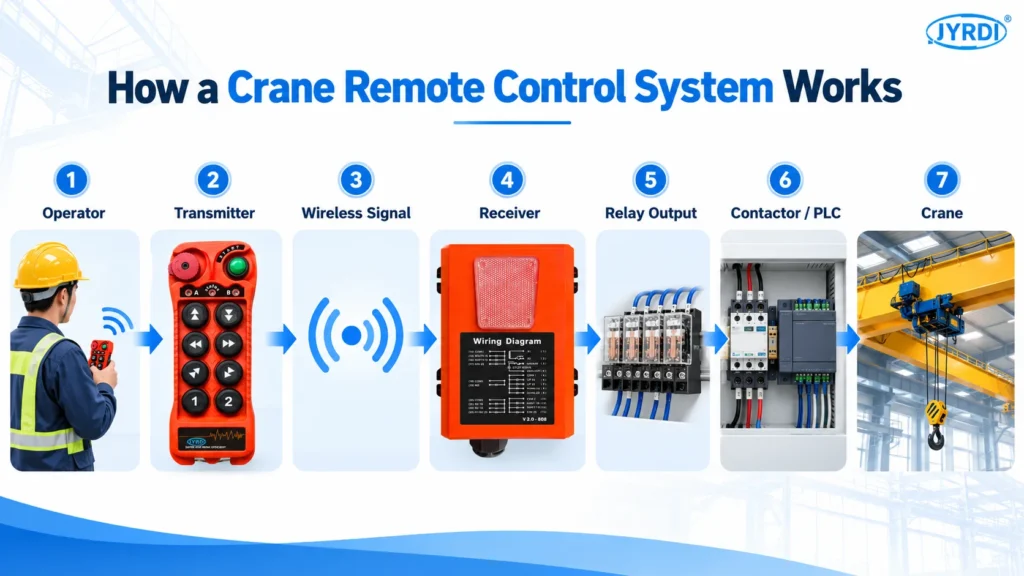
A complete crane radio remote control system normally includes several parts working together:
Operator → Transmitter → Wireless Signal → Receiver → Output → Crane Control Circuit
Transmitter
The operator uses the transmitter to issue commands such as lifting, lowering or travelling.
Depending on the machine, the transmitter may use push buttons or joysticks.
Wireless Communication
The transmitter sends radio commands to its matched receiver.
Actual communication performance depends on the wireless platform, installation environment, obstacles, antenna position and industrial interference.
Receiver
The receiver interprets the transmitter command and activates the corresponding electrical outputs.
The receiver therefore plays an important role in compatibility.
Crane Control Circuit
The receiver does not directly determine how the entire crane operates.
Its outputs interact with the crane’s existing:
Contactors · relays · PLC · inverter · hydraulic control system
For a detailed technical explanation, read our crane remote control system guide.
Receiver Matching Matters
A transmitter that looks suitable is not necessarily electrically compatible with a crane.
Before installation or replacement, four areas should be checked.
Receiver Voltage
Confirm the voltage supplied to the receiver.
Do not assume that the crane’s main incoming power voltage is the same as the control voltage.
Required Outputs
The receiver must provide enough outputs for the required movements and functions.
Speed Logic
Single-speed and dual-speed applications require different command/output logic.
Existing Wiring
Check whether the crane control circuit uses contactors, a PLC, an inverter or another control method.
If you are uncertain, send the existing receiver information and wiring diagram instead of trying to select only from the transmitter appearance.
CTA: Send Us Your Wiring Diagram
For factories with steel structures, motors, inverters or multiple wireless devices, you may also want to read our wireless crane remote control range, signal stability and anti-interference guide.
Where Are Wireless Crane Remote Controls Used?
Wireless control is useful wherever the operator benefits from moving away from a fixed pendant station and selecting a better position to observe the equipment and load.
Typical applications include manufacturing workshops, steel and metal processing, warehouses, logistics facilities, gantry crane areas, construction equipment and selected mobile or hydraulic lifting systems.
Wireless control is not automatically the best solution for every machine, however. The operating environment, required functions and existing control system should still be evaluated before retrofit.
If you are deciding between a conventional pendant and wireless operation, see our wired vs wireless crane remote control comparison.
Why Buyers Work With JIAYI
A B2B crane remote control supplier should provide more than a transmitter catalogue.
For JIAYI, the practical focus is on helping customers match the control system to the machine.
Industrial Remote Control Experience
JIAYI focuses on industrial wireless remote controls for cranes, hoists and machinery applications.
Our range covers conventional push-button controls as well as joystick solutions for more complex equipment.
Flexible Configurations
Different projects can require different combinations of:
button count · speed mode · receiver voltage · outputs · functions · control logic
Instead of assuming one model fits every crane, configuration should be selected according to the actual application.
Wiring & Matching Support
For replacement or retrofit projects, customers can provide:
existing model information, receiver information, control voltage and wiring diagrams.
This helps reduce the risk of choosing an incompatible system.
OEM & Customization
Depending on the product and project, customization can include button functions, labels, symbols, logo and control configuration.
Product Testing
Remote control sets are checked according to the ordered configuration before shipment.
For customized projects, testing should reflect the required control functions wherever applicable.
For more testing tutorials,check out our youtube channel.
Replacing an Existing Crane Remote Control
When an existing remote control fails, first determine whether you need:
only a new transmitter
or
a complete transmitter-and-receiver system
A replacement transmitter should not be assumed to work with an existing receiver simply because the button layout looks similar.
Check:
receiver compatibility · model/SN information · channel/frequency configuration · control functions
Where compatible matching cannot be confirmed, replacing the complete transmitter and receiver system is often the simpler approach.
Read: Can You Replace Only a Crane Remote Control Transmitter?
Replacing Another Remote Control Brand?
For some existing proprietary radio control systems, JIAYI may be considered as a complete-system alternative rather than a transmitter-only substitute.
See one example in our ARC FLEX remote control alternative guide.
Retrofitting Wireless Control to an Existing Crane
An existing wired crane can often be converted to wireless control when the receiver outputs can be properly integrated with the existing crane control circuit.
Before retrofit, confirm:
existing pendant functions → control voltage → speed logic → wiring → contactor / PLC / inverter control
The goal is not simply to remove the pendant and connect a receiver. The wireless system must reproduce the correct control logic.
For electric hoists, see: Can You Add a Wireless Remote to an Electric Hoist?
Common Crane Remote Control Selection Mistakes
Several selection errors appear repeatedly in replacement and retrofit projects.
Choosing only by button count
Two six-button remotes are not automatically interchangeable.
Choosing receiver voltage from the crane’s main power supply
The actual control voltage may be different.
Ignoring single- or dual-speed logic
A transmitter and receiver need to match the speed-control method.
Assuming any transmitter can pair with any receiver
Wireless protocol and matching requirements differ between systems.
Choosing joystick control for a simple crane
More complex control is not always better.
Changing wiring before understanding the original control circuit
Replacement should begin with understanding the machine, not cutting wires.
What Affects Crane Remote Control Price?
There is no single price that applies to every industrial crane remote control.
The final cost depends on the configuration required for the application.
Key factors include:
Number of control functions — Different functions may require a different transmitter and receiver.
Single or dual speed — Dual-speed control requires different button and receiver logic.
Push-button or joystick — Joystick systems normally involve more complex control.
Receiver voltage and outputs — Receiver requirements vary between machines.
Customization — Special button functions, labels, logos and control logic may affect the configuration.
Order quantity — Replacement quantities and distributor/OEM orders can have different pricing structures.
For an accurate quotation, send:
crane type + functions + control voltage + quantity
CTA: Request a Configuration-Based Quote
What Information Should You Send Before Ordering?
For faster model selection, prepare the following information:
| Information | Why It Matters |
|---|---|
| Crane / hoist type | Defines the application |
| Required movements | Determines functions |
| Number of functions | Helps select transmitter/receiver |
| Single or dual speed | Determines control logic |
| Receiver/control voltage | Determines receiver configuration |
| Existing wiring diagram | Helps verify connection method |
| Existing remote model | Useful for replacement |
| Special functions | Determines customization |
| Quantity | Required for quotation |
Quick Recommendation
Standard overhead crane
Start with a push-button system and verify the movements, speed mode and receiver voltage.
Electric hoist
A compact push-button configuration may be sufficient when only basic lifting functions are required.
Hydraulic or multi-axis equipment
Evaluate whether joystick control or customized outputs are more suitable.
Replacement project
Verify transmitter/receiver compatibility before deciding whether one component or the complete set should be replaced.
Real Products. Real Testing. Real Applications.
Our official YouTube page offers you factory product testing, product details, application feedback, and shipping record video references.
Crane Remote Control Guides
Instead of repeating every technical question on this commercial page, use the following guides when you need more detail:
How to Choose a Crane Remote Control for Industrial Lifting Equipment
A detailed selection process covering functions, speed, voltage, wiring and applications.
Crane Remote Control System: Transmitter, Receiver, Wiring and Outputs Explained
Understand how the complete system interfaces with the crane control circuit.
Overhead Crane Remote Control Selection, Safety and Receiver Matching Guide
Focused guidance for bridge and overhead crane applications.
Wireless Crane Remote Control Range, Signal Stability and Anti-Interference Guide
For environments with steel structures, motors, inverters and multiple wireless systems.
Wired vs Wireless Crane Remote Control
Compare pendant and wireless operation before retrofit.
Can You Replace Only a Crane Remote Control Transmitter?
Understand when transmitter-only replacement may or may not be practical.
Frequently Asked Questions
What is a crane remote control?
A crane remote control is a wireless system that allows an operator to send movement commands from a handheld transmitter to a receiver installed on the crane. The receiver then interfaces with the crane’s control circuit to operate functions such as lifting, lowering and travelling.
How do I choose a wireless crane remote control?
Start with the crane type, required functions, single- or dual-speed operation, receiver/control voltage and existing control circuit. For standard overhead cranes and hoists, push-button control is usually the first option. More complex hydraulic or multi-axis equipment may require joystick or customized control.
Can wireless control be added to an existing crane?
Often yes, provided the existing control circuit can accept the required receiver outputs. The pendant logic, control voltage, speed mode and wiring should be checked before retrofit.
Can I replace only the crane remote transmitter?
Sometimes. The replacement transmitter must be compatible with the existing receiver and correctly matched. If compatibility cannot be confirmed, replacing the complete transmitter-and-receiver system is normally easier.
What is the difference between single-speed and dual-speed crane controls?
A single-speed system provides one command stage for a movement. A dual-speed system provides two command stages, commonly low and high speed. The crane control system itself must support dual-speed operation.
What receiver voltage should I choose?
Choose according to the actual control voltage supplied to the receiver. Do not assume it is the same as the crane’s main power supply. Check the existing receiver or wiring diagram.
Is push-button or joystick control better?
Neither is universally better. Push-button remotes are normally more practical for conventional overhead cranes and electric hoists. Joystick controls are more appropriate for certain multi-axis, hydraulic or complex motion-control applications.
How much does a crane remote control system cost?
Pricing depends on the required configuration, including the number of functions, single- or dual-speed logic, receiver voltage, transmitter type, customization and order quantity. Providing the crane specifications allows a more accurate quotation.
Final CTA
Need the Right Remote Control for Your Crane?
Send us your:
Crane type · required functions · single/dual speed · receiver voltage · wiring diagram · quantity
We can use this information to help narrow down a suitable JIAYI remote control configuration.
CTA: Get a Model Recommendation
For distributor and OEM enquiries, include the required models, functions and quantity so we can evaluate the configuration and quotation more efficiently.