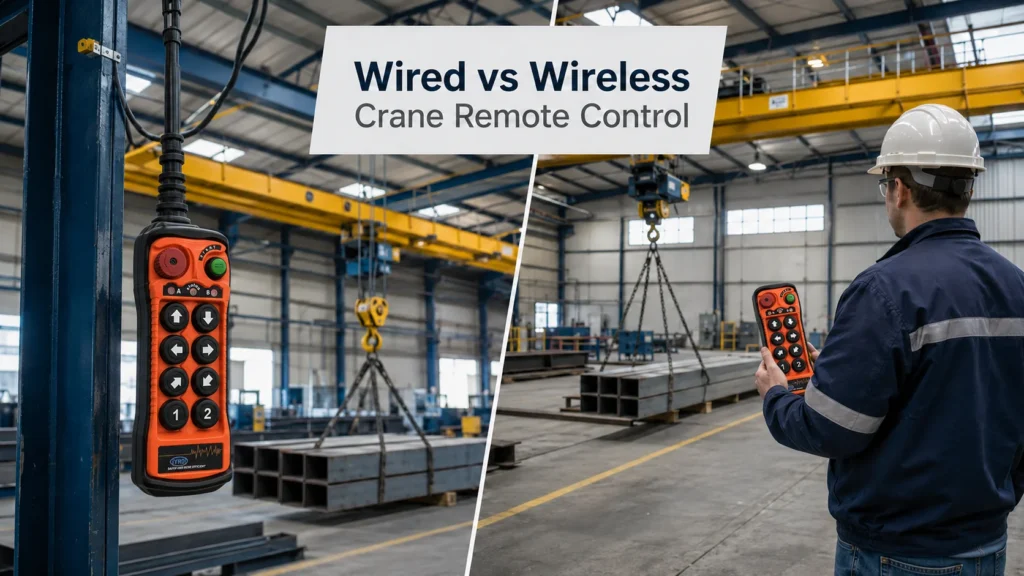
Short Answer
For many overhead, bridge and gantry crane applications, a wireless crane remote control provides better operator mobility and load visibility. However, a wired pendant may remain the more practical choice for small, fixed work areas with simple control functions.
Neither method is automatically safer or more reliable in every application. Wired controls avoid batteries and radio communication but rely on a pendant cable that can wear, twist or become damaged. Wireless controls remove the operating cable but require correct receiver wiring, battery management and suitable radio installation.
The right choice depends on the crane layout, required movements, control voltage, operator position, working environment and maintenance conditions—not simply on whether the control uses a cable or a radio signal.
Author Module
Prepared by: JIAYI Industrial Remote Control Team
Technical Review: Industrial Remote Control Application Team
Last Updated: July 2026
This article provides general guidance for comparing wired pendant and wireless crane controls. Final system selection and installation should be confirmed according to the crane circuit, equipment manufacturer’s requirements and applicable local safety requirements.
Key Takeaways
- Choose a wired pendant for simple crane movements in a small, fixed work area.
- Choose wireless control when operator mobility and load visibility are important.
- A wireless receiver must still be wired correctly into the crane control system.
- Receiver voltage and output logic are more important than transmitter appearance.
- Wireless control removes pendant-cable problems but introduces batteries and radio communication.
- Loss of a valid control signal should remove motion commands rather than hold the last command.
- Wired and wireless controls can sometimes coexist, but proper source selection and interlocking are required.
How Wired and Wireless Crane Controls Work
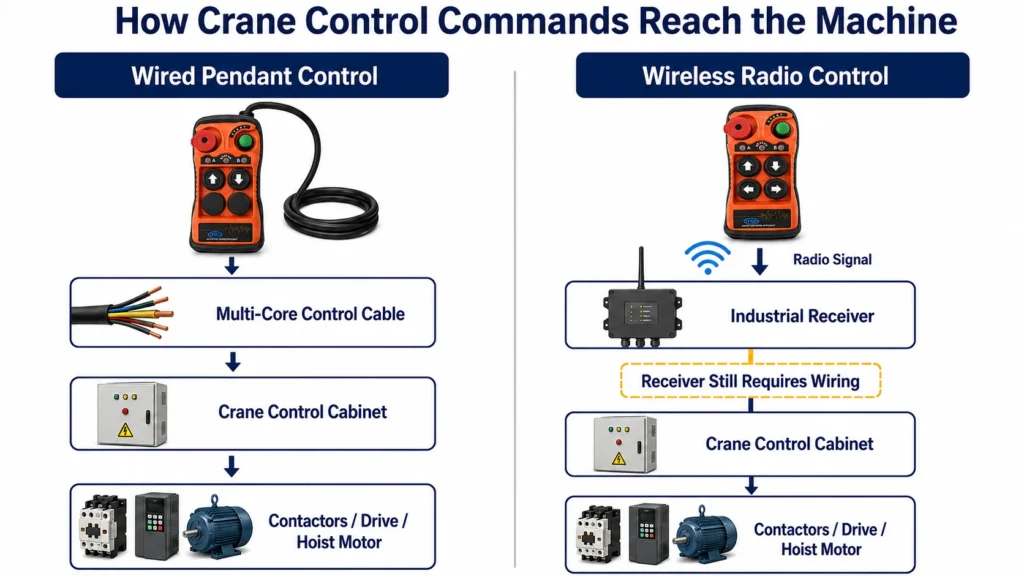
Both control methods ultimately send commands to the crane’s electrical control system. The main difference is how the operator’s command reaches the control cabinet.
Wired Pendant Control
A wired pendant is physically connected to the crane through a multi-core control cable.
When the operator presses a button, the corresponding electrical circuit is activated through the cable. Typical functions include:
- Hoist up and down
- Trolley left and right
- Bridge forward and reverse
- Start
- Stop
- Horn or auxiliary functions
Depending on the crane design, the pendant may hang directly from the crane or travel along a festoon or independent track.
The operator must remain within the physical reach of the cable.
Wireless Crane Remote Control
A wireless crane remote control uses a handheld transmitter and a receiver installed on the crane.
The operating process is:
- The operator presses a button or moves a joystick on the transmitter.
- The transmitter sends a radio command.
- The receiver identifies and processes the command.
- The receiver activates the corresponding relay, PLC input or compatible control circuit.
- The crane performs the requested movement.
The handheld transmitter is wireless, but the receiver still requires electrical connection to the crane control cabinet.
This is why replacing a wired pendant with a wireless system is not simply a matter of choosing the same number of buttons.
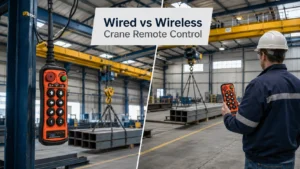
Wired vs Wireless Crane Remote Control Comparison
| Comparison | Wired Pendant Control | Wireless Crane Remote Control |
|---|---|---|
| Operator movement | Limited by cable length and pendant position | Operator can move around the working area |
| View of the load | Depends on pendant location | Operator can select a clearer viewing position |
| Main physical wear point | Pendant cable, strain relief and buttons | Transmitter housing, buttons and battery |
| Radio communication | Not required | Required |
| Handheld power | Normally supplied through the control cable | Battery or rechargeable power supply |
| Receiver installation | May be simple when replacing a compatible pendant | Receiver voltage, outputs and wiring must be matched |
| Common maintenance | Cable, conductors, button contacts and festoon system | Battery, transmitter, receiver, antenna and wiring |
| Initial equipment cost | Usually lower for simple systems | Usually higher |
| Operating flexibility | Suitable for a fixed operating position | Better where the operator needs to change position |
| Typical application | Small hoists and fixed workstations | Overhead, bridge and gantry cranes with larger working areas |
The table provides general guidance. The actual decision should be based on the crane circuit and operating conditions.
Operator Mobility and Load Visibility
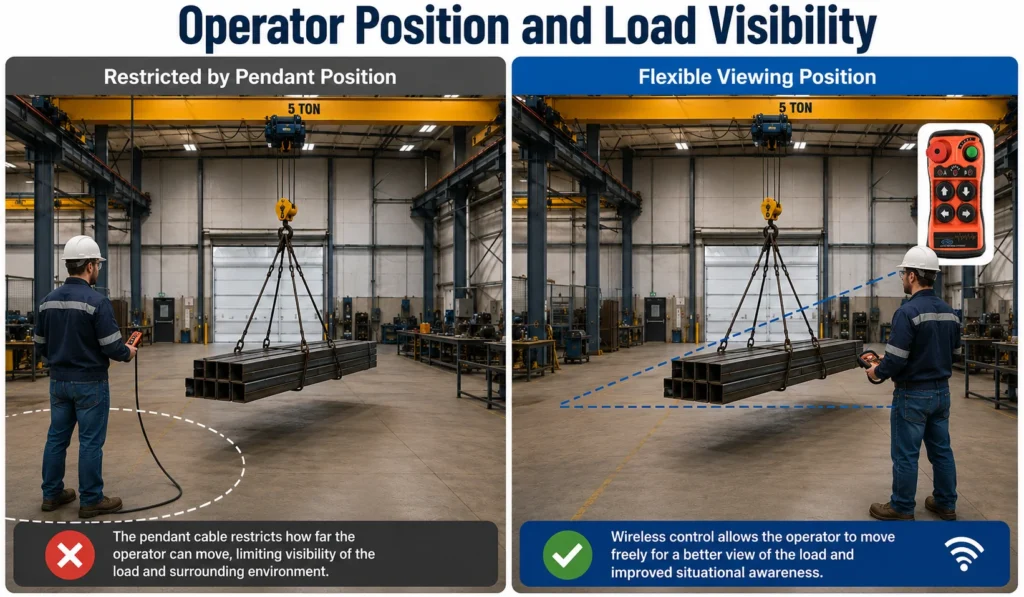
The most practical difference between wired and wireless crane controls is usually the operator’s working position.
Limitations of a Wired Pendant
With a wired pendant, the operator must follow the pendant cable.
This may be acceptable when:
- The load travels over a short and predictable path
- The crane serves one fixed workstation
- The lifting area is open and easy to observe
- The operator can remain in a suitable position throughout the movement
Problems can occur when:
- The load is long or irregular
- Stored materials block the operator’s view
- The crane travels across a large workshop
- The operator must walk near machinery or obstacles
- The pendant cable does not reach the best observation point
The cable can also become caught on equipment, workpieces or storage racks if it is not properly routed.
Advantages of Wireless Control
A radio remote allows the operator to change position while controlling the crane.
This can make it easier to:
- Observe the load from a clearer angle
- Move to the opposite side of a workpiece
- Stay farther from the suspended load
- Avoid walking directly beside the crane runway
- Coordinate with rigging personnel
- Operate large or irregular loads
- Maintain visibility during long crane travel
Wireless control improves freedom of movement, but the operator must still remain in an authorized operating area and maintain a clear view of the crane and load.
Operator mobility should not be confused with automatic system safety. The crane still requires appropriate operating procedures, training and control-system design.
Reliability and Maintenance Differences
Neither wired nor wireless control is free from failure. The more reliable option depends on which failure modes are more likely in the actual workplace.
Common Wired Pendant Problems
Typical wired-control problems include:
- Cable conductor fatigue
- Damaged outer insulation
- Loose strain relief
- Cable twisting
- Cable snagging
- Worn push buttons
- Moisture entering the pendant housing
- Damage to a festoon or pendant travel system
- Intermittent faults caused by broken internal conductors
A wired pendant can remain reliable for many years in a clean, fixed application. However, the cable may become a recurring maintenance item where the crane travels frequently or operates around sharp edges, hot materials or heavy equipment.
Common Wireless Control Problems
Typical wireless-control problems include:
- Low transmitter battery
- Damaged transmitter housing
- Worn buttons or joysticks
- Incorrect transmitter and receiver pairing
- Poor receiver or antenna location
- Loose receiver wiring
- Incorrect receiver voltage
- Radio-environment problems
- Receiver power-supply faults
Wireless control removes the moving pendant cable, but it shifts maintenance attention toward the transmitter, battery, receiver and communication link.
Practical Reliability Conclusion
Wired systems concentrate maintenance on the pendant, cable and physical connections.
Wireless systems concentrate maintenance on the transmitter, battery, receiver, antenna and output wiring.
A wireless system may reduce downtime where pendant cables are frequently damaged. A wired pendant may remain the simpler choice where the operating area is small and the cable is well protected.
Installation and Control-System Matching
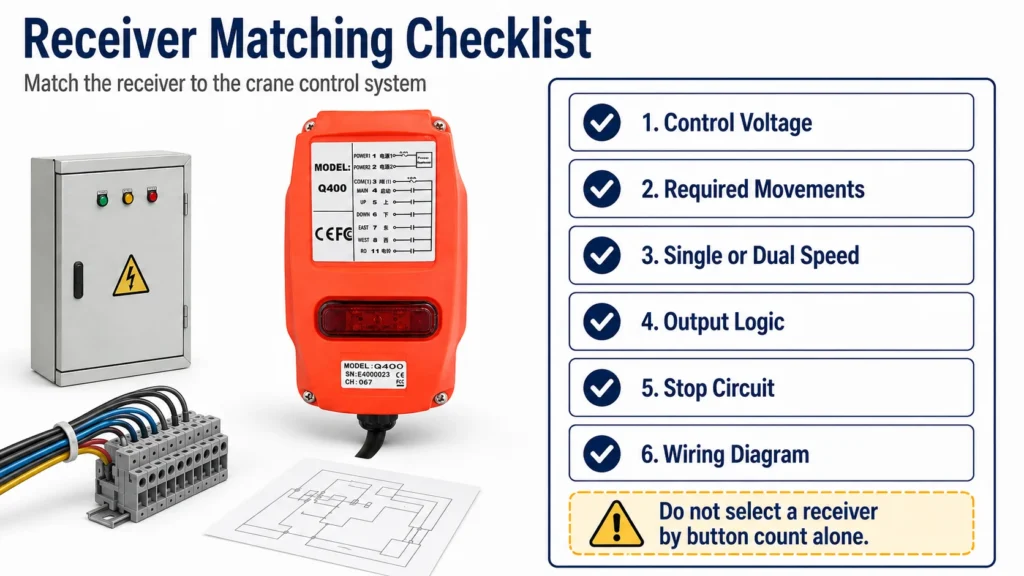
Installation is one of the most important differences between the two control methods.
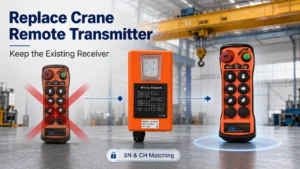
Replacing a Wired Pendant
A compatible wired pendant replacement normally requires confirmation of:
- Control voltage
- Number of cable conductors
- Button contact arrangement
- Single-speed or dual-speed functions
- Stop circuit
- Common conductors
- Electrical interlocking
- Pendant cable length
- Strain-relief requirements
Two pendants with the same number of buttons may still use different internal contact arrangements.
The replacement should therefore be selected according to the wiring diagram, not only according to appearance.
Installing a Wireless Receiver
A wireless receiver must be matched to the crane control circuit.
Before installation, confirm:
- Receiver input voltage
- Required number of outputs
- Relay contact arrangement
- Single-speed or dual-speed control
- Momentary or maintained functions
- Interlocked directions
- Stop-function circuit
- Common terminals
- PLC or contactor interface
- Antenna installation
- Receiver mounting position
The receiver outputs may interface with contactors, PLC inputs, intermediate relays or other compatible machine-control circuits.
Direct connection to hydraulic valves, motors or other electrical loads should only be made when the output type, voltage, current and load characteristics have been confirmed.
Control Voltage Is Not Always the Main Power Voltage
One common replacement mistake is selecting the receiver according to the crane’s main power supply.
For example, a crane may use a high-voltage main power circuit while the control circuit operates at a different voltage.
The correct receiver voltage must be confirmed from:
- The control transformer
- Existing pendant circuit
- Electrical drawing
- Contactor-coil voltage
- Existing receiver label
For a detailed explanation, read:
Crane Remote Control System: Transmitter, Receiver, Wiring and Outputs Explained
Safety and Signal-Loss Behavior
Safety should be evaluated at two separate levels:
- The operator’s working position
- The complete crane control system
Operational Position
Wireless control may allow the operator to:
- Stay farther from the load
- Choose a clearer viewing angle
- Avoid obstacles near the pendant route
- Move with the load without being restricted by a cable
These advantages can improve operating conditions, but they do not replace safe lifting procedures.
The operator should still:
- Maintain a clear view of the crane and load
- Stay outside the suspended-load path
- Prevent unauthorized transmitter use
- Follow the crane’s operating procedures
- Stop operation when visibility is lost
Stop Function
A radio transmitter may include a red stop button or safety-related stop function.
However, the presence of this button alone does not prove that the complete crane system meets a particular safety category or certification.
The actual stopping performance depends on:
- The transmitter and receiver design
- Stop-relay architecture
- Crane contactor circuit
- Electrical interlocking
- Drive or PLC logic
- Installation method
- System validation
The selected remote control and complete crane circuit should therefore be reviewed together.
What Should Happen If the Radio Signal Is Lost?
In a properly designed system, loss of a valid radio command should remove crane motion commands rather than maintain the last operating command.
The exact response depends on the receiver and crane circuit.
Signal-loss behavior should be checked during installation and commissioning by confirming:
- Movement stops when communication is interrupted
- No unintended command remains active
- Communication can be safely restored
- The receiver returns to the required operating state
- The stop function remains effective
This behavior should be verified on the actual crane, not assumed from transmitter specifications alone.
Signal Stability in Industrial Environments
Industrial radio controls operate around metal structures, motors, variable-frequency drives and other wireless systems.
Signal performance can be affected by:
- Steel building structures
- Large machinery
- Electrical noise
- Frequency converters
- Multiple nearby remote controls
- Metal control cabinets
- Poor antenna placement
- Walls and stored materials
- Outdoor distance
- Moving obstacles
Range Is Only One Part of Performance
Maximum advertised distance does not automatically mean that a system will provide better performance inside a factory.
A long-range remote may still perform poorly if:
- The receiver is installed in a heavily shielded metal cabinet
- The antenna is positioned incorrectly
- The radio environment is crowded
- The receiver power supply is unstable
- The system is not suitable for multiple remotes operating nearby
The more useful question is:
Can the remote maintain stable and predictable control throughout the actual crane working area?
Signal selection should consider:
- Required working distance
- Number of nearby cranes
- Metal obstructions
- Receiver mounting position
- Antenna arrangement
- Indoor or outdoor use
- Radio-channel planning
For more detail, see:
Wireless Crane Remote Control Range, Signal Stability and Anti-Interference Guide
Cost Comparison
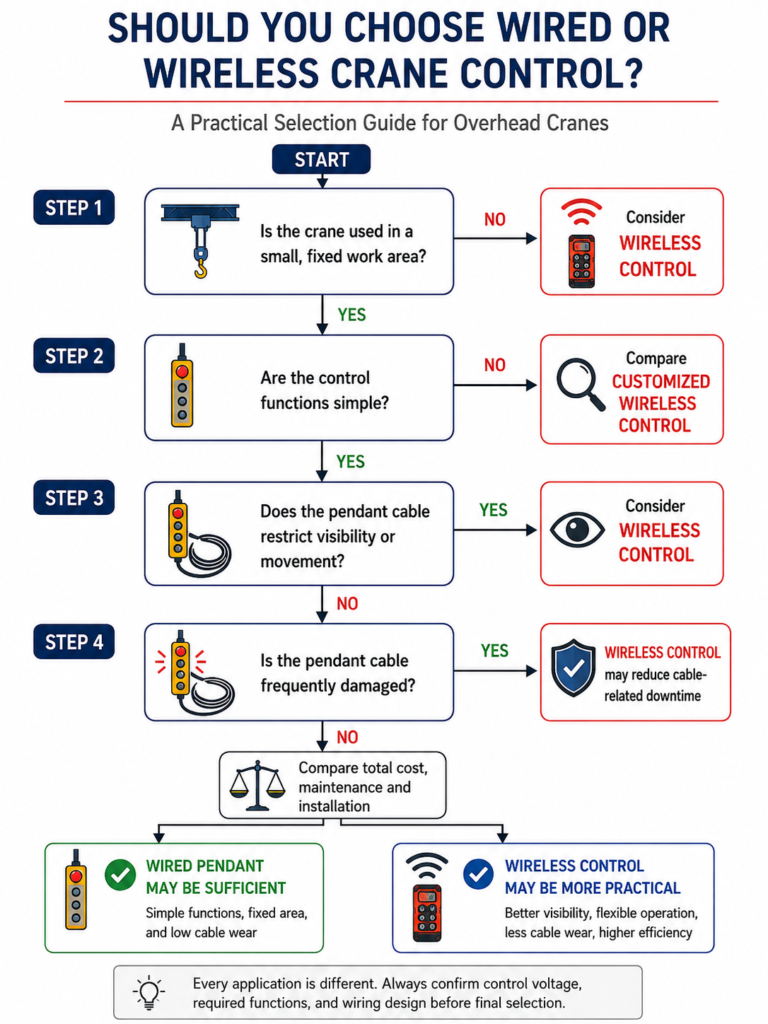
A wired pendant usually has a lower initial equipment cost for a simple crane.
A wireless system normally includes a transmitter, receiver, configuration and installation work, so the initial cost may be higher.
However, purchase price is only one part of the decision.
| Cost Factor | Wired Pendant | Wireless Remote |
|---|---|---|
| Initial equipment cost | Usually lower | Usually higher |
| Installation | Simple when replacing a compatible pendant | Requires receiver matching and wiring |
| Common maintenance | Cable, strain relief and buttons | Battery, transmitter and receiver |
| Downtime risk | Cable damage or conductor failure | Battery, transmitter or receiver fault |
| Operator flexibility | Limited | Higher |
| Best economic use | Small, fixed and simple operation | Large area, frequent cable damage or poor visibility |
Compare total ownership cost rather than purchase price alone.
Wireless control may justify its higher initial cost where pendant cable damage, restricted movement or poor load visibility repeatedly affects production.
When Should You Choose a Wired Pendant?
A wired pendant is often the practical choice when:
- The crane works in a small fixed area
- The operator remains near one workstation
- The required movements are simple
- The load path is short and clearly visible
- The existing pendant system is in good condition
- The pendant cable is well protected
- Radio communication provides little operational benefit
- Initial equipment cost is the main consideration
Typical Applications
- Small electric hoists
- Light-duty workshop cranes
- Fixed workstation cranes
- Simple lifting equipment
- Low-frequency operations
- Machines with only a few basic functions
A wired pendant should not be replaced merely because wireless control appears more modern.
When the wired system already provides good visibility, reliable operation and suitable operator access, replacement may provide limited practical value.
When Should You Choose a Wireless Crane Remote Control?
Wireless control is usually more suitable when:
- The crane travels across a large area
- The operator needs to move around the load
- The pendant position restricts visibility
- The pendant cable is frequently damaged
- The load is long, irregular or difficult to observe
- The operator needs to change sides during movement
- The equipment requires several control functions
- Outdoor gantry-crane operation is involved
- A customized transmitter layout is required
- Removing the operating cable can simplify movement around the machine
Typical Applications
- Overhead cranes
- Bridge cranes
- Gantry cranes
- Larger electric hoists
- Jib cranes with changing operator positions
- Material-handling systems
- Hydraulic and customized industrial machinery
Wireless control is not automatically the correct solution for every crane. The receiver voltage, outputs, stop function and communication environment must still be matched to the equipment.
Application-Based Recommendation
| Application | Wired Pendant | Wireless Control | General Recommendation |
|---|---|---|---|
| Small fixed electric hoist | Suitable | Suitable | Wired may be sufficient |
| Fixed workstation crane | Suitable | May provide limited additional value | Usually based on operator position |
| Workshop overhead crane | Suitable | Often practical | Evaluate travel area and visibility |
| Large bridge crane | Operator movement may be restricted | Strong mobility advantage | Wireless is often more practical |
| Outdoor gantry crane | Pendant cable may be inconvenient | Better operator flexibility | Wireless is often preferred |
| Jib crane | Suitable for fixed local operation | Useful where the operator changes position | Depends on working radius |
| High-interference factory | No radio-link concern | Requires suitable radio planning | Evaluate the actual environment |
| Frequent pendant-cable damage | Higher maintenance risk | Removes the operating cable | Wireless may reduce downtime |
These recommendations are general. Final selection should be based on the crane manufacturer’s instructions, electrical design and local operating requirements.
Can Wired and Wireless Controls Be Used on the Same Crane?
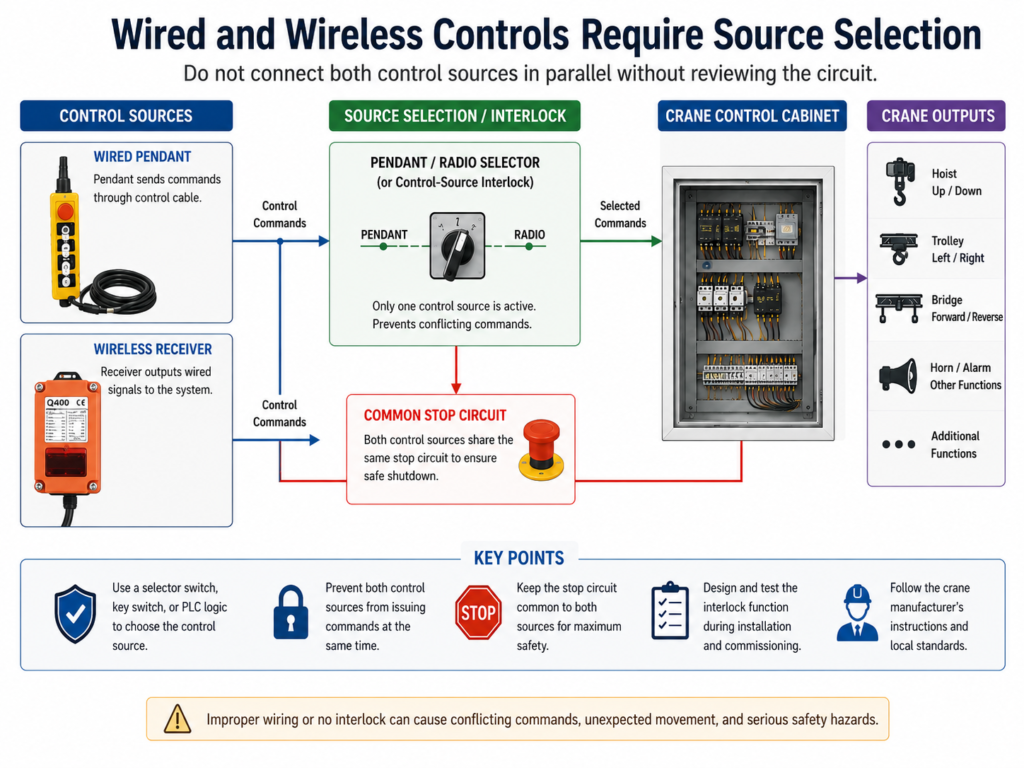
Some cranes can retain both a wired pendant and a wireless remote.
This may provide:
- A backup operating method
- Easier maintenance and testing
- Different control methods for different tasks
- Continued use of an existing pendant
However, the two control systems should not simply be connected in parallel without reviewing the control circuit.
The crane may require:
- Pendant/radio selector switch
- Control-source interlocking
- Key authorization
- PLC source selection
- Defined command priority
- Coordinated stop circuit
The design should prevent both control sources from issuing conflicting commands.
Whether both controls can be retained depends on the crane’s electrical design and should be confirmed before installation.
Common Selection Mistakes
1. Choosing by Button Quantity Alone
A six-button pendant and a six-button radio transmitter may not provide the same functions.
Some buttons may be:
- Single-speed
- Dual-speed
- Maintained
- Momentary
- Interlocked
- Assigned to auxiliary functions
Confirm the output logic, not just the number of buttons.
2. Ignoring the Receiver Voltage
The receiver voltage must match the crane control circuit.
Do not assume that it is the same as the crane’s main power voltage.
3. Choosing Wireless Control Only by Maximum Range
Long distance is not useful if the radio signal is unstable in the actual workshop.
Receiver position, antenna installation and nearby radio systems also matter.
4. Assuming Wireless Means No Wiring
The transmitter is wireless, but the receiver still requires correct power and output wiring.
5. Treating the Stop Button as a Complete Safety System
A stop button is only one part of the complete crane safety circuit.
Its function must be coordinated with the receiver, contactors, drive and machine control logic.
6. Copying Old Wiring Without Verification
Existing wiring may have been modified or may not match the original diagram.
Check terminal labels, voltage and actual control logic before installation.
7. Ignoring Signal-Loss Behavior
The crane should not continue the last movement command when valid communication is lost.
This behavior must be tested during commissioning.
8. Connecting Wired and Wireless Controls Without Interlocking
Two uncontrolled command sources may create conflicting movements.
A selector or interlocking method may be required.
How to Select the Right Crane Control System
Before choosing wired or wireless control, confirm the following information.
1. Crane Type
- Electric hoist
- Overhead crane
- Bridge crane
- Gantry crane
- Jib crane
- Customized industrial equipment
2. Required Movements
Examples include:
- Hoist up and down
- Trolley left and right
- Bridge forward and reverse
- Horn
- Lighting
- Magnet control
- Grab control
- Auxiliary equipment
3. Speed Requirement
Confirm whether the crane uses:
- Single-speed control
- Dual-speed control
- Stepped-speed control
- Variable-frequency-drive commands
- Proportional control
4. Control Voltage
Provide the actual control-circuit voltage or existing receiver information.
5. Output Logic
Confirm whether each function requires:
- Momentary output
- Maintained output
- Interlocked output
- Relay contact
- PLC input
- Special sequence control
6. Working Environment
Consider:
- Indoor or outdoor use
- Dust and moisture
- Temperature
- Metal obstructions
- Required distance
- Number of nearby radio systems
- Receiver mounting location
7. Existing Information
For a replacement or retrofit, provide:
- Wiring diagram
- Pendant photo
- Control-cabinet photo
- Existing receiver label
- Terminal information
- Crane function list
For more details, read:
How to Choose a Crane Remote Control for Industrial Lifting Equipment
Considering an Upgrade to Wireless Control?
JIAYI provides push-button and joystick radio remote controls for electric hoists, overhead cranes, bridge cranes, gantry cranes and customized industrial machinery.
Depending on the selected model, available configurations may include:
- Single-speed or dual-speed control
- Two to twelve function buttons
- Push-button or joystick transmitter
- Custom function logic
- Receiver voltage matching
- Momentary, maintained or interlocked outputs
- Transmitter and receiver pairing
- Custom button labels
- OEM and private-label support
Available functions depend on the selected product and crane control system.
To recommend a suitable configuration, JIAYI needs:
- Crane type
- Required movements
- Control voltage
- Speed requirement
- Existing wiring information
- Operating distance
- Quantity
Explore available systems:
Industrial Remote Control Products
For machinery requiring more complex directional control:
Industrial Joystick Remote Control
Final Recommendation
Choose a wired pendant when the crane performs simple movements in a small, fixed and easily observed work area.
Choose a wireless crane remote control when the operator needs:
- Better freedom of movement
- A clearer view of the load
- Greater distance from operating hazards
- Less dependence on a moving pendant cable
- A more flexible control layout
The final decision should not be based only on purchase price, button quantity or advertised range.
The correct system must match:
Crane application + operator position + control voltage + output logic + stop function + working environment + maintenance requirements.
A well-matched wired pendant can be reliable and economical.
A well-designed wireless system can improve mobility and reduce pendant-cable problems.
The better choice is the one that fits the actual crane and operating conditions.
Need Help Choosing Between Wired and Wireless Control?
Send JIAYI the following information:
- Crane or equipment type
- Required movements
- Control voltage
- Single-speed or dual-speed requirement
- Existing wiring diagram
- Pendant or control-cabinet photos
- Required operating distance
- Quantity
Our team can review the information and recommend a suitable transmitter and receiver configuration.
Email: sales@jiayiremotecontrol.com
WhatsApp: +86 15705596884
CTA Button
Get a Crane Control Recommendation
Frequently Asked Questions
Can a wireless remote replace an existing wired pendant?
In many cases, yes. However, the receiver voltage, output quantity, speed logic, stop circuit and wiring arrangement must be confirmed before replacement. The wireless system should not be selected only by comparing the number of buttons.
Does a wireless crane remote control still need wiring?
Yes. The handheld transmitter communicates wirelessly, but the receiver must still be connected to the crane control circuit. Receiver power, common terminals, outputs and stop functions must be wired correctly.
What should happen if the radio signal is lost?
Loss of a valid radio command should remove crane motion commands rather than maintain the last command. The exact response depends on the receiver and crane control circuit and should be verified during commissioning.
Is wireless control safer than a wired pendant?
Wireless control can allow the operator to choose a clearer viewing position and remain farther from the load. However, overall safety also depends on the stop function, output interlocking, crane circuit, operator training and installation quality.
Can a crane retain both wired and wireless controls?
Some cranes can retain both systems, but a selector switch, source interlocking or control-priority logic may be required. The two control sources should not simply be connected in parallel without reviewing the circuit.
What information is needed before replacing a crane control?
Provide the crane type, required movements, control voltage, speed requirements, output logic and any available wiring diagrams, pendant photos or control-cabinet photos.