Short Answer
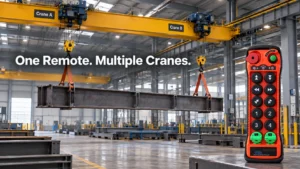
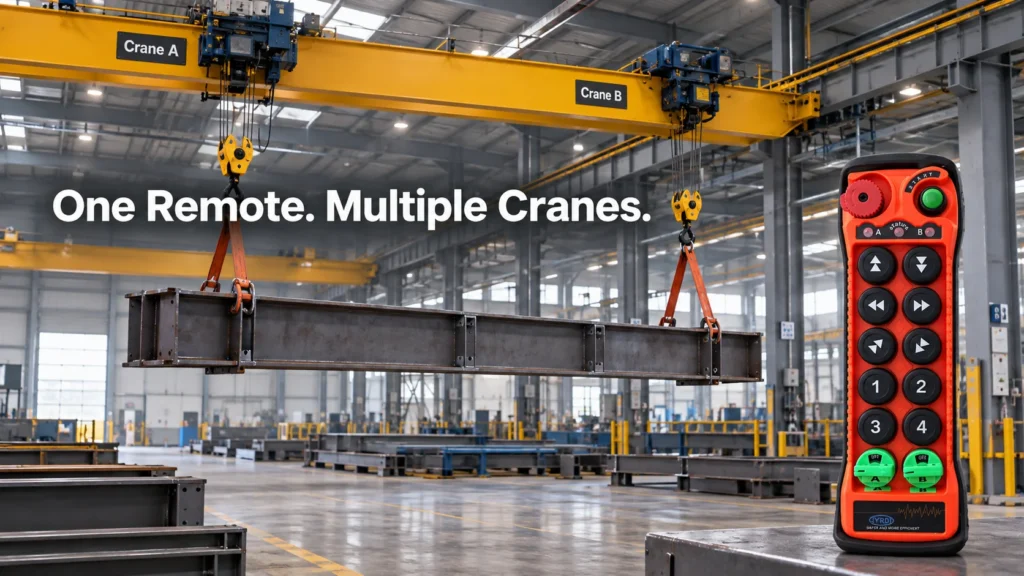
Yes. One industrial radio remote control can be configured to operate two or more overhead cranes, either individually or as a selected group, when the transmitter, receivers and crane control logic are designed for multi-crane operation.
This type of system is commonly used for long steel structures, large components and other loads that require more than one crane.
However, one transmitter sending the same command to multiple cranes does not automatically mean that the cranes are mechanically synchronized to exactly the same speed or position. Motor characteristics, drives, brakes, load distribution, wiring and safety interlocks still need to be evaluated.
For applications requiring precise synchronization, additional PLC, inverter or feedback control may be required.
Key Takeaways
Before going deeper, there are four points worth understanding:
- One transmitter can control multiple crane receivers.
- Cranes can be selected individually or operated as a group.
- Wireless coordinated control is not automatically the same as closed-loop position synchronization.
- Existing cranes can often be upgraded, but voltage, wiring and safety logic must be checked first.
This distinction is particularly important when selecting a tandem crane remote control system.
Why Would Multiple Cranes Need to Work Together?
A normal overhead crane is designed to operate independently.
For example, one operator may control:
- Hoist Up / Down
- Trolley Left / Right
- Bridge Forward / Reverse
- Start / Stop
- Auxiliary functions
But some loads cannot be safely or efficiently handled from a single lifting point.
Common examples include:
- Long steel beams
- Large fabricated frames
- Bridge components
- Heavy industrial molds
- Precast components
- Large machinery structures
- Long production-line assemblies
In these situations, two or more cranes may share the same load.
The challenge is no longer simply:
“Can each crane move?”
The more important question becomes:
“Can the selected cranes receive coordinated commands while still allowing independent operation when needed?”
That is where multi-crane remote control becomes useful.
What Problems Occur When Two Cranes Are Controlled Separately?
Using two separate transmitters and two operators is possible in some lifting operations.
But frequent multi-crane handling introduces additional coordination problems.
1. Different Start and Stop Timing
Even experienced operators cannot consistently press their controls at exactly the same moment.
One crane may start lifting or travelling slightly earlier than the other.
For a long load, that difference may cause:
- Load tilt
- Swing
- Uneven loading
- Position deviation
2. Different Travel or Hoisting Speeds
Even when two cranes receive similar commands, their actual movement may differ.
Possible causes include:
- Different motor characteristics
- Brake response
- Variable-frequency drive settings
- Mechanical resistance
- Wheel condition
- Hoist condition
- Load distribution
This is why multi-crane control cannot be evaluated from the remote transmitter alone.
3. Operator Communication Delay
With separate controls, operators need to coordinate every movement through voice, hand signals or radio communication.
For occasional lifting this may be acceptable.
For workshops where tandem handling is performed regularly, however, one centralized command source can simplify operation.
How Does a Multi-Crane Remote Control System Work?
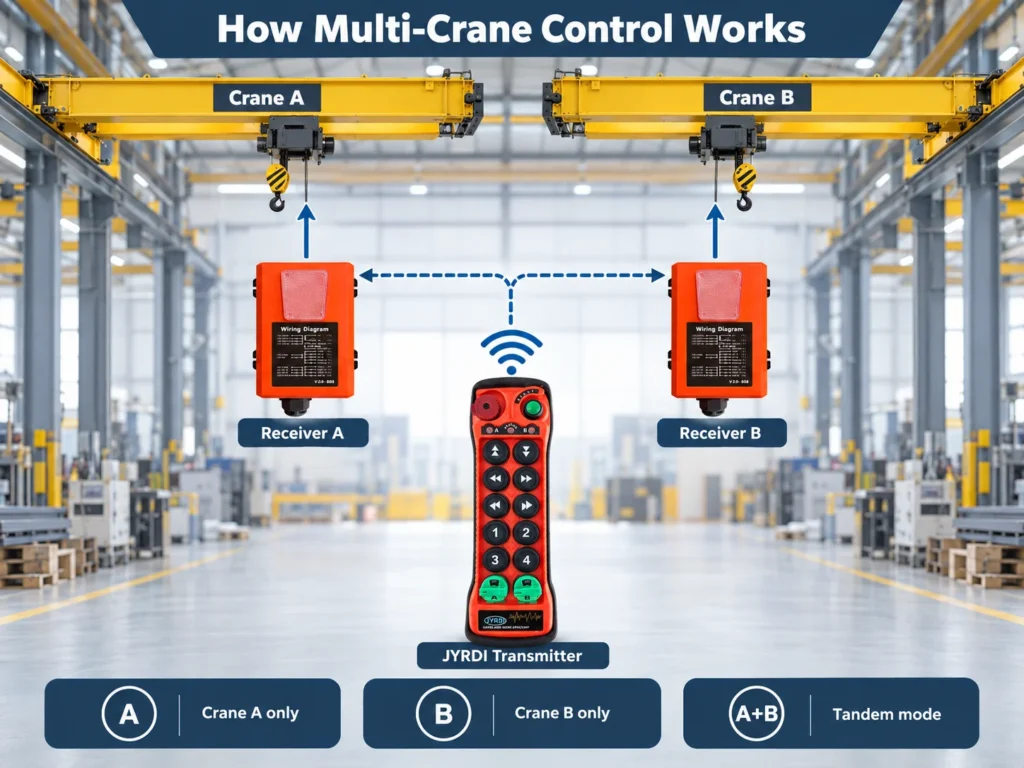
The basic architecture is straightforward:
One Operator
↓
One Wireless Transmitter
↓
Multiple Selected Receivers
↓
Individual Crane Control Circuits
↓
Crane A / Crane B / Additional Cranes
The key is not simply broadcasting to every crane.
A properly configured system should allow the operator to determine which crane or crane group is active.
For example:
| Mode | Active Equipment | Typical Use |
|---|---|---|
| A | Crane A only | Normal independent work |
| B | Crane B only | Normal independent work |
| A + B | Crane A and Crane B | Tandem handling |
| Group 1 | Selected cranes | Multi-crane operation |
| Group 2 | Another selected group | Different production task |
This allows the same cranes to remain useful for normal independent work and only operate together when the job requires it.
What Multi-Crane Configurations Are Available?
According to the current JYRDI multi-crane project information, different Q Series configurations are designed for different system sizes.
Q808 / Q1010 / Q1212 Series
These configurations can support 2–6 cranes in selectable combinations, depending on the project design.
They are mainly suited to:
- Medium-sized workshops
- Multiple overhead crane installations
- Steel fabrication
- Component handling
- Production areas where cranes normally work independently but sometimes need tandem operation
Q2000 Series
For larger systems, the Q2000 configuration can support 2–14 cranes with configurable grouping, according to the project requirements described in the existing technical material.
This makes it more suitable for larger workshops or projects with more complex equipment grouping.
Important
The number of cranes alone does not determine the final solution.
The project also needs to consider:
- Number of functions
- Single or dual speed
- Receiver voltage
- Relay outputs
- Crane grouping
- Existing wiring
- Interlocks
- Safety requirements
Coordinated Control Is Not the Same as Precise Synchronization
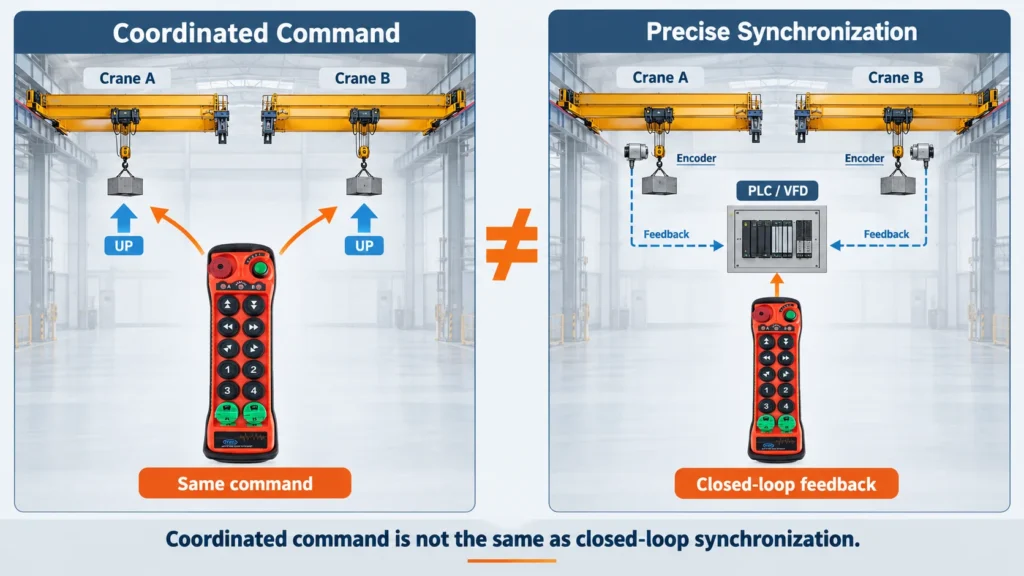
This should be one of the most important sections of the article.
A radio remote control can issue the same operating command to multiple receivers.
For example:
UP → Crane A Up + Crane B Up
or:
FORWARD → Crane A Forward + Crane B Forward
This creates coordinated control.
But it does not automatically guarantee that the hooks will remain at exactly the same height or that two bridges will travel at exactly the same physical speed.
Actual movement may still depend on:
- Motor characteristics
- Inverter settings
- Mechanical wear
- Brake timing
- Wheel slip
- Load imbalance
- Rope length
- Encoder feedback
Therefore:
Multi-crane remote control coordinates the operator commands. Precise motion synchronization, when required, must also be handled by the crane’s drive and control system.
This distinction is important for heavy lifting and automated applications.
When Is a Tandem Remote Control Enough?
A multi-crane radio control can be a practical solution when:
- Operators mainly need centralized command control.
- Cranes already have compatible movement characteristics.
- The application does not require closed-loop millimeter-level positioning.
- Independent and tandem operation need to coexist.
- Existing crane control circuits can accept the required receiver outputs.
For example, two workshop cranes handling a long fabricated beam may primarily require coordinated:
- Lift
- Lower
- Travel
- Stop
In this type of project, centralized wireless command control can significantly simplify the operating process.
When Is Remote Control Alone Not Enough?
Additional engineering should be considered when the application requires:
- Precise position synchronization
- Automatic skew correction
- Automatic load balancing
- Encoder feedback
- Closed-loop speed matching
- PLC-based synchronization
- Drive-to-drive communication
- Automated tandem lifting
In these applications, the radio remote control acts mainly as the operator interface.
The actual motion synchronization is managed by the crane control system.
This is an important boundary that should be confirmed before specifying the solution.
Why Is Bidirectional Communication Useful in Multi-Crane Operation?
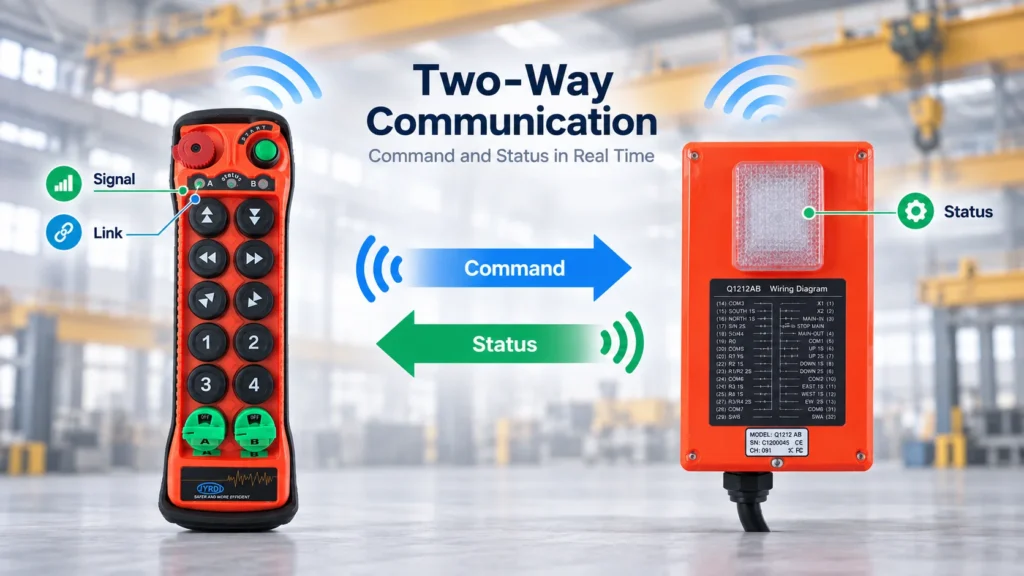
Traditional one-way radio controls mainly transmit commands from the handheld transmitter to the receiver.
The upgraded Q Series uses bidirectional communication between the transmitter and receiver.
According to the Q Series technical upgrade documentation, the transmitter includes:
- Two signal-strength indicators
- One status indicator
- Connection-status feedback
This allows signal strength and communication status to be viewed directly at the transmitter.
For multi-crane applications, this is especially useful because the operator needs to know whether the radio link remains stable while controlling selected equipment.
It does not replace the crane’s safety monitoring system, but it provides additional communication visibility.
Why Does Frequency Management Matter in a Multi-Crane Workshop?
A factory with several cranes may also contain many wireless and electrical interference sources.
For example:
- Multiple crane remote controls
- Electric motors
- Variable-frequency drives
- Welding machines
- Steel structures
- Electrical cabinets
- Other radio systems
In these environments, simply increasing transmission power is not always the best solution.
The upgraded Q Series uses the LLCC68 control chip with:
- Frequency modulation
- Spread-spectrum functions
- Automatic frequency selection
The technical upgrade document specifies 256 available channels, compared with 99 channels in the previous Q platform.
When multiple remote systems are installed in the same area, the automatic frequency-selection function is designed to avoid channels already being used by other Q remote-control systems.
This is particularly relevant for factories where many cranes operate in close proximity.
How Far Can the Q Series Operate?
The current Q Series technical material specifies an effective control distance of up to 250 meters under its stated operating conditions.
The upgrade is associated with the LLCC68 platform and its narrow–wide–narrow signal-processing mode.
However, actual industrial range can still be affected by:
- Workshop structure
- Steel obstacles
- Electrical interference
- Receiver installation position
- Antenna conditions
- Surrounding radio systems
Therefore, the 250 m figure should be treated as a product specification rather than a guarantee for every factory layout.
For most indoor crane projects, signal stability in the actual operating area is usually more important than achieving the maximum theoretical distance.
Can Existing Overhead Cranes Be Upgraded?
In many cases, yes.
The original project document positions the multi-crane solution as an upgrade for existing crane systems and emphasizes avoiding major modification of the original crane.
For the website, I recommend expressing this more precisely:
Existing cranes can often be upgraded with a multi-crane wireless control system without redesigning the complete electrical architecture, provided the receiver voltage, outputs, wiring, interlocks and control logic are compatible.
Before confirming the retrofit, check the following.
| Item | What Needs to Be Confirmed |
|---|---|
| Crane quantity | 2–6 or larger custom group |
| Operating mode | Independent / tandem / selectable group |
| Crane functions | Hoist / trolley / bridge / auxiliary |
| Speed | Single or dual speed |
| Receiver voltage | Existing control voltage |
| Receiver output | Relay / PLC / inverter input |
| E-stop circuit | Existing emergency-stop logic |
| Limit switches | How each crane responds at a limit |
| Interlocks | Required multi-crane safety logic |
| Existing wiring | Electrical drawing or cabinet photos |
| Working area | Distance and interference environment |
This table is valuable both for Google and for AI Search because it gives the reader a clear decision framework rather than only describing the product.
What Happens if One Crane Stops During Tandem Operation?
This is one of the most important questions to discuss before designing a multi-crane control system.
Suppose Crane A and Crane B are moving together.
What should happen if:
- Crane A reaches a travel limit?
- Crane A loses drive availability?
- Crane A enters a fault state?
- Crane B cannot continue moving?
The correct answer depends on the crane control architecture and the lifting requirements.
For many tandem applications, the control design should consider whether the remaining crane is allowed to continue or whether the coordinated movement should stop.
This must be handled through the appropriate crane safety and interlock logic.
The wireless remote should not be treated as a replacement for those protections.
Single-Speed or Dual-Speed: Why Does It Matter?
Multi-crane systems should not be selected only by the number of buttons.
For example, an 8-button remote can look correct physically but still be unsuitable if:
- One crane uses single-speed contactors.
- Another uses dual-speed control.
- The machine uses inverter control.
- The second button stage has a specific timing requirement.
The upgraded Q Series includes additional button-control functions and software logic compared with the previous generation, including additional control modes and timing functions.
Therefore, before ordering, the actual control method should be confirmed.
Common Mistakes When Choosing a Multi-Crane Remote Control
Mistake 1: Assuming “Same Command” Means “Perfect Synchronization”
The radio system coordinates commands.
It does not automatically compensate for differences in motors, drives or mechanical movement.
Mistake 2: Choosing Only by Button Quantity
Two transmitters with the same number of buttons can use completely different:
- Output logic
- Speed modes
- Voltage
- Interlocks
- Crane grouping
Mistake 3: Ignoring Independent Operation
Many factories only require tandem operation occasionally.
The system should therefore consider both:
Normal independent operation
and
Multi-crane group operation
Mistake 4: Ignoring Fault and Limit Behavior
Before commissioning, determine what the system should do when one crane reaches a limit or cannot continue the commanded movement.
Mistake 5: Treating the Radio Remote as the Entire Safety System
The wireless remote control does not replace:
- Crane brakes
- Limit switches
- Overload protection
- Drive protection
- PLC safety logic
- Lift planning
It is one part of the overall control system.
Which JYRDI Q Series Is Suitable for Multi-Crane Control?
A useful preliminary selection can be made from the project scale.
| Project Requirement | Suggested Direction |
|---|---|
| 2 cranes, simple A/B selection | Q Series tandem configuration |
| 2–6 selectable cranes | Q808 / Q1010 / Q1212 project configuration |
| Multiple selectable groups | Customized Q Series logic |
| Up to 14 cranes | Q2000 project configuration |
| Precise position synchronization | Q remote + additional crane control engineering |
| Existing crane retrofit | Evaluate wiring, voltage and outputs first |
This should be treated as an initial selection guide, not a final engineering specification.
Final configuration depends on the actual crane electrical system.
What Information Should You Send for a Multi-Crane Project?
To recommend the correct solution, provide:
- Number of cranes
- Crane type
- Existing control voltage
- Single-speed or dual-speed operation
- Required control functions
- Required crane combinations
- Existing transmitter or pendant photos
- Receiver / control-cabinet photos
- Electrical wiring diagram
- Motor or inverter information
- Required working distance
- Any existing PLC or synchronization system
This is more useful than simply asking:
“How many cranes can the remote control?”
Because the actual project depends on both the radio system and the crane control architecture.
JYRDI Q Series for Multi-Crane Control
For projects where one operator needs to control several overhead cranes, the JYRDI Q platform can be configured around:
Independent Crane Selection
Operate one selected crane for normal production.
Tandem / Group Selection
Send coordinated commands to a selected group.
Bidirectional Communication
View communication and signal status at the transmitter.
256-Channel Platform
Provides more frequency options for environments with multiple radio systems.
Automatic Frequency Selection
Designed to help avoid frequencies already occupied by other Q remote systems in multi-remote installations.
Customized Control Logic
Configure button functions and crane groups according to project requirements.
The purpose is not simply to replace several transmitters with one.
The goal is to create a control arrangement that fits the way the cranes are actually used.
FAQ
Can one remote control control two overhead cranes?
Yes. A properly configured multi-crane radio remote can control two overhead cranes independently or as a selected tandem group.
Can one remote control control more than two cranes?
Yes. The current JYRDI project information includes Q Series configurations for 2–6 cranes and larger Q2000 configurations for up to 14 cranes, depending on project design.
Does tandem control mean both cranes always move at exactly the same speed?
No. The remote can send coordinated commands, but actual crane speed and position also depend on motors, drives, mechanical conditions and control logic.
Can the cranes still work separately?
Yes. A multi-crane system can be configured to allow independent operation as well as group operation.
Can an existing crane be upgraded to multi-crane wireless control?
Often yes, but receiver voltage, wiring, outputs, limit circuits and safety interlocks should be evaluated before installation.
Is bidirectional communication important?
It can be useful because the operator can see signal and communication status at the transmitter, providing more information than a simple one-way radio link.
How many radio channels does the new Q Series support?
The current new Q Series technical documentation specifies 256 selectable channels.
What information do I need before requesting a quotation?
Provide the number of cranes, required crane combinations, voltage, single/dual-speed requirement, button functions, wiring diagram and control-cabinet photos.
Conclusion
One remote control can operate multiple cranes, but the correct solution depends on more than the number of receivers.
A multi-crane system should be designed around:
which cranes operate together, how they are selected, how fast they move, how the existing control circuit works, and what happens when one crane reaches a limit or fault condition.
For standard workshop tandem handling, one transmitter controlling selected crane groups can simplify operation significantly.
For applications requiring precise mechanical synchronization, the radio remote should be combined with the appropriate PLC, drive or feedback system.
Need a Multi-Crane Control Configuration?
Send us:
Crane quantity + voltage + operating functions + required combinations + wiring diagram
We can evaluate the suitable Q Series configuration for your project.