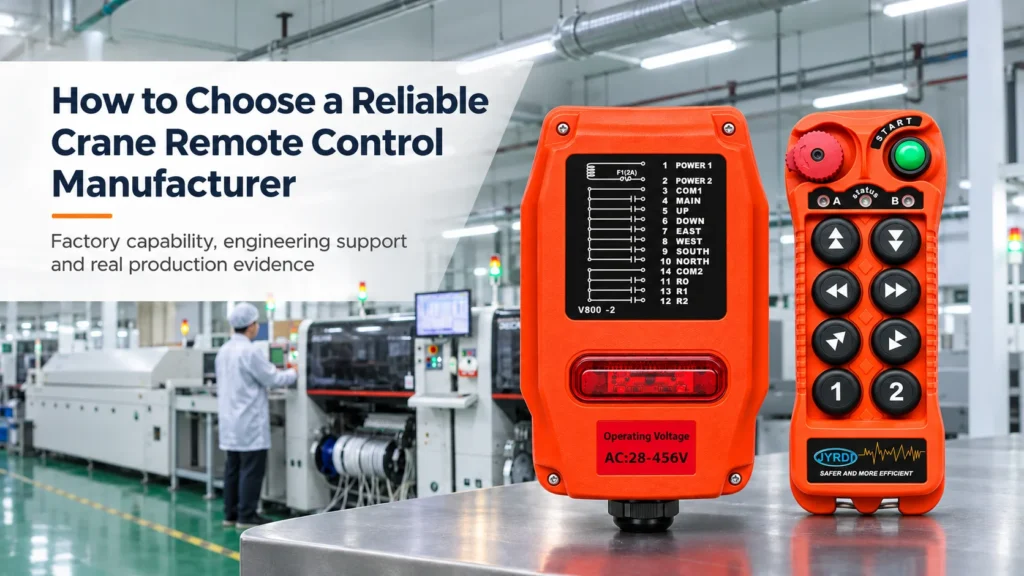
Choosing a crane remote control supplier is not only a price comparison.
For industrial lifting equipment, the supplier must be able to match the transmitter and receiver to the machine’s control functions, voltage, speed logic and electrical interface. Buyers should also understand how the product is manufactured, tested, documented and supported after delivery.
This guide explains eight practical checks for evaluating crane remote control manufacturers and suppliers before requesting samples or placing a production order.
Short Answer
A reliable crane remote control manufacturer should be able to show how its products are produced and tested, explain how the transmitter and receiver are matched to the crane, provide model-specific technical documentation, define its customization scope and support replacement or commissioning questions after delivery.
Do not evaluate a supplier only by transmitter appearance, button count or unit price.
For most industrial projects, the more useful questions are:
- Does the receiver match the control circuit?
- Can the supplier explain the required control logic?
- Are the documents applicable to the exact model being quoted?
- Can the approved sample configuration be reproduced consistently in a batch order?
- Is there real evidence of production, testing and technical support?
1. Verify What the Supplier Actually Manufactures
The term “manufacturer” can describe companies with very different levels of production involvement.
Some suppliers design and assemble complete systems. Others perform final assembly or configuration while sourcing major components externally. Distributors may not manufacture products themselves but can still provide strong local stock and technical support.
For a B2B buyer, the important question is not simply:
“Are you a factory?”
A better question is:
“Which production and engineering processes are handled by your company?”
Ask the supplier to explain responsibility for:
- PCB assembly
- Transmitter assembly
- Receiver assembly
- Programming or configuration
- Functional testing
- Product labeling
- Final inspection
- Packaging
Factory photos are useful, but continuous production footage and identifiable product processes provide stronger evidence.
Example of Manufacturing Evidence
JIAYI publishes a factory video showing SMT production and AOI inspection footage:
https://www.youtube.com/watch?v=TzNoQHnhqro
This type of material helps buyers understand the production environment.
For projects with formal quality requirements, however, buyers should still ask which processes apply to the specific product being purchased and request the relevant inspection or production documentation when necessary.
2. Check Whether the Supplier Can Match the Complete Control System
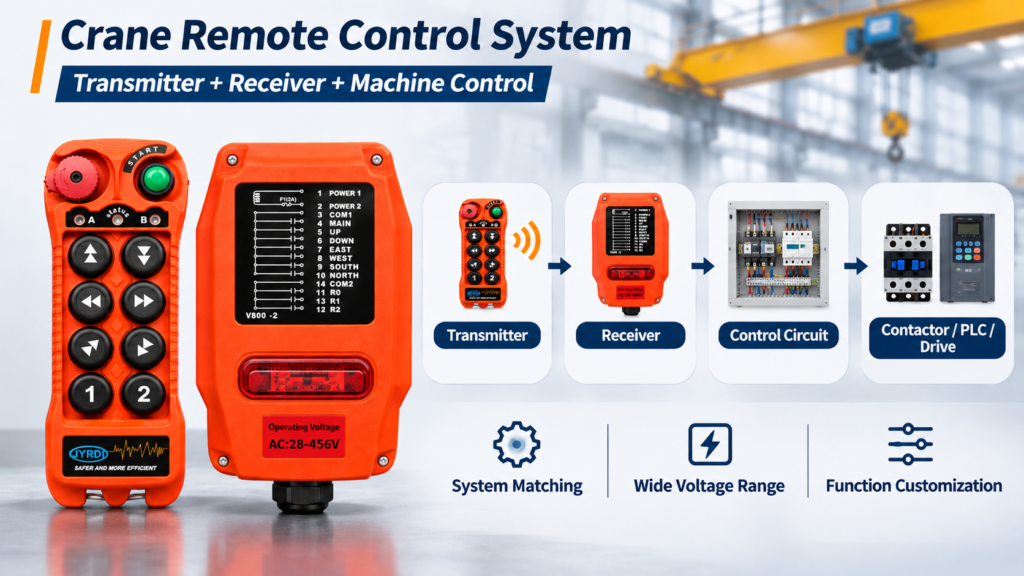
A crane remote control is not only a handheld transmitter.
The transmitter must communicate with a compatible receiver, and the receiver must interface correctly with the machine’s existing control system.
A supplier should therefore ask about the equipment before recommending a model.
Typical information includes:
| Information to Confirm | Why It Matters |
|---|---|
| Required movements | Determines the required control functions |
| Single- or dual-speed operation | Determines command and output logic |
| Control voltage | Helps determine the correct receiver configuration |
| Receiver outputs | Must match the existing control circuit |
| Existing pendant or remote | Helps identify the current control arrangement |
| Wiring diagram | Helps verify terminal and control logic |
| PLC, contactor or drive interface | Determines how receiver commands enter the machine control system |
Two transmitters can have the same number of buttons and still require different receivers or output configurations.
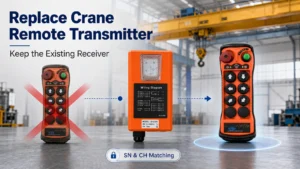
For replacement projects, the receiver label and wiring information can be more useful than the transmitter appearance alone.
For a detailed explanation of the transmitter, receiver and control circuit, see the JIAYI crane remote control wiring guide.
3. Make Sure the Supplier Understands Your Application
The supplier does not need to manufacture the crane itself, but it should understand how the remote control will interact with the equipment.
For example:
An overhead crane may require hoist, trolley and bridge travel commands.
A fixed electric hoist may require only lifting and lowering, while a powered trolley adds horizontal travel.
A gantry crane may require additional travel functions.
The correct remote-control configuration should be based on the actual machine rather than a generic model recommendation.
A useful supplier should be able to explain:
- Which functions must be controlled
- How many independent commands are required
- Whether the equipment uses single- or dual-speed control
- Which receiver configuration is required
- Whether the existing wiring must be reviewed before installation
If the supplier recommends a model without asking about the machine or control circuit, additional verification is advisable.
For product selection by crane type, use the relevant application page rather than relying only on a manufacturer guide.
4. Request Model-Specific Technical Documentation
A product catalogue is not enough for many industrial purchasing decisions.
Before approving a model, request the technical documents that apply to the exact transmitter and receiver combination being quoted.
Depending on the project, useful documents may include:
| Document | What to Verify |
|---|---|
| Technical data sheet | Model, frequency, voltage and operating specifications |
| Receiver wiring diagram | Terminal assignments and output logic |
| Transmitter function layout | Button functions and speed stages |
| User manual | Operation, setup and maintenance information |
| Pairing instructions | Correct transmitter-receiver matching procedure |
| Compliance documents | Exact model scope and applicable market |
| Inspection documentation | Test scope relevant to the supplied configuration |
Check the Scope of Certificates
Do not assume that one certificate automatically applies to an entire product range.
If compliance documentation is required, verify:
- The product model covered
- The scope of the document
- The applicable standard
- The issuing or testing organization
- Whether the document is relevant to the destination market
- Whether the quoted configuration is included
A certificate is useful only when its scope matches the product being purchased.
5. Evaluate Customization by Asking What Can Actually Be Changed
“OEM/ODM available” is too broad to be useful on its own.
Industrial remote-control customization can involve very different levels of engineering.
Ask the manufacturer to define which items can be changed on the proposed product platform.
These may include:
Branding and Labels
- Customer logo
- Button symbols
- Language-specific labels
- Product identification
Control Functions
- Button assignments
- Momentary or maintained functions where supported
- Single- or dual-speed configurations
- Application-specific output logic
Receiver Configuration
- Receiver supply voltage
- Output arrangement
- Terminal configuration
- Supported machine interfaces
Documentation and Delivery
- Wiring documentation
- Customized labels
- Packing requirements
- Product identification for repeat orders
A supplier should clearly distinguish between a simple label change and an actual change to the transmitter or receiver control logic.
Real Customization Evidence
JIAYI has published a Q-Series button-function modification demonstration:
https://www.youtube.com/watch?v=DpL1e4ECHts
The video provides evidence that button-function configuration is supported on the demonstrated Q-Series setup.
For another model or project, buyers should confirm whether the same customization method is available before placing an order.
6. Ask What Is Checked Before Shipment
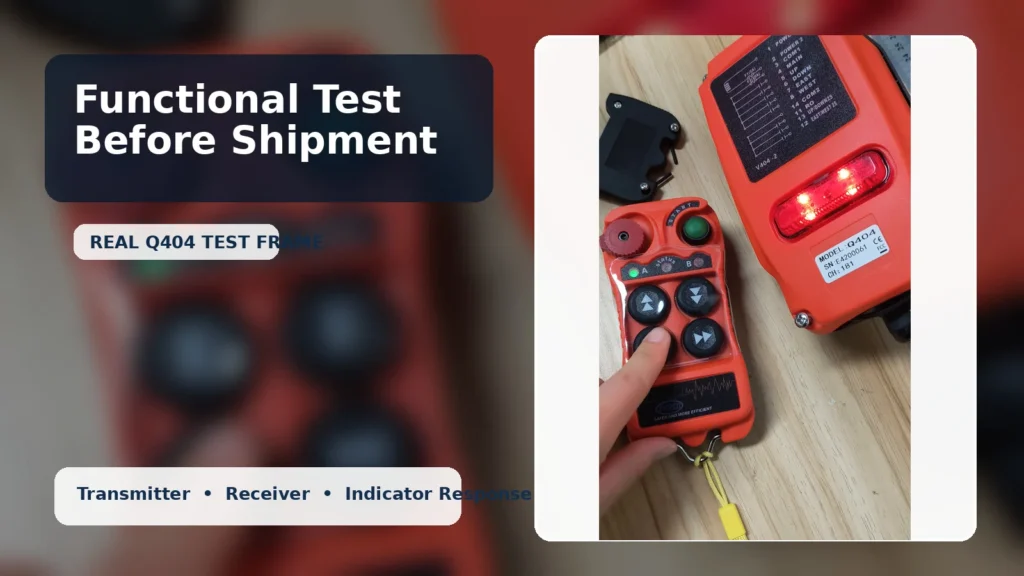
“100% tested” is not useful unless the supplier can explain what the test includes.
For a crane remote-control system, relevant functional checks may include:
- Transmitter button response
- Receiver output response
- Transmitter-receiver pairing
- Stop-function response
- Single- or dual-speed command sequence
- Indicator operation
- Configuration consistency
The exact test plan should depend on the model and project requirements.
For an important OEM or batch order, ask:
What is checked?
Is the check performed on every unit or by sampling?
Can the supplier provide an inspection record or order-specific test evidence if required?
Examples of JIAYI Test Evidence
Q404 transmitter and receiver functional test:
Q808 remote control testing before shipment:
These videos demonstrate functional testing of the products shown.
They should not be treated as proof that every JIAYI model follows an identical test procedure. For a specific order, confirm the applicable inspection process.
7. Check Batch Consistency, Not Only Sample Quality
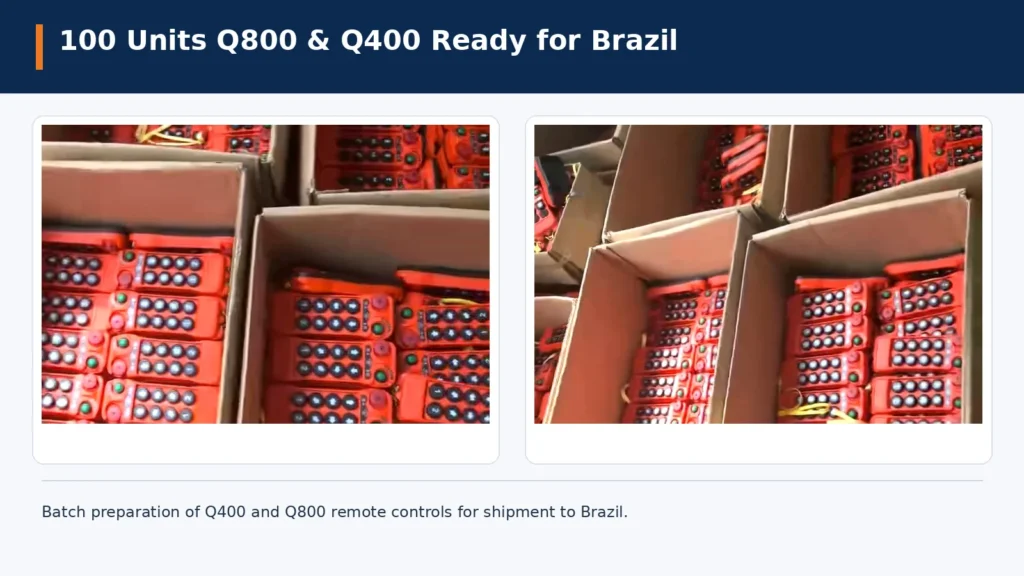
A sample order and a production order are different purchasing stages.
A sample may confirm basic compatibility, but distributors and OEM buyers also need to know whether the approved configuration can be reproduced consistently.
Before approving a larger order, confirm:
- Product model and revision
- Receiver voltage
- Button-function configuration
- Single- or dual-speed logic
- Product labels
- Packaging requirements
- Required documentation
- Production lead time
- Change-control process
If the supplier changes a component, configuration or product revision, buyers should know whether that change affects compatibility with previously supplied units.
Shipment Evidence Is Useful — but Know What It Proves
JIAYI has published a video showing 100 Q800 and Q400 remote controls prepared for Brazil:
https://www.youtube.com/watch?v=3PZ9f-3IUps
This is useful evidence of a real batch being prepared for shipment.
It does not, by itself, establish monthly production capacity, long-term field performance or the inspection result of every individual unit.
Those points should be confirmed separately when relevant to the purchasing decision.
8. Evaluate Technical Support for Pairing, Replacement and Commissioning
Industrial remote controls may require support after delivery, particularly when a buyer is:
- Replacing a damaged transmitter
- Pairing a new transmitter and receiver
- Checking receiver wiring
- Confirming button functions
- Replacing an older system
- Reordering a previous configuration
Before choosing a supplier, ask who provides technical support and what information is available.
Useful support may include:
- Pairing instructions
- Wiring diagrams
- Model identification
- Receiver matching
- Replacement-transmitter guidance
- Configuration records
- Troubleshooting information
Pairing Support Example
JIAYI publishes a Q-Series transmitter and receiver pairing demonstration:
https://www.youtube.com/watch?v=DvWwkRxEFlQ
For transmitter-only replacement, the existing model, receiver condition and matching method should be confirmed before ordering.
Customer or Distributor Feedback
JIAYI also publishes overseas distributor feedback on the Q606:
https://www.youtube.com/watch?v=zaAZ3Wv-HDs
Customer feedback can be useful supporting evidence, but buyers should still evaluate whether the demonstrated product and use case are relevant to their own application.
Manufacturer, Distributor or System Integrator: Which Do You Need?
A direct manufacturer is not automatically the best purchasing channel for every project.
Different supplier types can provide different advantages.
| Supplier Type | Typical Strength | What to Verify |
|---|---|---|
| Manufacturer | Product configuration, production and customization | Actual manufacturing scope and engineering capability |
| Distributor | Local availability and product support | Authorization, stock and technical capability |
| System integrator | Machine-level electrical integration | Engineering experience and installation responsibility |
| Trading company | Procurement and export coordination | Product source and responsibility for technical support |
For a standard replacement remote, local distributor support may be valuable.
For an OEM project, custom control logic or unusual receiver configuration, direct access to the manufacturer’s engineering team may become more important.
Choose the supplier type according to the project rather than the label on the company website.
Crane Remote Control Supplier Evaluation Scorecard
Use this checklist when comparing quotations.
| Evaluation Area | Strong Evidence | Warning Sign |
|---|---|---|
| Manufacturing | Identifiable production processes and clear responsibility | Only catalogue photos with no explanation of production |
| System matching | Supplier asks about voltage, functions, speed and wiring | Recommendation based only on button count |
| Technical documents | Model-specific manual, wiring and specifications | Only generic catalogue |
| Compliance | Exact model and document scope can be identified | Generic certification claims for all products |
| Customization | Supported changes are clearly defined | “Anything can be customized” without technical confirmation |
| Testing | Supplier explains test items and acceptance method | Only says “tested” |
| Batch control | Configuration and revisions can be recorded | Sample and batch specifications are unclear |
| Technical support | Pairing, wiring and replacement support are available | No clear support after shipment |
A lower unit price does not compensate for an incorrect receiver, incompatible wiring or unclear control logic.
Common Mistakes When Choosing a Crane Remote Control Supplier
Choosing by Button Count Alone
A six-button transmitter is not automatically compatible with another six-button system.
Receiver voltage, outputs, control logic and pairing must also match.
Comparing Price Before Defining the Configuration
Quotations are difficult to compare when suppliers are quoting different receiver voltages, speed configurations or product versions.
Define the configuration first.
Accepting Generic Certification Claims
Ask which exact model the document covers and whether it applies to the destination market.
Treating a Shipment Video as a Field Case Study
Shipment evidence proves that a batch was prepared for delivery.
It does not automatically prove field performance or customer results.
Approving a Sample Without Defining the Production Version
For repeat or batch orders, record the approved model, receiver voltage, function logic, labels and documentation requirements.
What Information Should You Send Before Requesting a Quote?
The quality of a supplier recommendation depends heavily on the information provided by the buyer.
For a new project, send:
Equipment Information
- Crane or hoist type
- Required movements
- Single- or dual-speed requirement
- Auxiliary functions
Electrical Information
- Control voltage
- Existing receiver information
- Control cabinet or interface details
- Wiring diagram, if available
Existing System Information
For replacement projects:
- Old transmitter photos
- Receiver photos
- Model label
- Existing wiring information
- Required replacement functions
Commercial Requirements
- Required quantity
- Sample requirement
- Destination country
- Branding or labeling requirements
- Required technical documentation
A wiring diagram is ideal.
If it is unavailable, clear photographs of the transmitter, receiver label and control cabinet can still help with the initial review.
How Can Buyers Evaluate JIAYI Against These Criteria?
JIAYI publishes several types of evidence that buyers can review before contacting the company:
- Factory footage showing SMT production and AOI inspection
- Q-Series button-function modification
- Q404 and Q808 functional test videos
- Q-Series transmitter and receiver pairing
- Batch preparation for Q400 and Q800 products
- Overseas distributor feedback on Q606
These materials can help buyers verify specific aspects of production, configuration, testing and support.
For project-critical requirements, buyers should still request the technical documents, wiring information, applicable compliance documents and order-specific inspection requirements for the product being quoted.
The goal should not be to choose a supplier based on marketing claims.
It should be to confirm that the proposed transmitter and receiver configuration matches the equipment and that the supplier can provide the evidence and technical support required for the project.
Frequently Asked Questions
How do I choose a reliable crane remote control manufacturer?
Check whether the supplier can explain its manufacturing scope, match the transmitter and receiver to the machine, provide model-specific technical documentation, define its customization capabilities and explain its pre-shipment testing and technical support.
Do not select a supplier only by price or transmitter appearance.
What information should I send to a crane remote control manufacturer?
Provide the equipment type, required movements, single- or dual-speed requirement, control voltage, quantity and destination country.
For replacement projects, also send photographs of the existing transmitter and receiver, the receiver label and a wiring diagram if available.
Is buying directly from a manufacturer always better?
No.
A distributor may provide better local stock or service, while a system integrator may be better suited to projects requiring machine-level electrical integration.
Direct manufacturer access is particularly useful when a project requires product customization, receiver configuration or engineering support.
How can I check whether a crane remote control receiver is compatible?
Confirm the receiver supply voltage, required outputs, movement functions, speed-control logic, existing wiring and transmitter-receiver matching method.
The transmitter appearance or number of buttons alone is not enough to confirm compatibility.
What technical documents should a supplier provide?
Depending on the project, useful documents can include a technical data sheet, receiver wiring diagram, transmitter function layout, user manual, pairing instructions and applicable compliance documents.
The exact document set should match the product and destination market.
Can a crane remote control manufacturer customize button functions?
Some product platforms support changes to labels, button assignments, control logic or receiver configuration.
The supported customization scope varies by model, so the required change should be confirmed before ordering.
Final Buying Principle
When comparing crane remote control manufacturers, start with the machine and control system — not with the catalogue.
Define the required movements, speed logic, receiver voltage and electrical interface first.
Then compare suppliers based on whether they can:
- Recommend a technically compatible system
- Provide model-specific documentation
- Explain what they manufacture and test
- Reproduce the approved configuration consistently
- Support installation, pairing and replacement questions
For a quotation or configuration review, send your equipment information, existing remote photos and wiring information before selecting a model.