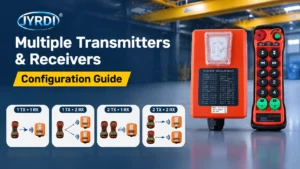
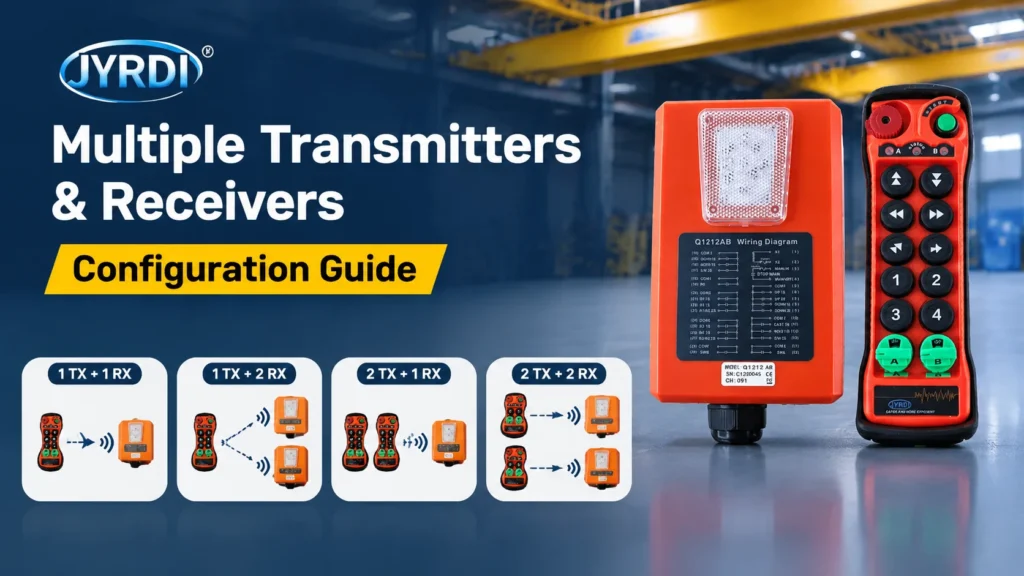
Industrial wireless remote control systems are not always limited to one transmitter and one receiver. Depending on the equipment layout and operating requirements, a project may need multiple handheld transmitters, multiple receivers, or a selection function that allows one transmitter to control different machines.
These requirements are common in crane installations, material handling systems, industrial vehicles, and equipment with multiple operating positions.
However, adding more transmitters or receivers does not automatically make a system compatible. The transmitter-to-receiver pairing, wireless addressing, control logic, and equipment electrical circuit must all be considered.
This guide explains four common wireless control configurations, how they work, and what buyers should confirm before ordering an industrial remote control system.
1. How Do Multiple Transmitters and Receivers Work?
Before selecting a configuration, it is important to understand the two main components.
Transmitter (TX)
The transmitter is the handheld wireless remote control operated by the user. It sends commands such as lifting, lowering, moving, starting, and stopping.
Receiver (RX)
The receiver is installed on the controlled machine. It receives wireless commands from the transmitter and activates the corresponding output circuits.
In a standard system, one transmitter communicates with one receiver. When multiple machines or operators are involved, the control relationship may need to be configured differently.
The four configurations below represent common system architectures. They are intended to explain purchasing and engineering requirements. Actual availability and compatibility must be confirmed for each project.
2. Four Common Transmitter and Receiver Configurations
Configuration 1: One Transmitter + One Receiver (1 TX + 1 RX)
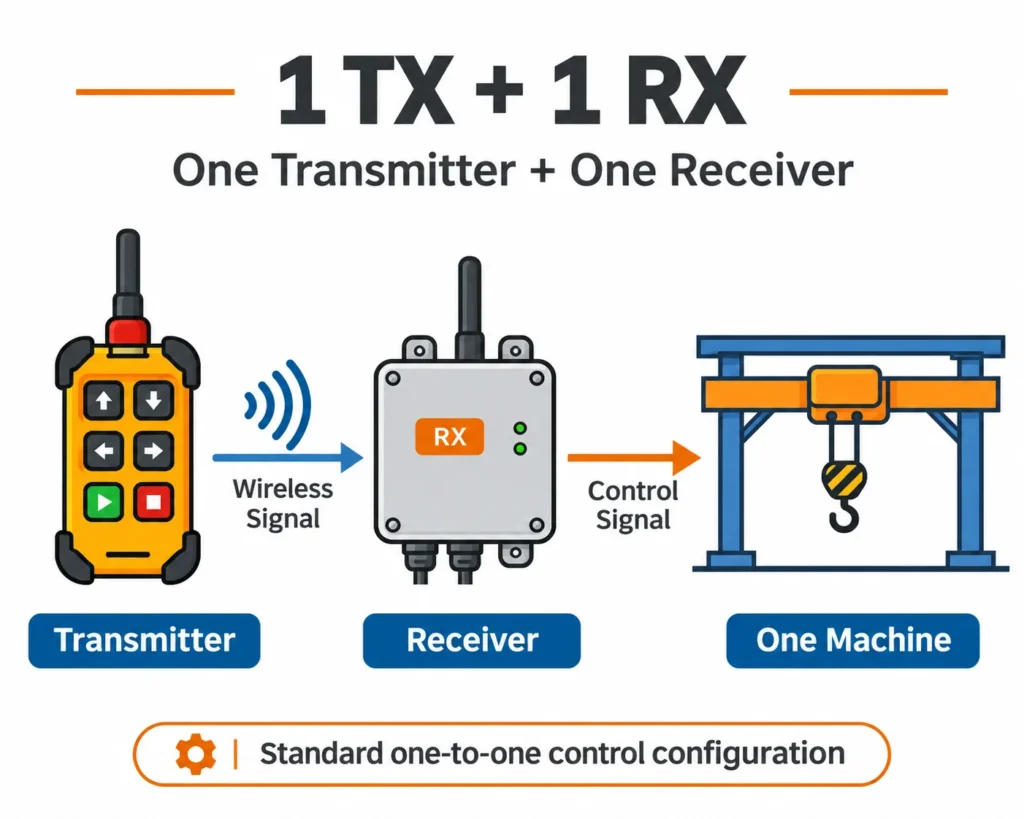
One handheld remote control operates one machine.
This is the standard configuration used in many industrial wireless remote control applications.
The operator uses one transmitter to send commands to one receiver installed on the equipment.
Typical applications include:
- Overhead crane control.
- Electric hoist operation.
- Industrial lifting equipment.
- Single-machine wireless control.
How it works:
- The operator presses a button on the transmitter.
- The transmitter sends a wireless command.
- The receiver identifies and processes the command.
- The corresponding output activates the machine’s control circuit.
When should you choose this configuration?
Choose 1 TX + 1 RX when one operator needs to control one machine independently and no additional transmitter or receiver selection is required.
[IMAGE 1: 1 TX + 1 RX system configuration diagram]
Alt text: One industrial wireless remote control transmitter communicating with one receiver installed on a machine.
Configuration 2: One Transmitter + Two Receivers (1 TX + 2 RX)
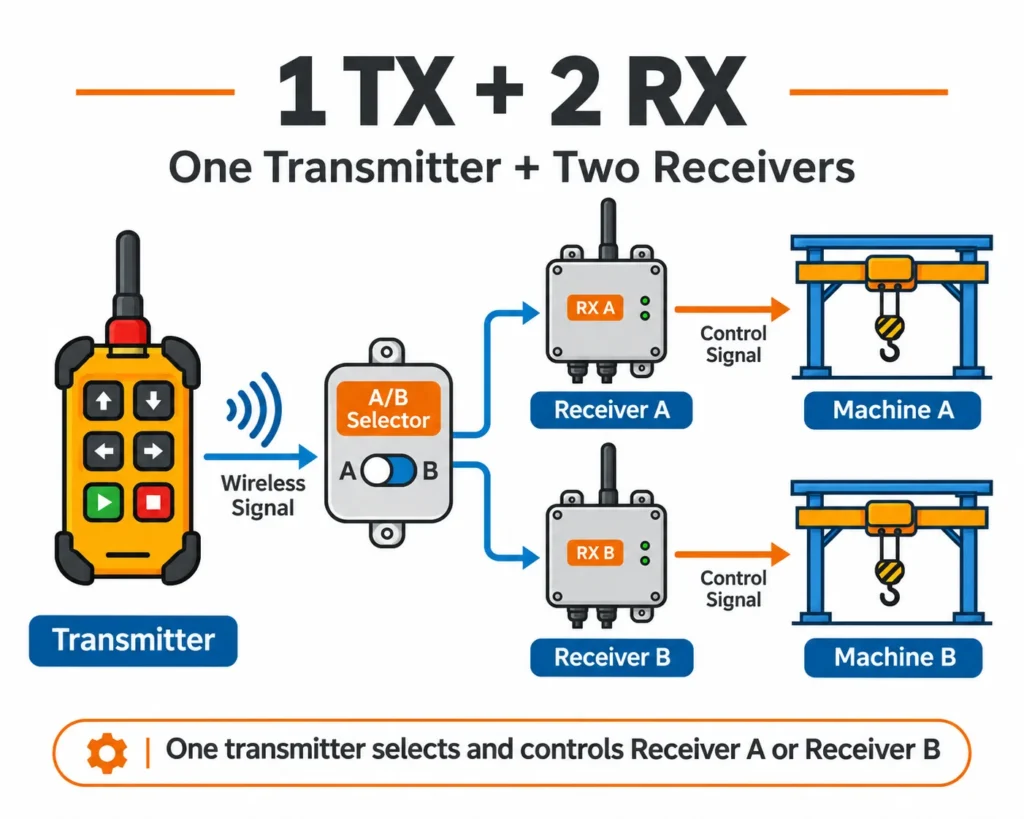
One transmitter is designed to select between two receivers.
This configuration is intended for applications where one operator needs to control two separate machines or control groups using a single handheld transmitter.
For example, an operator may need to select Machine A or Machine B before sending operating commands.
A selection mechanism, such as an A/B selector, may be used depending on the system design.
How it works:
- Mode A: The transmitter is assigned to Receiver A.
- Mode B: The transmitter is assigned to Receiver B.
- Switching between A and B changes the selected control group.
The system must be designed so that commands are directed to the intended receiver.
Typical applications:
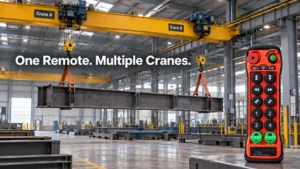
- One operator controlling two separate cranes.
- Switching between two lifting stations.
- Controlling different equipment areas from one operating position.
- Applications requiring a reduced number of handheld transmitters.
Important technical considerations:
- How is Receiver A or Receiver B selected?
- Does the selection require a physical selector switch or programmed button logic?
- How is the active receiver identified?
- Can both machines operate simultaneously, or is only one selected at a time?
- How is unintended operation of the unselected receiver prevented?
A/B selection should not be assumed to be available on every standard remote control. The transmitter programming, receiver configuration, and machine control circuit must be evaluated together.
[IMAGE 2: 1 TX + 2 RX system configuration diagram]
Alt text: One wireless remote control transmitter with an A/B selection function for two receivers.
Configuration 3: Two Transmitters + One Receiver (2 TX + 1 RX)
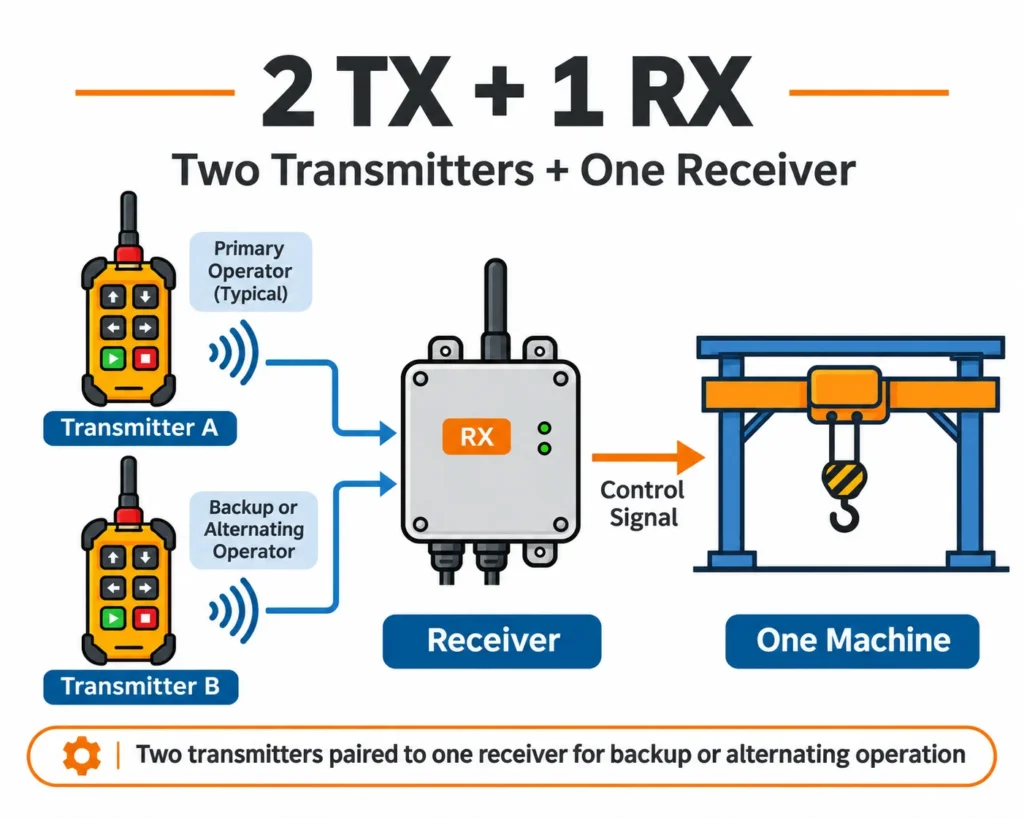
Two transmitters are associated with one receiver.
This arrangement is commonly considered when a machine requires more than one handheld remote control.
For example, a customer may need one transmitter for regular operation and another as a backup.
Possible applications include:
- Primary and backup transmitters.
- Two operators taking turns controlling one machine.
- Additional transmitters for different operating positions.
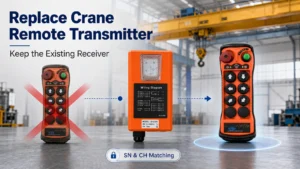
- Replacement of an existing transmitter while retaining the original receiver.
How it works:
Both transmitters must be compatible with the receiver and configured according to the intended operating arrangement.
However, pairing two transmitters with one receiver does not automatically mean both transmitters can operate the machine simultaneously.
The actual operating rules depend on the receiver’s pairing mechanism and control design.
What should be confirmed?
- Are both transmitters intended to be used as backups?
- Will two operators take turns using the system?
- Must both transmitters remain available?
- Can the receiver recognize more than one paired transmitter?
- Is simultaneous operation required or prohibited?
- Does the existing receiver support additional transmitters?
For replacement projects, model number alone is not enough to guarantee compatibility. Frequency, coding or pairing protocol, and receiver hardware version should also be checked.
[IMAGE 3: 2 TX + 1 RX system configuration diagram]
Alt text: Two industrial wireless remote control transmitters associated with one receiver.
Configuration 4: Two Transmitters + Two Receivers (2 TX + 2 RX)
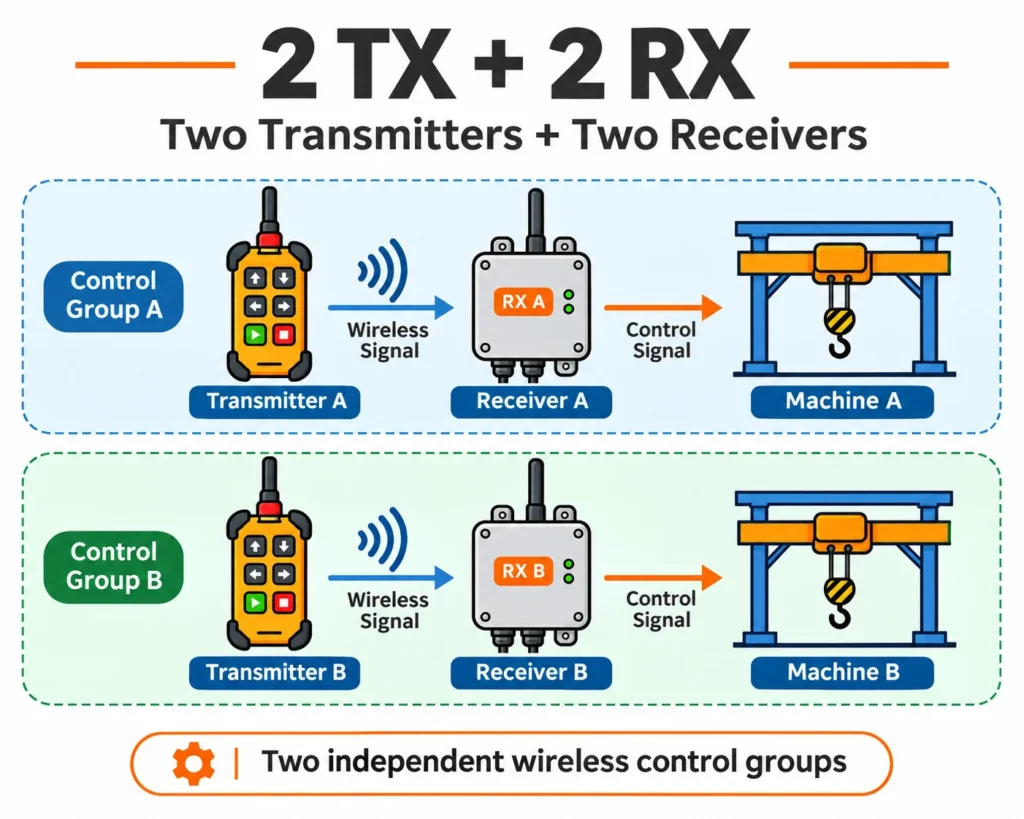
Two transmitters and two receivers form two independent control groups.
This configuration is suitable for projects where two machines need separate wireless control systems.
A typical arrangement is:
- Transmitter A communicates with Receiver A.
- Transmitter B communicates with Receiver B.
Each transmitter controls its corresponding machine independently.
Typical applications:
- Two overhead cranes operating in the same facility.
- Two separate lifting stations.
- Two machines with independent operators.
- Industrial facilities requiring separate wireless control groups.
How it works:
Each transmitter is configured for its corresponding receiver. The two control groups operate independently according to their respective system configurations.
If operators need to switch between machines or coordinate both machines, additional control logic may be required.
Important technical considerations:
- Are the two transmitter-receiver pairs completely independent?
- Can both machines operate at the same time?
- Is cross-control between the two receivers prevented?
- Are different pairing identities or addressing arrangements required?
- Does either machine need an additional selection or interlocking function?
This configuration should not be confused with a tandem crane system.
Two independent control groups mean that each transmitter controls its own receiver. Tandem operation may instead require coordinated commands to two crane control groups from one operating system.
[IMAGE 4: 2 TX + 2 RX system configuration diagram]
Alt text: Two independent wireless remote control groups, each consisting of one transmitter and one receiver.
3. What Is the Difference Between A/B Selection and Tandem Crane Control?
A/B selection and tandem operation are related concepts, but they are not necessarily the same control function.
A/B Selection
A/B selection allows an operator to select which control group is active.
For example:
| Selection Mode | Intended Control |
|---|---|
| Mode A | Control Crane A |
| Mode B | Control Crane B |
| Mode A+B | Linked control of Crane A and Crane B, if supported by the system |
The exact behavior depends on the transmitter programming and receiver configuration.
Tandem Crane Control
Tandem crane control is used when two cranes need to perform coordinated lifting or movement operations.
Depending on the equipment design, both cranes may need to receive coordinated commands from the same operating system.
This requires more than simply connecting one transmitter to two receivers. The control system must account for the crane electrical circuits, operating sequence, synchronization requirements, and safety functions.
For more information, see our Tandem Crane Remote Control System with A/B Selection product page.
4. Can Multiple Transmitters Operate One Receiver at the Same Time?
This is one of the most important questions to clarify before purchasing a multi-transmitter system.
The answer depends on the receiver design and the required operating logic.
There are three different arrangements:
1. Backup Operation
One transmitter is used regularly, while another is kept as a spare.
The backup transmitter is used when the primary transmitter is unavailable.
2. Alternating Operation
Two operators use different transmitters, but only one operator controls the machine at a time.
The system must define how control authority is transferred between transmitters.
3. Simultaneous Operation
Two transmitters may be expected to send commands to the same receiver at the same time.
This requires specific engineering evaluation. The system must define command priority, conflicting commands, operating permissions, and how simultaneous inputs are handled.
Do not assume that a receiver supporting multiple paired transmitters automatically supports simultaneous operation.
For lifting equipment, the operating arrangement must also be evaluated against the machine’s safety requirements.
5. Technical Factors to Check Before Choosing a Configuration
When selecting an industrial wireless remote control system with multiple transmitters or receivers, the following factors should be reviewed.
5.1 Wireless Pairing and Receiver Compatibility
The transmitter and receiver must use a compatible wireless communication protocol and pairing method.
For an existing system, check:
- Complete transmitter model number.
- Receiver model number.
- Wireless frequency.
- Coding or pairing protocol.
- Receiver PCB or hardware version.
- Existing pairing configuration.
A matching product name does not necessarily guarantee compatibility.
5.2 Receiver Addressing and Control Identification
When several receivers are installed in the same facility, the system must establish which transmitter can communicate with which receiver.
Depending on the system design, this may involve pairing identities, addressing, or another receiver-selection mechanism.
The purpose is to ensure that commands reach the intended machine rather than another machine nearby.
5.3 A/B Selection Logic
If an A/B selector is required, define:
- How the operator selects A or B.
- Whether the selection is made through a rotary switch, selector button, or programmed function.
- Whether the active selection is visibly indicated.
- Whether switching is permitted while the machine is operating.
- What happens if the operator changes selection unintentionally.
The switching behavior must be evaluated together with the equipment control circuit.
5.4 Receiver Voltage and Output Configuration
The number of receivers is only one part of the configuration.
Each receiver must also match the machine’s electrical requirements.
Confirm:
- AC or DC power supply.
- Required receiver input voltage.
- Number of control outputs.
- Single-speed or double-speed functions.
- Relay output requirements.
- Connection to the existing electrical control panel.
The receiver supply voltage and relay contact ratings are different specifications and should be checked separately.
5.5 Interlocking and Prevention of Unintended Operation
For systems controlling multiple machines, the control design should consider:
- Prevention of unintended cross-control.
- Restrictions on conflicting operations.
- Selection and switching permissions.
- Emergency stop requirements.
- Defined machine response when wireless communication is interrupted.
These functions must be designed and verified according to the actual equipment and applicable safety requirements. A standard wireless pairing function should not be treated as a certified safety interlock.
6. Real Buyer Requirements: What Do Industrial Buyers Actually Ask For?
At JIAYI, inquiries from overseas buyers are not limited to standard transmitter and receiver combinations.
Some customers already have an existing remote control system and want to add transmitters. Others need to control multiple machines or configure a more complex wireless control arrangement.
The following anonymized examples are based on actual customer inquiries received by our sales team.
Case 1: A Brazilian Buyer Needed Two Transmitters and Two Receivers
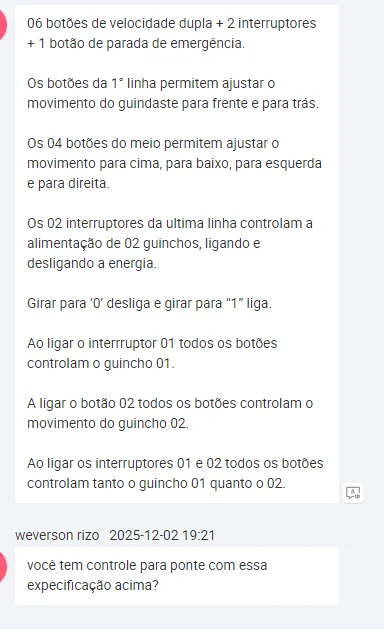
Country: Brazil
Requested configuration: 2 transmitters + 2 receivers
The customer asked for two remote controls to operate two receivers, with a button-selection function to control the intended receiver separately.
The key purchasing requirement was not simply the quantity of remote controls. The buyer needed a clearly defined relationship between the transmitters and receivers.
Several technical details still needed clarification:
- Should each transmitter be permanently assigned to one receiver?
- Should one transmitter switch between Receiver A and Receiver B?
- Should the two machines operate independently or simultaneously?
- How should the active receiver be selected?
- What measures are needed to prevent unintended control?
This inquiry illustrates why the control architecture should be confirmed before recommending a transmitter and receiver combination.
Case 2: A Greek Buyer Wanted Two Additional F24-8D Transmitters
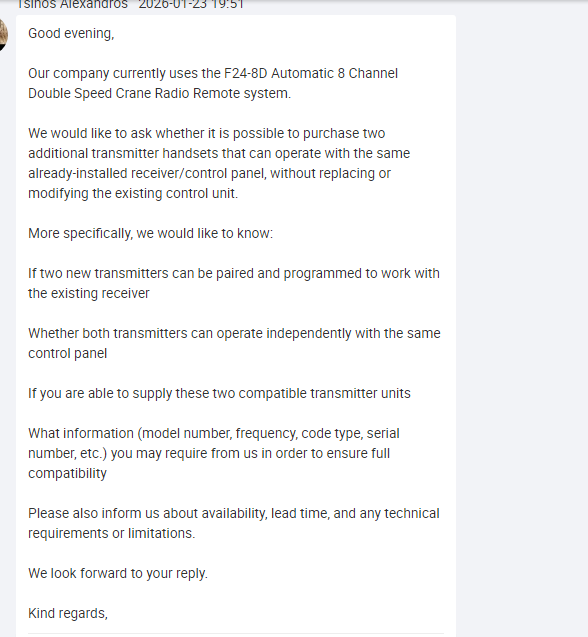
Country: Greece
Existing system: F24-8D, 8-channel, double-speed
The customer was already using an F24-8D wireless crane remote control system and wanted to purchase two additional transmitters while retaining the existing receiver and control panel.
The main purchasing concern was compatibility with the installed receiver.
Before confirming the additional transmitters, the following information needed to be checked:
- Complete F24-8D model and version.
- Transmitter and receiver frequency.
- Coding and pairing method.
- Receiver hardware version.
- Whether the additional transmitters were intended as backups or for alternating operation.
This is a typical example of a customer who does not want to replace the entire system. The buyer wants to expand the existing configuration while keeping the installed receiver.
Case 3: An Australian Buyer Asked for Two Transmitters and One Receiver

Country: Australia
Requested configuration: 2 transmitters + 1 receiver
The customer initially requested a quotation for two transmitters and one receiver for delivery to Sydney, Australia.
The customer subsequently asked about purchasing two sets, each containing two transmitters.
This type of inquiry requires clarification of the actual purchasing arrangement:
- Are the two transmitters assigned to the same receiver?
- Are they intended for backup or alternating operation?
- Does the customer need one complete system or two independent systems?
- What equipment functions and receiver voltage are required?
The quotation should clearly list the number of transmitters and receivers included in each set.
What These Inquiries Tell Us
These three purchasing requests demonstrate that buyers may use similar descriptions such as “two remotes” or “multiple receivers” while expecting different operating arrangements.
The correct recommendation must be based on the actual transmitter-to-receiver relationship, machine functions, electrical requirements, and operating rules.
7. What Information Should You Provide Before Requesting a Quotation?
To help us evaluate your wireless remote control requirements, please prepare the following information.
| Information Required | What to Provide |
|---|---|
| Equipment Type | Overhead crane, hoist, industrial vehicle, or other machinery |
| Number of Machines | How many machines need wireless control? |
| Transmitter Quantity | How many handheld transmitters are required? |
| Receiver Quantity | How many receivers are required? |
| Control Relationship | Which transmitter should control which receiver? |
| Operating Mode | Independent, backup, alternating, A/B selection, or tandem operation |
| Control Functions | Required movements and auxiliary functions |
| Speed Configuration | Single-speed or double-speed |
| Receiver Voltage | AC or DC and the required voltage |
| Existing System | Transmitter, receiver, and wiring photographs if applicable |
| Delivery Information | Country, city, and postal code |
If you are not sure which configuration is suitable, you can also send us a simple hand-drawn diagram showing the machines, transmitters, and receivers.
Our sales and technical teams can review the intended arrangement before recommending a solution.
8. Frequently Asked Questions
Can one wireless transmitter control two receivers?
Yes, a system may be designed to select between two receivers, depending on its transmitter programming, receiver configuration, and control architecture. The required A/B selection method and compatibility must be confirmed before ordering.
Can two transmitters be paired with one receiver?
Some systems can support multiple transmitters associated with one receiver. However, the supported number of transmitters and their operating rules depend on the receiver and pairing design.
Can two transmitters control one machine simultaneously?
Not necessarily. Multiple transmitter pairing does not automatically provide simultaneous control. Command priority, conflicting inputs, and operating permissions must be evaluated.
Can two cranes be controlled by one remote control?
A system may be configured for separate crane selection or coordinated tandem operation, depending on the required control architecture. The machine electrical circuits and synchronization requirements must be reviewed.
What is the difference between A/B selection and tandem operation?
A/B selection determines which control group is active. Tandem operation coordinates two cranes or lifting units to perform linked movements. A tandem system may include A/B selection, but the two functions are not interchangeable.
Can I add another transmitter without replacing the receiver?
In some cases, yes. However, the new transmitter must be compatible with the existing receiver in terms of model version, frequency, coding, and pairing protocol. Existing receiver information should be checked first.
What information is needed to configure multiple transmitters and receivers?
At minimum, provide the number of transmitters, receivers, and machines, the required control relationship, machine functions, receiver voltage, and any existing system photographs or wiring diagrams.
9. Request a Multiple-Transmitter or Multiple-Receiver Solution
Every industrial wireless control project has different operating requirements.
Whether you need one transmitter to select between two receivers, two transmitters associated with one receiver, or two independent wireless control groups, the correct configuration should be determined before selecting the hardware.
JIAYI provides industrial wireless remote control systems for crane, hoist, and other equipment applications, with configuration evaluation and OEM/ODM support.
Send us your requirements:
- Equipment type and application.
- Number of transmitters and receivers.
- Required control relationship.
- Machine functions and receiver voltage.
- Existing product photographs or wiring diagrams.
Our team will review your requirements and help identify a suitable wireless remote control configuration.
Contact JIAYI for Technical Evaluation and Quotation.