
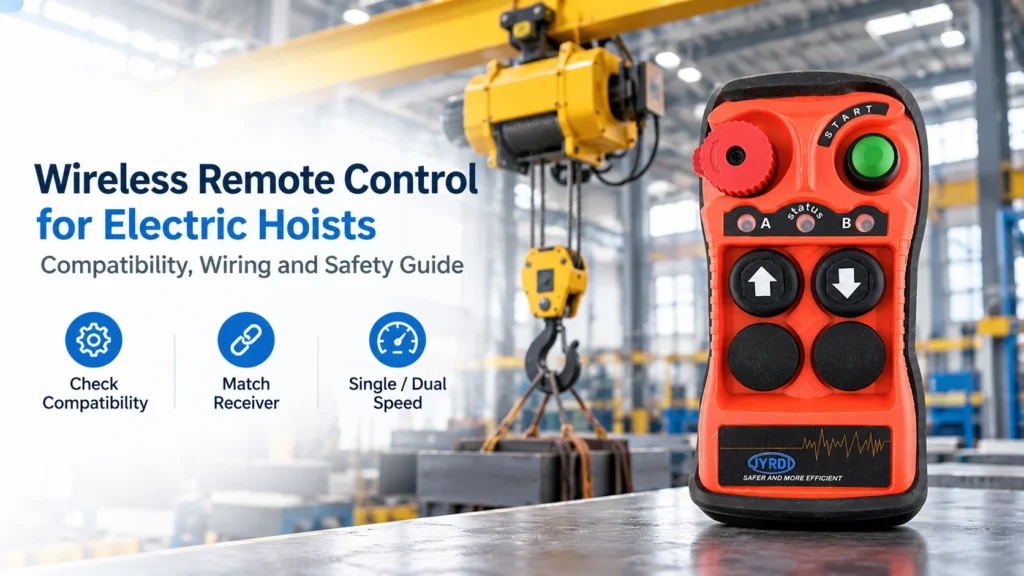
JIAYI provides wireless remote control systems for electric chain hoists, wire-rope hoists, powered trolleys and industrial lifting equipment.
Whether you are replacing a wired pendant, adding wireless control to an existing hoist or configuring a new lifting system, the transmitter and receiver should be selected according to the actual control voltage, required movements, speed logic and wiring design.
Push-Button Control · Single / Dual Speed · AC / DC Receiver Options · Custom Functions
Get an Electric Hoist Remote Recommendation
Send Your Wiring for Review
Looking for the hoist itself? JIAYI specializes in industrial remote control systems. This page covers wireless remote controls for electric hoists rather than the electric hoist machine itself.
Which Electric Hoist Remote Control Do You Need?
The right remote depends mainly on how your hoist moves and how its control circuit is designed.
| Your Equipment | Typical Control Functions | Suggested Starting Point |
|---|---|---|
| Fixed electric hoist | Up / Down | 2-direction push-button control |
| Hoist with powered trolley | Up / Down + Left / Right | 4-direction control |
| Hoist integrated into an overhead crane | Hoist + trolley + bridge travel | 6-direction control |
| Dual-speed hoist | Two-stage directional commands | Dual-speed configuration |
| Hoist with additional functions | Movement + start / horn / selector | Multi-button or customized control |
Button quantity is only the starting point.
Two electric hoist remotes with the same number of buttons may still use different control voltages, speed logic, common terminals, output sequences or interlocking.
For an accurate recommendation, the receiver must match the actual hoist control circuit.
CTA: Send Your Hoist Information
Electric Hoist Applications We Support
Electric Chain Hoists
Wireless control can be used with many fixed and trolley-mounted electric chain hoists used in workshops, production areas, warehouses and material-handling systems.
Typical functions may include:
- Hoist Up
- Hoist Down
- Start or Enable
- Optional Powered Trolley Control
A compact push-button remote is often sufficient when only basic lifting and trolley movements are required.
Wire-Rope Hoists
Industrial wire-rope hoists may require more functions or more complex speed logic than a basic fixed chain hoist.
Common requirements include:
- Up / Down
- Single- or dual-speed lifting
- Powered trolley travel
- Start or enable
- Horn
- Auxiliary functions
Receiver selection should be based on the existing control diagram rather than transmitter appearance alone.
Powered Trolley Hoists
For an electric hoist mounted on a powered trolley, the operator normally needs both vertical lifting and horizontal travel control.
A typical function layout is:
Up · Down · Left · Right
This is a common application for a four-direction wireless hoist remote, but the receiver voltage and output logic still need to be confirmed.
Overhead Crane Hoists
When an electric hoist forms part of an overhead or bridge crane, additional bridge-travel commands may be required.
Typical functions include:
Hoist Up / Down
Trolley Left / Right
Bridge Forward / Reverse
For complete overhead crane applications, see our Overhead Crane Remote Control Solutions.
Single-Speed vs Dual-Speed Electric Hoist Remote Control
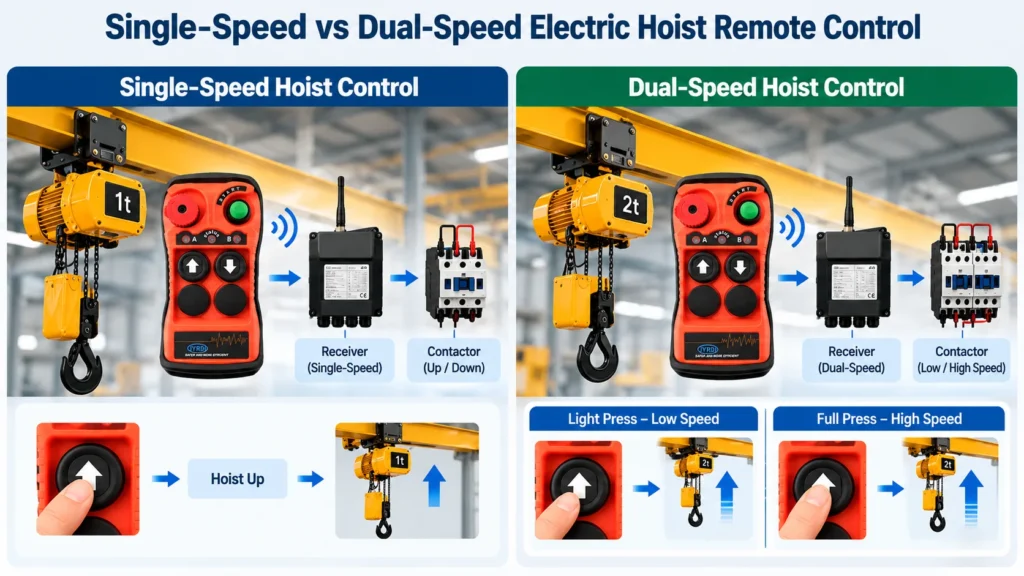
The number of speed stages is one of the most important factors when selecting an electric hoist remote control.
Single-Speed Hoist Control
A single-speed directional button normally sends one movement command.
For example:
UP Button → Receiver Output → Contactor / Drive Input → Hoist Up
This arrangement is suitable for many standard hoists where each movement operates at one commanded speed.
Dual-Speed Hoist Control
A dual-speed push button normally has two operating stages.
A typical arrangement may be:
First Stage → Low Speed
Second Stage → High Speed or Additional Speed Input
However, dual-speed logic is not identical on every hoist.
In some systems, the first-stage output remains active when the second stage is pressed. In other systems, the second stage uses a different output combination.
The wireless receiver must therefore reproduce the original speed-control sequence, not simply provide two unrelated outputs.
Dual Speed Is Not Proportional Control
Two-stage push-button operation should not be confused with:
- Stepless speed control
- Proportional joystick control
- Analog output
- PWM control
- CAN control
If your machine requires more complex directional or proportional control, see our Industrial Joystick Remote Control.
Receiver Matching Matters More Than Button Count
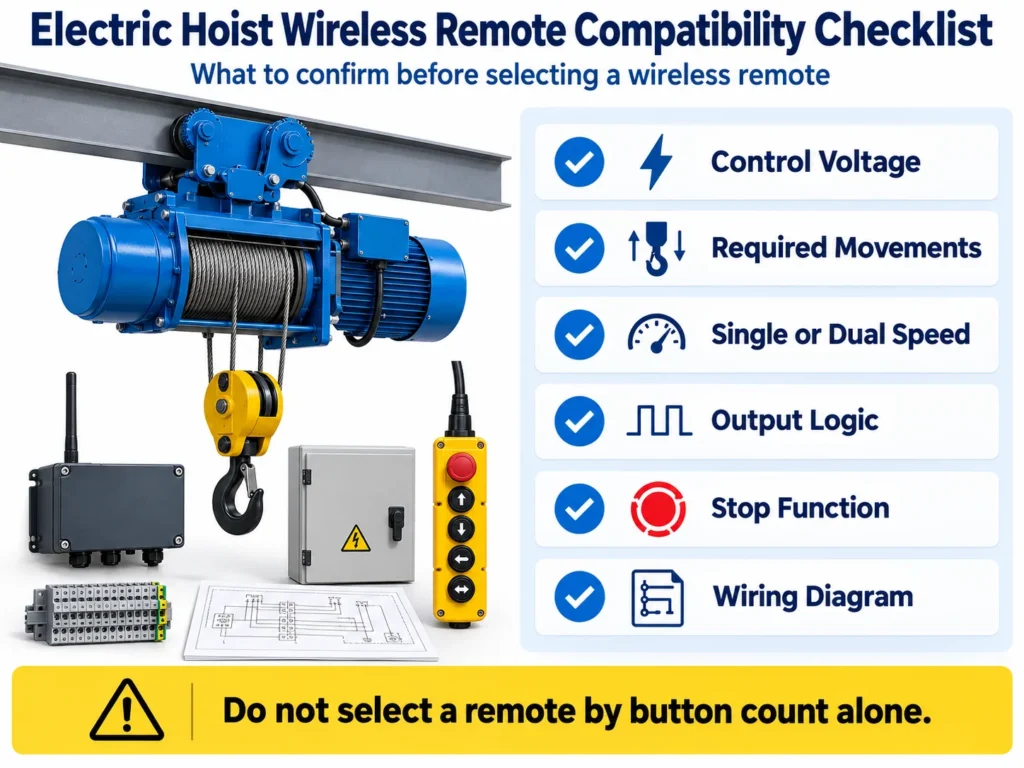
The handheld transmitter is only one part of an electric hoist wireless remote control system.
The receiver must also match the electrical and functional requirements of the equipment.
Control Voltage
Confirm the actual control-circuit voltage before selecting the receiver.
Do not assume that the receiver voltage is the same as the voltage shown on the electric hoist motor nameplate.
Required Movements
List every movement that must be controlled:
- Up / Down
- Left / Right
- Forward / Reverse
- Start / Enable
- Horn
- Lighting
- Auxiliary functions
Single or Dual Speed
The receiver outputs must reproduce the required speed-control sequence.
Output Logic
Confirm whether the receiver will interface with:
- Contactor coils
- PLC digital inputs
- Intermediate relays
- Compatible drive inputs
Stop or Enable Function
The remote-control system must be integrated correctly with the existing machine-control design.
A red stop button on the transmitter alone does not define the safety performance of the complete hoist system.
Wiring Information
The existing pendant wiring diagram and control cabinet are usually the most useful references for receiver matching.
Do not select an electric hoist remote by button count alone.
CTA: Send Your Wiring for Receiver Matching
Control Voltage Is Not Always the Motor Voltage
This is one of the most common problems when replacing or adding an electric hoist remote control.
An electric hoist may use:
- One voltage for the motor power circuit
- A different voltage for the pendant and control circuit
The wireless receiver normally needs to match the control voltage, not simply the main equipment supply.
How to Check the Control Voltage
Check one or more of the following:
- Electrical wiring diagram
- Control transformer label
- Contactor-coil label
- Existing pendant circuit
- Existing receiver label
- Control cabinet terminal markings
If you are unsure, send us a clear photograph of the control transformer or contactor-coil label.
CTA: Ask Us to Check Your Receiver Voltage
Recommended JIAYI Remote Control Options for Electric Hoists
The following product families provide useful starting points. Final model selection should still be confirmed according to the actual hoist functions, speed logic and receiver wiring.
Q400 / Q404 — Standard Hoist and Powered Trolley Control
The Q400 / Q404 family is a practical starting point for electric hoist applications requiring a compact push-button layout.
Typical applications include:
- Electric chain hoists
- Powered trolley hoists
- Monorail lifting systems
- Workshop lifting equipment
Typical directional requirements may include:
Up · Down · Left · Right
Receiver voltage and speed configuration should be confirmed before ordering.
Q600 / Q606 — More Functions and Crane-Integrated Hoists
The Q600 / Q606 family is suitable for applications requiring additional movements or more complex control logic.
Typical applications include:
- Hoist + trolley systems
- Hoists integrated into overhead cranes
- Multi-direction lifting equipment
- Single- or dual-speed configurations
The final output arrangement should be matched to the machine wiring.
Q800 / Q808 — Additional Push-Button Functions
Q800 / Q808 configurations can be considered when an electric hoist or lifting system requires additional push-button functions or auxiliary commands.
Suitable requirements may include:
- Additional equipment functions
- Multiple movement commands
- Auxiliary outputs
- Customized function layouts
The required receiver and output logic should be confirmed from the actual control circuit.
Joystick Remote Control — Complex Motion Requirements
A joystick transmitter may be more appropriate when the equipment requires:
- More complex directional control
- Additional selector switches
- Customized machine functions
- A layout that is not well suited to standard push buttons
Joystick control does not automatically mean proportional control. The required output interface should be confirmed before model selection.
Existing Electric Hoist Retrofit or New Installation?
Wireless remote control can be considered for both existing hoists and new machine-control systems.
Adding Wireless Control to an Existing Hoist
If your electric hoist currently uses a wired pendant, the first step is to review:
- Control voltage
- Pendant functions
- Single- or dual-speed logic
- Receiver output requirements
- Existing interlocking
- Stop or enable circuit
- Wiring diagram
Not every wired pendant can be replaced by simply connecting a radio receiver to the same conductors.
Some small or older hoists use a direct-control pendant where motor current passes through the pendant contacts. These applications require additional technical review.
For the complete retrofit explanation, read:
Can You Add a Wireless Remote to an Electric Hoist?
Wireless Control for a New Hoist System
When the control panel has not yet been finalized, the remote system can be considered during the electrical design stage.
This makes it easier to define:
- Receiver power supply
- Function quantity
- Single- or dual-speed logic
- Relay outputs
- Interlocking
- Auxiliary functions
- Wired / wireless source selection
Send us the required movements and electrical information before the control design is finalized.
Can You Keep the Original Wired Pendant?
In some electric hoist systems, the original wired pendant can remain available together with wireless control.
However, this should be treated as a dual-control-source design, not as simple parallel wiring.
Depending on the existing circuit, the system may require:
- Pendant / Radio selector switch
- Key-operated selector
- Electrical control-source interlock
- PLC source selection
- Defined command priority
- Coordinated stop functions
The objective is to prevent the wired pendant and radio receiver from issuing uncontrolled or conflicting commands.
For a detailed comparison, see:
Wired vs Wireless Crane Remote Control
How Does an Electric Hoist Wireless Remote Control Work?
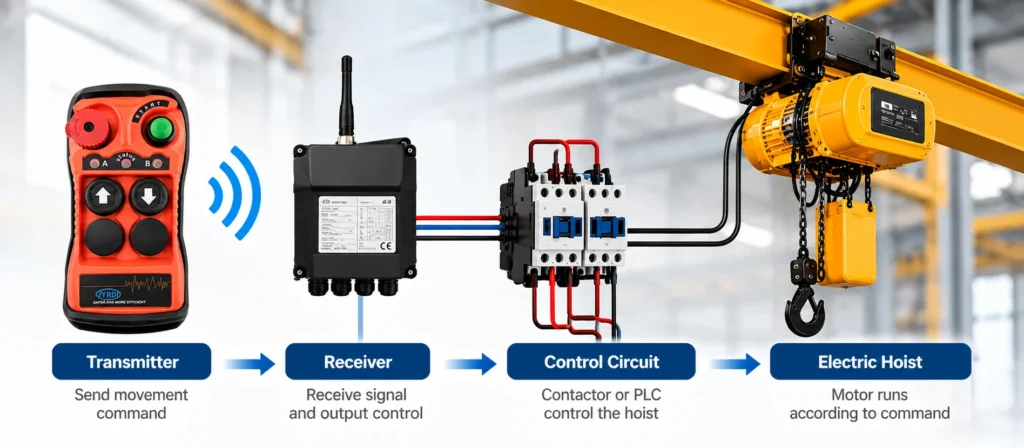
A typical system follows this control path:
Operator → Wireless Transmitter → Radio Signal → Receiver → Hoist Control Circuit → Contactor / PLC / Drive → Motor & Brake
The transmitter sends the operator’s command by radio.
The receiver processes the valid command and provides wired outputs to the existing control system.
In most industrial applications, the receiver controls contactors, PLC inputs or compatible drive inputs rather than directly switching the main motor load.
Wireless transmitter does not mean wireless wiring. The receiver still has to be correctly connected to the hoist control circuit.
For more detail, read:
Crane Remote Control System: Transmitter, Receiver, Wiring and Outputs
Existing Hoist Protection Must Remain Effective
Adding wireless control should not bypass the protective functions already designed into the electric hoist.
Depending on the equipment, these may include:
- Upper limit switch
- Lower limit switch
- Overload protection
- Thermal protection
- Brake control
- Contactor interlocking
- Motor protection
- Drive fault protection
- Existing stop circuit
The wireless receiver should provide operating commands within the existing machine-control architecture rather than replace the protective devices designed for the hoist.
Opposing commands such as:
Up / Down
and:
Left / Right
must also remain appropriately interlocked.
Why Use a Wireless Remote on an Electric Hoist?
Wireless control can provide several practical advantages when it is suitable for the application.
More Flexible Operator Position
A wired pendant restricts the operator to the physical reach of the cable.
With wireless control, the operator can select a more suitable working position while maintaining visibility of the lifting operation.
Better Load Visibility
For long, large or irregular loads, the operator can move to a position that provides a clearer view of the load path.
Less Dependence on a Moving Pendant Cable
In applications where pendant cables are frequently pulled, twisted or exposed to mechanical wear, wireless control can reduce dependence on the moving cable.
Flexible Function Configuration
The transmitter and receiver can be selected according to:
- Required movements
- Speed stages
- Auxiliary functions
- Receiver voltage
- Machine-control requirements
Important
Wireless control does not replace:
- Operator training
- Proper lifting procedures
- Limit switches
- Overload protection
- Brake systems
- Electrical interlocking
- Existing machine safety functions
How to Choose an Electric Hoist Remote Control
Use the following process before ordering.
Step 1 — Identify the Hoist Type
Confirm whether it is:
- Electric chain hoist
- Wire-rope hoist
- Fixed hoist
- Powered trolley hoist
- Overhead crane hoist
Step 2 — List All Required Functions
Record all required movements and auxiliary controls.
Step 3 — Confirm the Control Voltage
Check the control circuit rather than relying only on the motor nameplate.
Step 4 — Confirm Single or Dual Speed
For dual-speed systems, identify the original output sequence.
Step 5 — Review the Existing Wiring
Provide the pendant diagram, control cabinet diagram or clear electrical photographs.
Step 6 — Match the Receiver
Confirm:
- Input voltage
- Output quantity
- Output logic
- Speed sequence
- Interlocking
- Stop / enable function
Step 7 — Confirm the Final Configuration
The selected transmitter, receiver and function labels should correspond to the actual machine operation before installation.
For broader crane remote-control selection guidance, see:
How to Choose a Crane Remote Control for Industrial Lifting Equipment
What Information Should You Send Before Ordering?
Providing complete information helps us recommend a suitable configuration more efficiently.
Hoist Information
Please provide:
- Hoist manufacturer and model
- Hoist type
- Nameplate photo
- Indoor or outdoor application
Electrical Information
Please provide:
- Control voltage
- Wiring diagram
- Control cabinet photo
- Control transformer label
- Contactor-coil label
- Existing receiver information, if available
Function Information
Please confirm:
- Up / Down
- Left / Right
- Forward / Reverse
- Single or dual speed
- Start / Enable
- Horn
- Lighting
- Auxiliary functions
- Other special requirements
Project Information
Please provide:
- Required quantity
- Required operating distance
- Installation environment
- OEM / private-label requirements
- Destination market
A wiring diagram is ideal. If it is unavailable, clear photos of the existing pendant, control cabinet and electrical labels can also help us review the application.
Do not disconnect unidentified wires only to take photographs.
Primary CTA: Send Your Hoist Wiring for Review
Secondary CTA: Get a Remote Control Recommendation
Why Choose JIAYI for Electric Hoist Remote Control?
Industrial Remote Control Focus
JIAYI provides industrial remote control systems for cranes, hoists and other industrial machinery.
Configuration Support
We can review information including:
- Equipment functions
- Control voltage
- Speed logic
- Receiver outputs
- Existing wiring
Multiple Control Configurations
Available solutions include:
- Push-button transmitters
- Single-speed control
- Dual-speed control
- Multi-button layouts
- Joystick configurations
- Customized functions
OEM / ODM Support
Available customization may include:
- Function labels
- Product branding
- Receiver configurations
- Application-specific control arrangements
Wiring Review Before Selection
Customers can send existing equipment and wiring information before ordering so that the proposed receiver configuration can be reviewed against the actual application.
Related Electric Hoist and Crane Remote Control Guides
Can You Add a Wireless Remote to an Electric Hoist?
Already have a wired pendant and want to retrofit the hoist?
Read our compatibility and wiring guide:
Can You Add a Wireless Remote to an Electric Hoist?
How to Choose a Crane Remote Control
Compare control functions, receiver voltage, speed logic and equipment requirements:
How to Choose a Crane Remote Control
Wired vs Wireless Crane Control
Compare operating position, wiring, maintenance and control-system requirements:
Wired vs Wireless Crane Remote Control
Transmitter, Receiver and Wiring Explained
Understand how the radio system interfaces with contactors, PLCs and crane control circuits:
Crane Remote Control System: Transmitter, Receiver, Wiring and Outputs
Browse All Crane Remote Controls
Compare available JIAYI industrial crane control configurations:
Electric Hoist Remote Control FAQ
Can I add a wireless remote to an existing electric hoist?
Many electric hoists can be equipped with wireless control when the receiver matches the existing control voltage, movements and control architecture. Direct-control pendants, proprietary electronic systems or other specialized designs may require additional technical review.
What remote control do I need for an electric hoist?
A fixed up/down hoist may require only two directional controls. A powered trolley commonly adds left/right movement, while an overhead crane may require six or more directional functions. Receiver voltage, speed logic and output requirements must also be confirmed.
Can I use a four-button remote for an electric hoist?
Yes, when the equipment requires four directional functions such as up, down, trolley left and trolley right. However, the number of buttons alone does not confirm receiver compatibility.
Can a wireless remote control a dual-speed electric hoist?
Yes, provided that the transmitter and receiver configuration reproduces the original two-stage control logic. Different hoists may use different low- and high-speed output sequences.
Is the receiver voltage the same as the electric hoist motor voltage?
Not necessarily. The main motor supply and control-circuit voltage may be different. Check the control transformer, contactor-coil label or wiring diagram before selecting the receiver.
Does the wireless receiver connect directly to the hoist motor?
Usually not. In most industrial hoist systems, the receiver sends commands to contactor coils, PLC inputs or compatible drive inputs. Direct motor switching should not be assumed without reviewing the output ratings and complete electrical design.
Can I keep both the wired pendant and wireless remote?
Some systems can retain both controls, but the two sources should not simply be connected in parallel. A pendant/radio selector, electrical interlock or PLC source-selection method may be required.
What information should I provide before ordering?
Provide the hoist type, required movements, control voltage, single- or dual-speed requirement, existing pendant photos and preferably a wiring diagram or control-cabinet photos.
Need a Wireless Remote for Your Electric Hoist?
Whether you are replacing a wired pendant, adding wireless control to an existing hoist or configuring a new lifting system, correct receiver matching is the first step.
Send JIAYI:
Hoist Type + Required Functions + Control Voltage + Wiring Information
and we can review the application and recommend a suitable transmitter and receiver configuration.
Primary CTA: Send Your Wiring for Review
Secondary CTA: Browse Crane Remote Control Systems